Picture a regional bank that ran speech analytics for 14 months and called the project a failure. The vendor scorecard looked fine: 100% call coverage, 98% transcription accuracy, three compliance phrases flagged automatically. The CFO killed renewal anyway.
The reason was simple. Speech analytics ROI was being measured on what the tool detected, not on what the business did with what it detected. Compliance tagging caught risk. Nobody was mining the same calls for revenue.
This is the gap most contact centers fall into. The return lives or dies on the revenue side of the ledger, and the signals that drive it are sitting in calls your QA team will never review. Below are seven of them, what they sound like, and what to do about each one this quarter.
Why Most Speech Analytics ROI Stalls At Compliance
Most teams measure speech analytics by what it saves: cost avoidance, fewer compliance fines and shorter QA review cycles. Those are real wins, but they don’t change how the board sees the contact center.
McKinsey is clearer. It found that inbound service call centers generated up to 25% of new revenue at some credit card companies and up to 60% at some telecom companies. The conversations where that revenue gets won or lost are already being recorded. The recordings are already being transcribed. The signals are already in the data. They just aren’t being routed to anyone who can act on them.
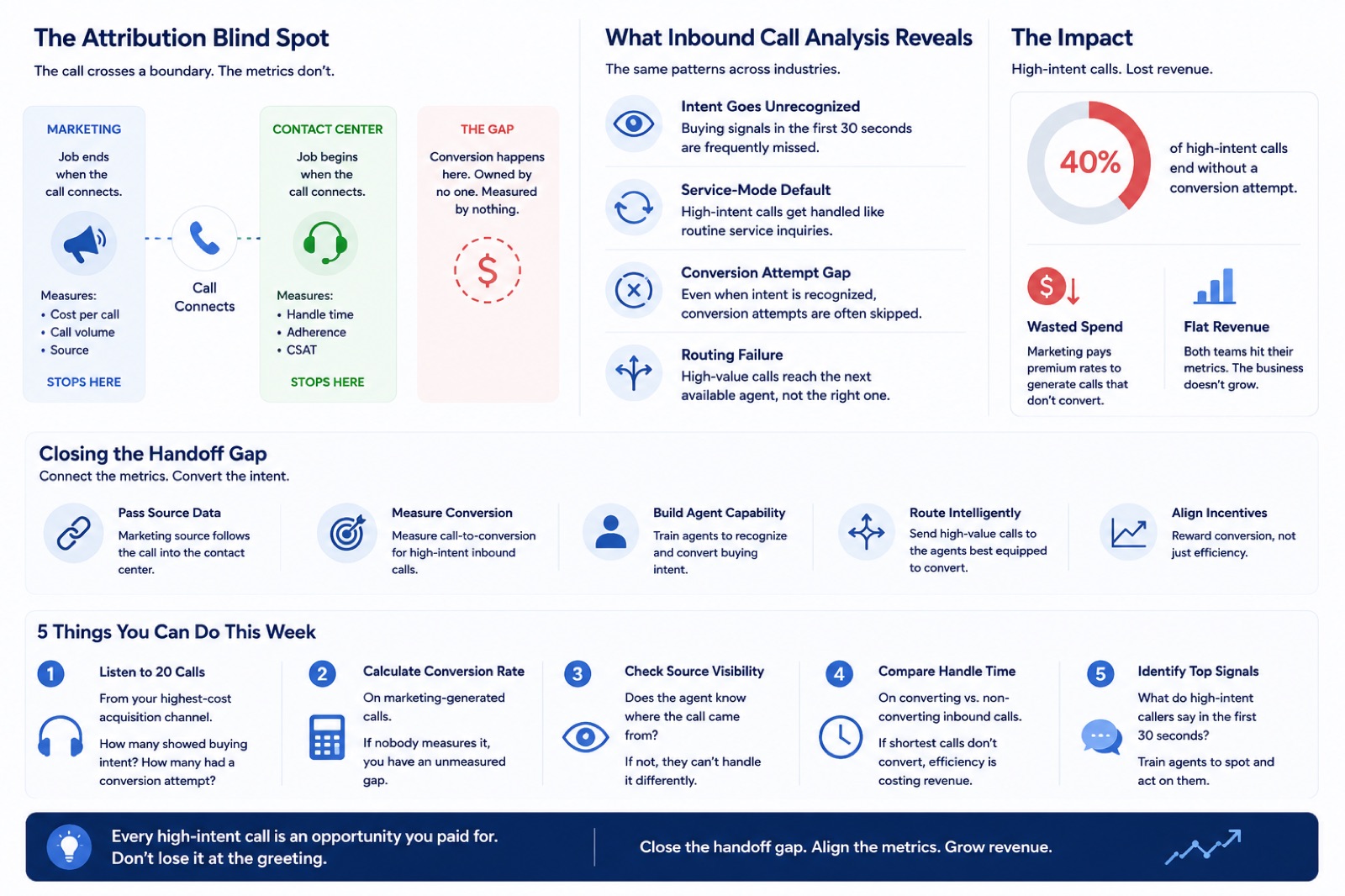
Most contact center ROI dashboards count calls handled, AHT, and CSAT. None of those measure the dollars in or out the door. The shift starts with a different question: of the 100% of calls speech analytics now covers, which ones carry revenue intent, churn risk, or upsell opportunity, and who sees them?
Signal 1: The Cancellation Save Window
Customers calling to cancel rarely lead with “I want to cancel.” They lead with frustration about the last bill, a feature they can’t find, or a competitor they heard about. The exact phrase (“can you close my account”) usually shows up 4-7 minutes in.
The signal worth tagging is the language before the cancel request. Phrases like “I’ve been thinking about switching,” “this is getting too expensive,” or “my coworker told me about” appear on calls where the customer hadn’t yet decided. That’s the save window.
Action this week: Build a watchlist of 8-12 cancel-adjacent phrases. Trigger a real-time agent prompt that surfaces a retention offer the moment one fires. Don’t wait for the customer to say “cancel.”
Signal 2: The Stalled Upsell
Agents pitch upgrades thousands of times per month. Most pitches fail in the same way. The customer asks a clarifying question, the agent doesn’t have the answer, and the conversation moves on. The pitch was never closed, never logged, and never followed up.
Conversation intelligence catches this if you tag it. Look for the pattern: agent introduces a product or tier, customer asks a question, agent uses hedge language (“I think,” “let me check,” “I’m not sure”), then the topic dies.
Action this week: Identify your three most common “agent doesn’t know” moments. Build a 30-second cheat sheet for each. Coach against hedge language as a measured behavior tracked through agent performance management.
Signal 3: Silent CSAT Drops
Post-call surveys catch maybe 5-10% of customers. The other 90% leave without telling you anything. Speech analytics fills the gap by reading sentiment in the conversation itself: pitch shifts, word velocity, interruption rate, and specific dissatisfaction phrases.
The signal that matters here is the mismatch. Customers who score 9-10 on the survey but show sustained negative sentiment in the call are the ones who churn quietly within 90 days. They don’t complain. They just leave.
Action this week: Pull the last 30 days of high-CSAT survey scores. Cross-reference against in-call sentiment. The mismatched accounts go to a 30-day check-in queue. Measure retention 90 days out against a control group.
Signal 4: The Repeat-Caller Tax
Customers who call twice about the same issue cost 4-6x more to serve than first-contact resolution. Worse, 86% of consumers say they would leave a brand after two to three poor service experiences (Emplifi, 2022). The repeat caller is the most expensive customer you have, and most contact centers can’t even find them.
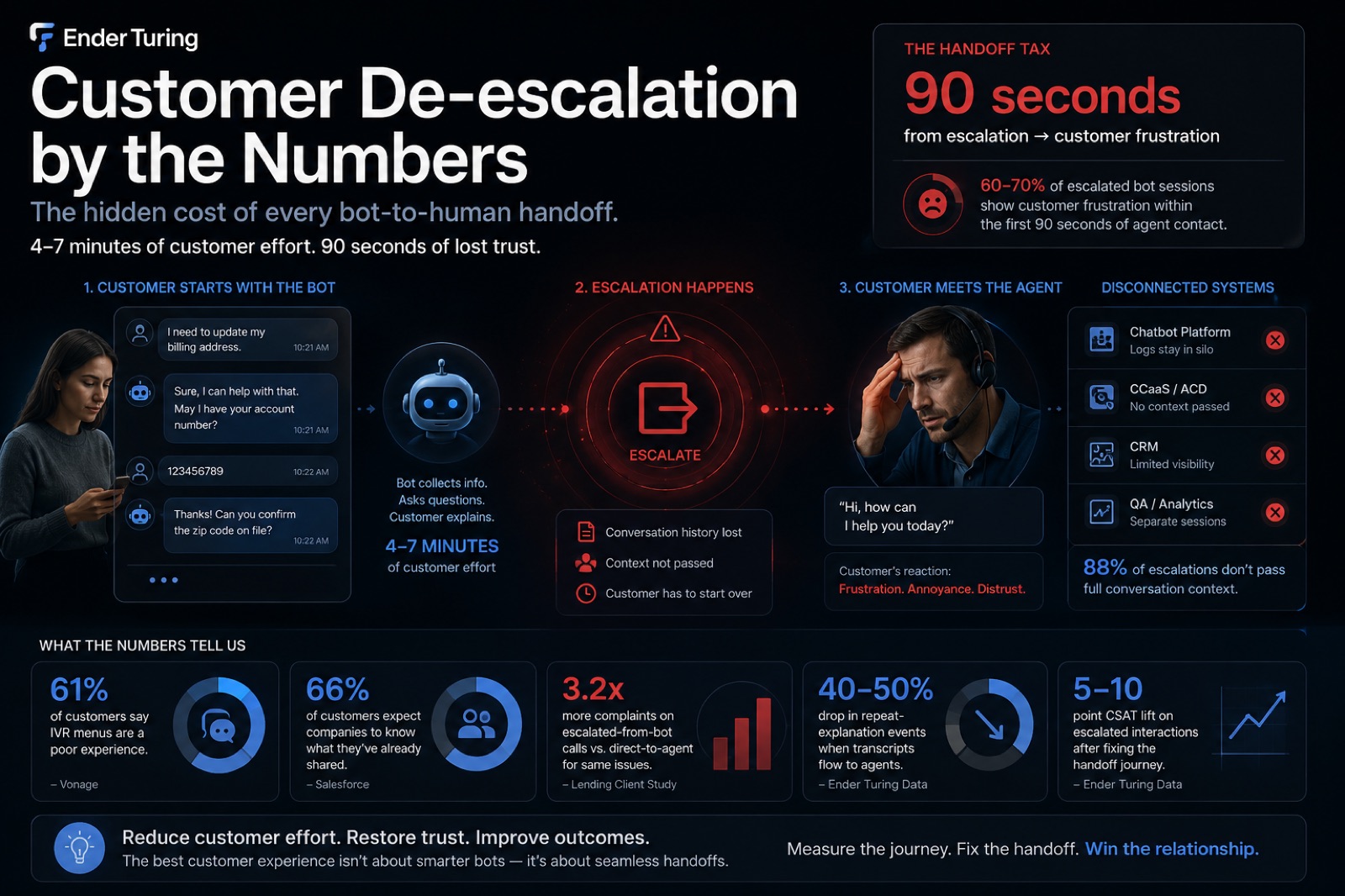
The signal sits in the opener. Phrases like “I called yesterday,” “this is the third time,” or “I already explained this to” are unambiguous. Tag them. Route the call to a senior agent. Refund the contact effort. The repeat-caller flag should also surface for the QA team — the first call that caused the second is a coaching gold mine, and your standard QA sampling will almost certainly miss it.
Action this week: Add a repeat-caller phrase library to your speech analytics rules. Route flagged calls to a tier-2 queue. Measure resolution rate and CSAT delta vs the standard queue. The first call that caused the second is the highest-leverage AI quality assurance coaching surface in the data.
Signal 5: The Product Question You’re Failing To Answer
Most contact centers know their top call drivers. Few know which questions agents consistently fail to resolve in-call. The signal is the verbatim question paired with the outcome: was it answered, escalated, or punted to a callback?
Action this week: Pull the top 20 questions where in-call resolution rate is under 60%. Hand them to your web and product teams. Self-service deflection is where the return compounds.
Signal 6: Vertical Vocabulary Drift
In banking, the words “rate,” “fee,” and “draw” mean specific things. In a medical lab, “results,” “draw,” and “panel” mean something else entirely. Generic speech analytics treats these as the same words. The miss rate on industry-specific intents can hit 30-40% if the underlying ASR wasn’t trained for your vertical.
This is where the purpose-built speech analytics layer matters. Vertical-tuned ASR catches the contextual meaning. It also catches the drift over time: when a new product launches and customers start using new vocabulary, the system needs to pick it up within days, not quarters. If your analytics dashboard still tags “draw” as a banking transaction six months after your lender added a credit line product called “Draw,” the vocabulary side is decaying.
Action this week: Audit the last quarter’s flagged intents against your product team’s release notes. Any product launch should produce a measurable intent spike. If it doesn’t, your investment is invisible to the system because the vocabulary is stale.
Signal 7: The Whisper Network
The seventh signal is the hardest to find and the most valuable. It’s the offhand comment that doesn’t fit any existing scorecard. “I read on Reddit that…” “My friend at [competitor] told me…” “I saw on TikTok…” These mentions carry market intelligence that no survey will surface.
Action this week: Build a competitor mention dashboard. Route to marketing weekly. The first time it surfaces a launch you didn’t know about, the conversation intelligence ROI case writes itself.
What Speech Analytics ROI Actually Looks Like
If you stitch the seven signals together, the return changes shape: save rates on cancellation calls, upsell close rates, repeat-caller volume, self-service gaps and competitor intelligence all become numbers you can track, not anecdotes.
None of these require new tooling beyond what you’ve already paid for. They require routing the existing data to people outside QA — to retention, marketing, product, and the CRO.
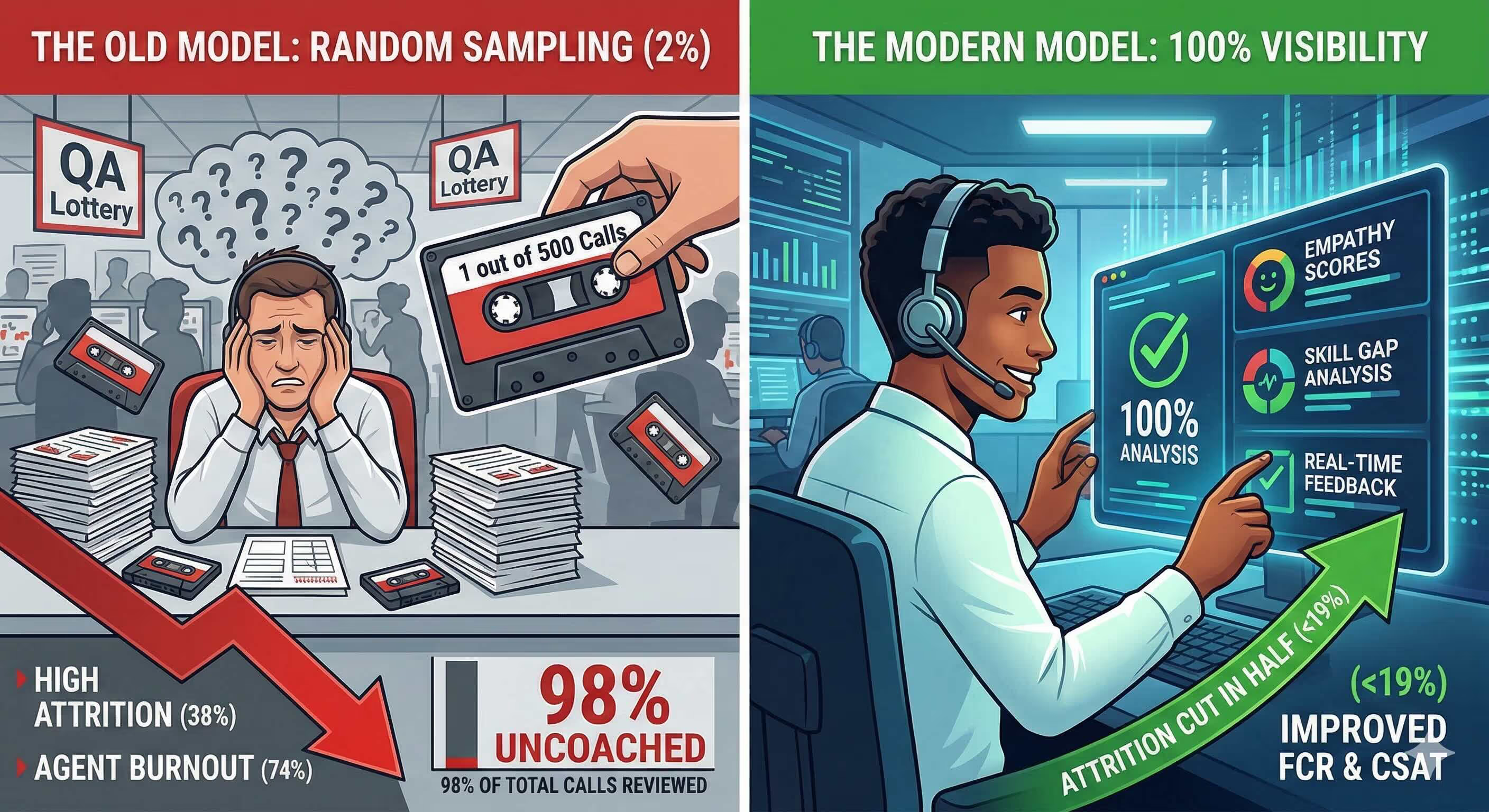
This is the gap most contact center ROI projects never close. The tool is in. The recordings are flowing. The transcripts are sitting in a database. But the only person reading them is a QA analyst sampling 2% to score politeness. Meanwhile the 98% holds every revenue signal listed above.
The board doesn’t care that speech analytics caught 100% of compliance phrases. The board cares that the contact center moved from a budget line to a margin contributor. Those seven signals are how that shift happens, and it’s why we built conversation intelligence tuned for vertical contact centers instead of generic transcription with a dashboard bolted on.
What To Do This Week
If you take nothing else from this, take these five:
- Pull last quarter’s “save” calls. Find the language used before “cancel” was spoken. Build a watchlist. Wire it to a real-time agent prompt.
- Tag your stalled upsells. Look for the question-then-hedge pattern. Coach against hedging. Measure pitch close rate as a behavior.
- Cross-reference CSAT 9-10 with in-call sentiment. The mismatches are your silent churners. Move them to a 30-day outreach queue.
- Build a repeat-caller route. First-call recovery is the highest-leverage QA coaching surface in your data. The call that caused the second call is your training set.
- Stand up a competitor mention dashboard. Send it to marketing weekly. The first surfaced launch pays for the year.
If your current vendor can’t do any of these — or can only do them with another year of professional services — that’s the renewal conversation. Speech analytics ROI was never going to come from compliance. It comes from the seven signals above, and they were in your calls the whole time.