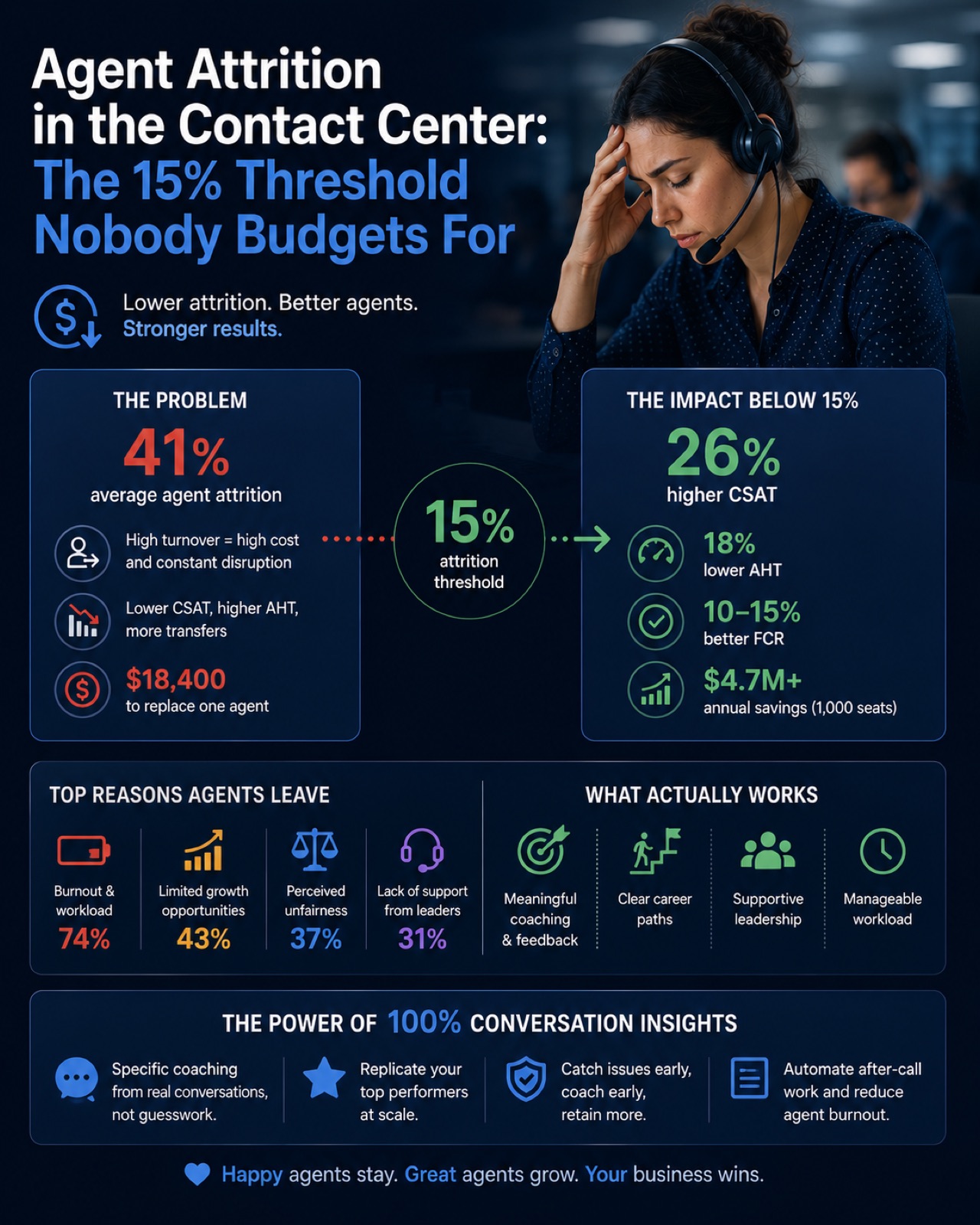
Agent Attrition Contact Center: The 15% Threshold Nobody Budgets For
A CFO walked us through her call center P&L last quarter. Labor: 68% of total cost. Technology: 4.2%. Retention programs: 0.6%. Agent attrition: 39%. Replacement cost per agent, fully loaded: $18,400. That’s a 1,200-seat contact center hemorrhaging $8.6 million a year on a line item she hadn’t named in the budget. When we showed her the Metrigy data on what happens when agent attrition in a contact center drops below 15%, she stopped the meeting. CSAT climbs 26%. AHT drops 18%. FCR improves by double digits. Every metric the board actually cares about moves in her favor. The retention problem isn’t an HR issue. It’s the single largest uncaptured ROI line in contact center finance.
The math is brutal and the fix isn’t what most people think it is.
Why Agent Attrition in the Contact Center Got This Bad
The global call center turnover average sits at 41.2% annually per Gitnux’s 2026 market data. That’s not one bad year. That’s the baseline. And it’s been the baseline for most of the last decade, which tells you something important: this is a systems problem, not a motivation problem.
Here’s what actually drives it. Calabrio’s 2025 Voice of the Agent survey found burnout and workload pressure tied as the number one reason agents quit. Not pay. Not stagnation. Not Monday mornings. Burnout. Salesforce measured 56% of agents actively experiencing it. Plivo’s 2025 report put the at-risk population at 74%.
Meanwhile, budget allocation tells the real story. A McKinsey analysis of contact center spend found that on average, centers allocate 43% of budget to labor and just 0.6% to technology that could reduce burnout. You cannot spend your way out of a problem you’ve budgeted away from solving.
There’s a second failure layer underneath the burnout one. SQM Group’s research names agent attrition as the single biggest hindrance to first call resolution. When turnover runs at 41%, your floor is perpetually staffed by people still in the ramp-up curve. They transfer more. They escalate more. They get frustrated customers who then churn. So you hire more agents. So your trainers are never caught up. So your veterans burn out covering the gap. So your attrition stays at 41%. The loop feeds itself.
The 15% Threshold Changes the Math
Metrigy’s benchmarking across multiple industries found a specific inflection point: when agent attrition drops below 15%, customer satisfaction climbs 26% on average. It’s not linear. It’s a phase change.
The reasoning is structural. At 15% attrition or lower, your median agent tenure passes three years. Agents aren’t just “trained.” They’re fluent. They’ve heard the edge-case billing complaint. They’ve worked the retention script six different ways. They know which manager to loop in when a customer escalates. Institutional knowledge stops leaking.
Now compare budgets. At 41% attrition in a 1,000-seat center with $18K loaded replacement cost, you’re spending $7.4 million a year just to stand still. Getting to 15% saves roughly $4.7 million in replacement costs alone. That’s before you count:
The CFO who stopped her own meeting wasn’t shocked by the $8.6 million. She was shocked that nobody had ever presented retention as a capital-allocation decision. Labor was fixed. Technology was discretionary. Attrition just happened.
Why Agent Retention Strategies Keep Failing
Most retention programs target the wrong levers. Pizza parties and gift cards are the punchline, but the real failure mode is more insidious: leaders treat retention as a benefits problem when it’s a daily-work problem.
Here’s what agents actually ask for when you listen to thousands of exit interviews:
Notice what’s missing from that list. Salary. Pay bumps help at the margin, but Calabrio, SQM, and Metrigy all find the same thing: once compensation crosses a reasonable local threshold, additional pay returns diminish fast. Development, fairness, and workload fix the retention problem. Pay doesn’t.
What Actually Moves Agent Attrition in the Contact Center: The Data Layer
The reason most retention strategies fail is structural. You can’t fix problems you can’t see. Contact centers review 2-5% of calls per agent per month. That’s the evidence base supervisors use to coach, promote, flag, and sometimes terminate. It’s also the evidence base agents experience as “my future is decided by a lottery.”
Shifting to 100% conversation analysis powered by speech analytics, which is what we build at Ender Turing and what a growing share of contact centers now run as baseline infrastructure, rewrites the retention equation in four ways.
First, coaching gets specific. Instead of “work on empathy,” a supervisor can say: “Your empathy scores on billing calls run 18% above team average. On technical support, they drop to team median. Let’s listen to two calls and find the pattern.” Agents who get specific feedback stay. Agents who get vague feedback leave.
Second, top performers become replicable. At most centers, the top 10% of agents produce disproportionate revenue and CSAT. Without 100% analysis, “what makes Maria good” is anecdotal. With it, her call patterns become a training asset. The Ender Turing agent performance management approach builds skill playlists from real top-performer calls, not whiteboard theory.
Third, behavioral issues surface before they become terminations. Call avoidance, AHT gaming, compliance drift. All of these show up in conversation data weeks before they show up in supervisor reports. Catching them early means coaching, not firing. And coaching retains agents. Firing creates vacancies.
Fourth, after-call work shrinks. Auto-generated CRM summaries from the call itself eliminate 60-80% of manual disposition work. Agents move from “I typed for three minutes about a call I already finished” to “the system logged it accurately before my next call started.” That’s 20% of their day back. That’s the burnout vector Calabrio named, treated directly.
McKinsey’s recent contact center research confirms the pattern at an industry level: operations that combine AI-driven quality assurance with structured coaching programs see attrition drop by a third or more within 18 months. One banking client we worked with moved from 34% to 19% annual attrition over two years. Their QA costs stayed flat. Their training costs dropped 28%. Their CSAT hit an all-time high the quarter attrition crossed below 20%.
How to Build the Business Case Your CFO Will Fund
If you’re a VP of Operations trying to get retention investment approved, the case has three components. Skip any one of them and the budget dies in committee.
Component one: quantify the actual cost. Multiply your agent count by your annual turnover rate by your fully-loaded replacement cost. Include recruiting, training, lost productivity during ramp, supervisor time absorbed by hiring, and the CSAT hit from undertrained agents on the floor. Most finance teams have never seen this number aggregated. Seeing it in one line changes the conversation.
Component two: benchmark the inflection point. Reference the 15% threshold from Metrigy. Reference the SQM data on attrition as the number one FCR hindrance. Reference McKinsey on CSAT-to-profit ratios. These are not vendor claims. They’re research your CFO can verify independently.
Component three: propose the investment as a capital allocation, not an HR program. Technology that reduces after-call work by 20%, enables 100% coaching coverage, and surfaces behavioral risks early is a capital investment in retained headcount. Frame it like you’d frame a new CRM. Expected payback: typically 9-14 months based on our deployments. Ongoing margin: the savings compound because once attrition drops, hiring volume drops, which reduces every downstream cost.
We published the full breakdown of the 7 revenue signals sitting in contact center conversations earlier this month. Retention is one of them. The revenue pool locked inside agent tenure is larger than most CFOs realize.
What To Do This Week
If you run a contact center and your attrition is north of 25%, here’s the practical starting point:
The 15% threshold is not theoretical. We see centers hit it when leadership stops treating attrition as weather and starts treating it as finance. What’s your current number, and what’s it costing you?