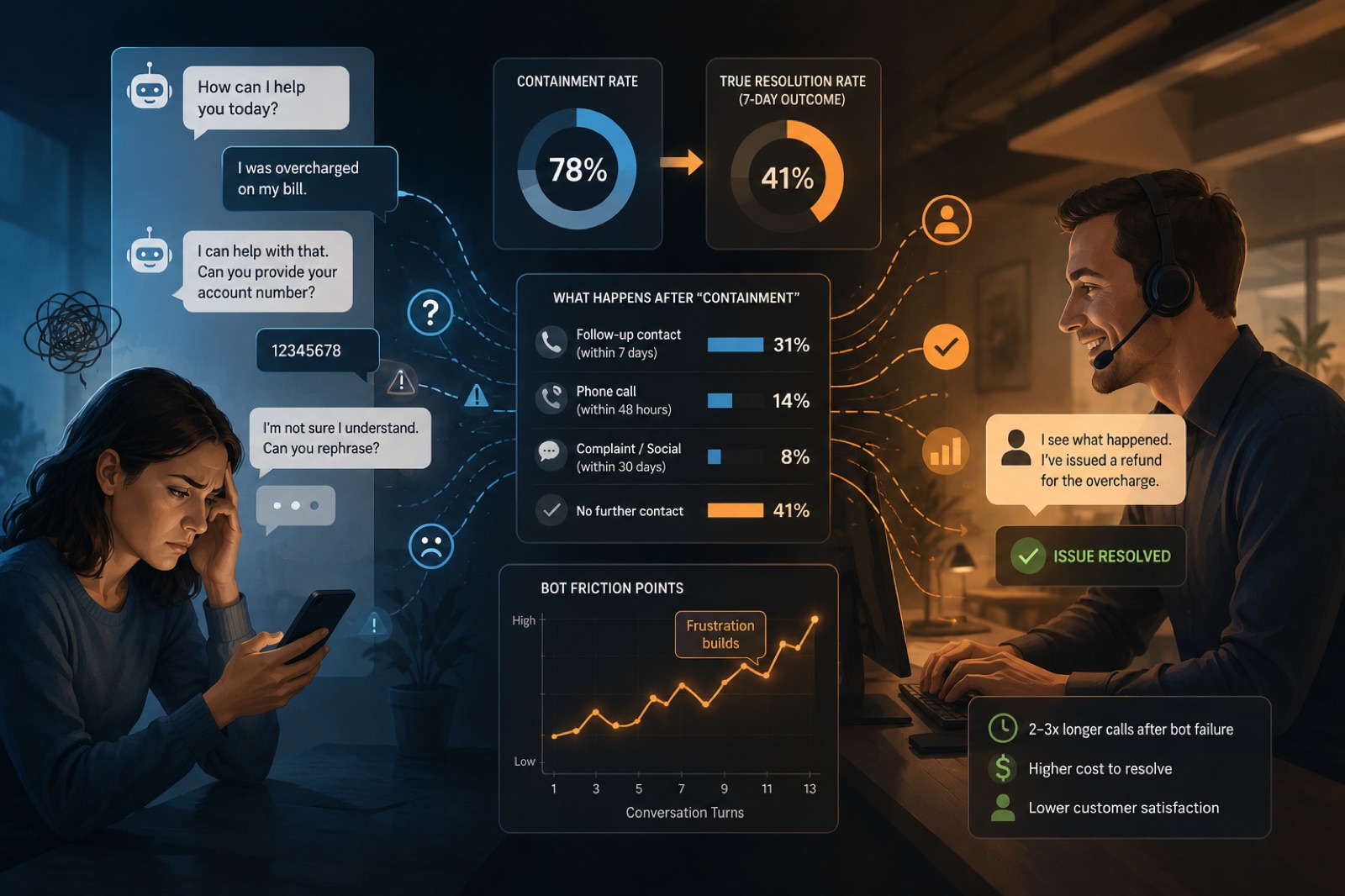
Picture a telecommunications company with a chatbot containment rate of 78%. Its AI vendor references this number in every quarterly business review. The CX leadership team has built its staffing model around it. The chatbot is, by every metric on the dashboard, a success.
Then instrument the bot’s actual outcomes — not just whether the customer ends the chat without a human transfer, but what happens next. The picture can change completely.
“Contained” sessions often produce a follow-up contact from the same customer within days or weeks: another chat, a phone call, a complaint or a social media mention. Net of these follow-ups, the chatbot’s real containment rate — defined as customer issues actually resolved without further contact — can be far lower than the dashboard number.
The vendor’s metric isn’t wrong. It’s just measuring the wrong thing. Containment is “did the customer leave the chat without escalating.” Resolution is “did the customer’s issue get fixed.” These are not the same and treating them as the same has produced one of the largest performance reporting gaps in modern contact center operations.
What Bot Containment Actually Measures
The dominant chatbot success metric across the industry is some variant of containment rate: the percentage of bot interactions that don’t result in transfer to a human agent. This metric became standard because it’s easy to measure, it correlates with the cost case for chatbot investment, and it makes the technology look good.
The problem is what it doesn’t measure.
It doesn’t measure customer outcome. A customer who gives up and leaves the chat is “contained.” A customer whose question was never properly understood and who received an unsatisfying scripted response is “contained.” A customer who was told the bot couldn’t help and that they should call during business hours is “contained.”
It doesn’t measure downstream activity. A customer who is contained by the bot but then calls the contact center the next day, escalates a complaint, posts on social media, or churns — that customer is still counted as containment success.
It doesn’t measure customer effort. A customer who spends 12 minutes navigating a bot to get an answer they could have gotten in 90 seconds from a human is contained successfully. The bot has saved the company a human interaction at the cost of substantially more customer time and substantially worse customer experience.
When you align the metric with what bot deployments are actually trying to achieve — resolved customer issues without unnecessary effort — the picture looks materially different than the containment dashboard suggests.
What 100% Conversation Analysis Reveals
When you run speech and chat analytics against the full bot conversation history, several patterns emerge consistently.
The frustration cascade. Customers who eventually escalate to humans typically show frustration signals 3-5 turns before they actually transfer or abandon. The bot doesn’t recognize the signals and continues with the scripted flow, making the experience progressively worse. By the time the customer escalates, they’re starting from a position of accumulated frustration that the human agent now has to defuse before they can even begin to address the issue.
The intent mismatch. A significant portion of bot interactions — usually 20-35% — involve the bot misclassifying the customer’s intent in the first 1-2 turns. The customer doesn’t notice immediately and the conversation proceeds along the wrong track. The customer either eventually gives up (counted as containment) or escalates (counted as a transfer). Either way, the underlying issue was a classification failure the bot wasn’t designed to catch.
The deflection trap. Bots are often designed with hard transfer barriers to maintain containment metrics. Customers who ask for a human are redirected back into the bot flow with “I can help you with that” messages. This may technically reduce transfers but it generates a specific pattern of customer frustration that shows up later in the same customer’s behavior — usually as a much more difficult subsequent interaction with a human agent.
The post-bot escalation tax. Calls that follow a failed bot interaction typically take 2-3x longer to resolve than calls that don’t, because the customer arrives already frustrated and the agent has to undo the bot’s confusion before they can address the original issue. This cost shows up in agent AHT but isn’t attributed back to the bot in most reporting.
The Compliance Problem Nobody’s Discussing
AI chatbots are increasingly handling conversations in regulated industries — financial services, healthcare, insurance — without the same oversight regime that applies to human agents in the same conversations.
When a human agent makes a regulatory misstatement on a call, it’s captured in call recording, scored in QA, and surfaced in compliance review. When a chatbot makes the same misstatement in a chat session, the conversation is logged but typically isn’t reviewed against compliance criteria, because the assumption is that the bot’s scripted responses have been pre-vetted.
This assumption is becoming dangerous. Modern AI chatbots, particularly those built on large language models, generate responses dynamically rather than selecting from pre-vetted templates. The responses are influenced by training data, prompt design, and context the bot has accumulated in the conversation. The bot can say things the compliance team never approved, in situations the compliance team never anticipated.
We covered the broader version of this question in our piece on who’s QA-ing your AI agents. The specific chatbot version of the question is: who is reviewing the actual content of bot conversations against regulatory requirements? In most deployments, the answer is nobody systematically. The bot’s compliance behavior is taken on faith.
This is going to change. The EU AI Act’s high-risk classification for certain customer-facing AI systems takes effect on 2 December 2027, with documentation, oversight, and outcome monitoring requirements that most current bot deployments cannot satisfy. In the US, the Consumer Financial Protection Bureau estimates that more than 98 million people, about 37% of the population, used a bank’s chatbot in 2022, and warns that institutions risk violating their legal obligations when they deploy one. The reporting gap is becoming a regulatory gap.
What Good Bot Performance Measurement Looks Like
Programs that take chatbot outcomes seriously typically replace single containment metrics with a layered measurement framework.
True resolution rate. Did the customer’s underlying issue actually get resolved without subsequent contact? Measured at the customer level, across a 7-day or 14-day window, against the original intent.
Customer effort score. How much work did the customer have to do to get to resolution? Number of turns, time to resolution, presence of frustration markers.
Downstream cost. When the bot interaction did not produce a resolution, what was the cost of the subsequent human interaction? Calls following failed bot sessions cost more than baseline calls and the differential should be attributed to the bot, not to the human channel.
Compliance verification. A sample of bot conversations is reviewed against compliance criteria by humans or by separate AI systems. The bot’s content is treated with the same audit rigor as agent content.
Customer-segment analysis. Bot performance varies significantly across customer segments — language proficiency, age, technical comfort, complexity of relationship. Aggregate metrics hide segment-level failures that are operationally significant.
Five Things You Can Do This Week
1. Cross-reference your bot containment with downstream contact rate. Pick a month of contained bot sessions. Track those customers for the next 14 days. What percentage made a subsequent contact? The gap between bot containment and net containment is your real number.
2. Listen to 20 contained bot sessions in full. Pick a random sample of conversations the bot resolved without transfer. Did the customer’s issue actually get resolved? Were they satisfied with the response? The pattern will be visible quickly.
3. Compare AHT for calls preceded by bot interactions vs calls without. If post-bot calls take meaningfully longer, you have a measurable bot quality problem masquerading as a human channel issue.
4. Audit your bot’s compliance review process. When was the last time a regulatory specialist reviewed a sample of actual bot conversation content, not just the pre-approved response templates? If the answer is “never” or “more than 6 months ago,” you have a gap that’s accumulating.
5. Define your bot’s success on customer outcome, not containment. Even a partial reframe — adding “resolved without 7-day callback” alongside containment in the executive dashboard — shifts how the bot’s performance is understood and managed.
The chatbot containment metric was a useful number when chatbots were simple and bot deployments were small. It has become structurally misleading at scale, and the gap between containment success and actual customer outcome is the source of much of the frustration customers report with AI customer service. The 78% number the vendor reports isn’t a lie. It’s just an answer to a question that nobody serious about customer experience should be asking on its own.