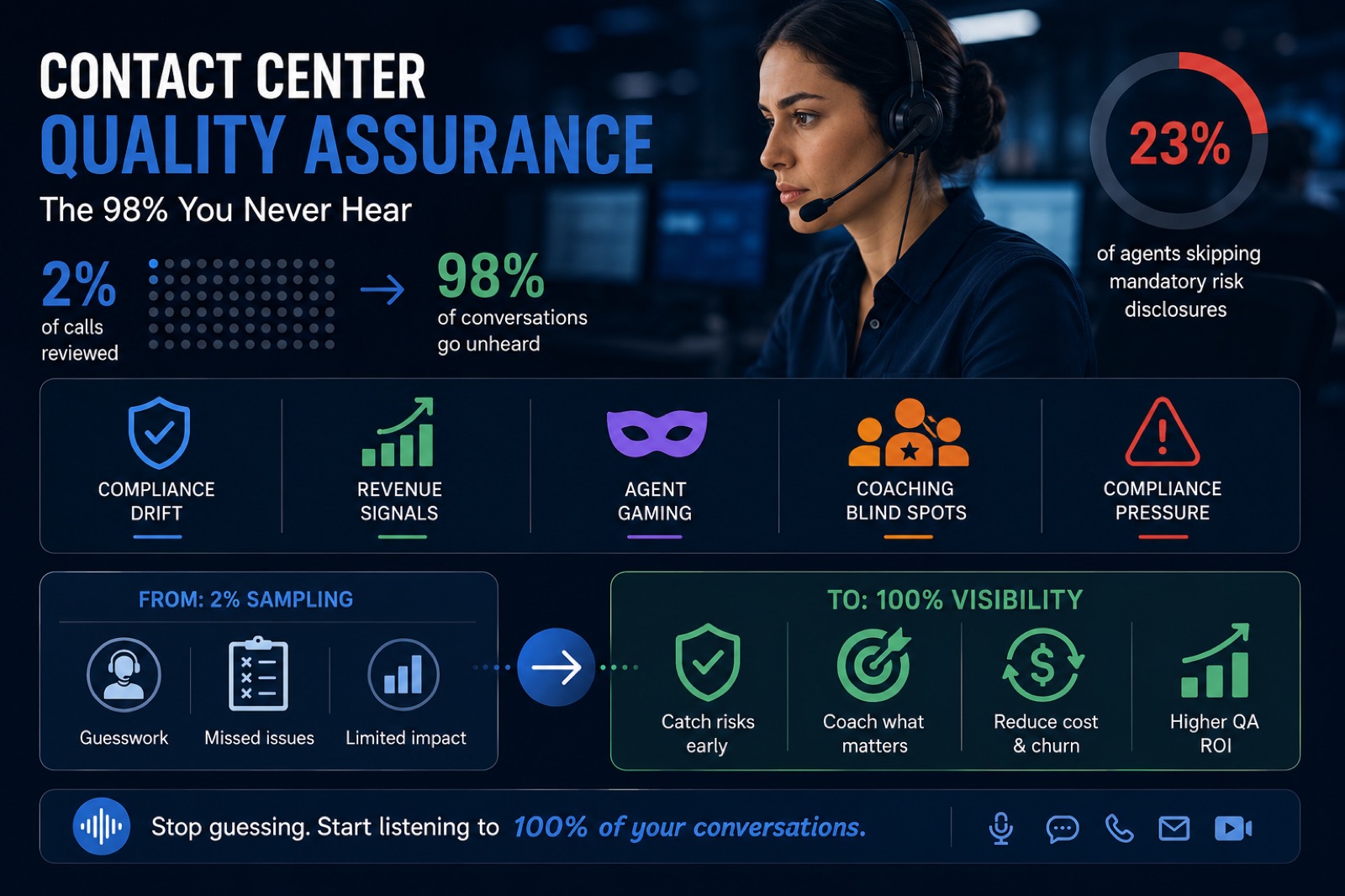
When a bank puts an AI deflection layer in front of its contact center, the simple calls disappear. Same business. Same products. Same agents. What is left is longer, more emotional, and worth more in lifetime customer value when it ends well. AI in contact centers is not making the work easier. It is concentrating the hardest work into a smaller stack of calls that almost nobody on the leadership team is measuring correctly.
This post is for VP-level operators planning the next 12 months of CC investment. The technology debate is over. Bots are absorbing Tier 1. The real question now is what your remaining human conversations look like, what they are worth, and why every metric you used to evaluate agent and platform performance was built for a volume mix that no longer exists. We will look at the data behind the shift, the metrics that break, and what actually works when 80% of the value lives in 20% of the calls.
What AI In Contact Centers Did To The Volume Curve
Gartner expects agentic AI in contact centers to resolve 80% of common customer service issues without human intervention by 2029, and 85% of customer service leaders planned to explore or pilot customer-facing conversational GenAI in 2025. The headline number everyone quotes is automation rate. The buried number is mix shift. When you automate the 60% of contacts that were “password reset, balance check, order status, return label,” you do not just shrink your headcount need. You change the chemistry of every remaining call.
After AI deflection goes live, three things tend to happen to the human queue. Average handle time goes up. First contact resolution drops. CSAT becomes bimodal. The satisfied get more satisfied. The dissatisfied get more dissatisfied. There is no middle anymore, because the middle was the easy stuff and the easy stuff is gone.
This is not a failure of AI. This is the expected behavior of a system that successfully removes the simplest interactions. The problem is that 9 out of 10 leadership dashboards are still built to reward shorter calls and higher FCR. They penalize the exact behavior that creates value in the post-automation mix.
The Four Conversation Tiers That Now Define Your Center
Most contact centers used to think in two tiers, “easy” and “everything else.” Post-AI, it helps to think of AI customer service in four tiers.
Tier 1 is fully automated. Self-service portals, bots, IVR. About 50% to 70% of volume in mature deployments. No agent involvement. These calls are not your problem unless the bot fails. And bot failures escalate up the tier ladder.
Tier 2 is bot-assisted human. The customer started with a bot, got partway, then routed to an agent. This is the dirtiest tier. The customer is already frustrated. The agent inherits half a context. The handoff tax is real and almost nobody is measuring it. Companies running automated quality assurance at full coverage catch this pattern in week one. Companies still doing 2% sampling will never see it.
Tier 3 is true human work. The customer chose a human because the problem needed one. Complex billing dispute. Medical claim appeal. Mortgage modification. Insurance escalation. These calls average 8 to 14 minutes and carry the highest revenue and retention impact in your entire operation.
Tier 4 is high-stakes recovery. Churn-imminent calls. Compliance-sensitive complaints. C-suite escalations. Less than 5% of volume but it can carry more than 30% of your retention impact. The agents who handle Tier 4 well operate like a different job role. They behave measurably different in the data. Speech analytics across every call is how you see what they do differently. Silence is a skill in this tier.
The combined Tier 3 plus Tier 4 calls, roughly 15% to 25% of volume in a mature deployment, drive 60% to 80% of measurable business outcome. That is the shift no leadership dashboard captures.
Why Your 2024 AI QA Contact Center Metrics Are Now Lying To You
If your scorecards still weight Average Handle Time heavily, you are punishing the agents doing the most valuable work. AHT was a useful proxy when 60% of calls were transactional. It is actively misleading when 60% of remaining calls are diagnostic, emotional, or revenue-critical.
First Contact Resolution is the next casualty. Pre-AI, FCR of 75% meant “we are solving problems.” Post-AI, an FCR drop from 75% to 65% might mean your team is now handling problems no bot can solve. That is a feature, not a defect. Most centers have no metric at all for the conversation work that produces their highest-value outcomes.
CSAT survey response rates are also collapsing. The reason is mix. The customers with simple resolved issues used to drive most of your survey volume. They are not calling anymore. The remaining customers are angrier and busier and they skip the survey. Replacing CSAT with conversation analytics on 100% of calls is now the only way to get a representative read on customer sentiment.
We disagree with the “AI makes everything faster” pitch most CCaaS vendors are still running. The only thing AI consistently makes faster is the part of the conversation that did not need a human anyway. Everything else gets slower, harder, and more valuable. Your metrics need to follow.
The Hybrid AI Customer Service Math, Updated
The early ROI decks compared pure AI with hybrid AI customer service (AI for triage and Tier 1, humans for Tier 2 through 4). Whatever the size of the gap between them, it is almost entirely Tier 2 handoff quality and Tier 3 conversation skill.
This is why “deflection rate” is now the wrong star metric. A center can hit its deflection target and still watch retention fall, because the calls that were not deflected get mismanaged when the team is structured around volume reduction, not conversation value.
The math that matters now is per-conversation contribution. Take total revenue retained or generated through service interactions, divide by total human conversations. When deflection shrinks the denominator faster than the numerator, this number rises: the conversations that remain are simply worth more.
McKinsey found that inbound service call centers generated up to 25% of new revenue at some credit card companies and up to 60% at some telecom companies. That is not a cost-center story. That is a P&L line item.
What Stops Working When The Mix Shifts
Three operating assumptions break, in order.
Scorecards built for transaction calls stop predicting outcomes. A scorecard that weights “call greeting tone” as heavily as “issue resolution” was built for a 2018 volume mix, and it ranks the best agents on the new mix in the middle of the pack because they spend time on diagnostic questions instead of moving fast through pleasantries. Scorecard redesign is now a quarterly job, not a yearly one.
Sampling-based QA stops being credible. When 80% of your value lives in 15% of your calls, reviewing 2% of calls means you statistically never see the conversations that drive the business. You are auditing the wrong population. Centers running 100% coverage AI QA catch the high-stakes patterns. Centers still on manual sampling catch their own greeting compliance. This gap will widen every quarter from here.
Coaching rhythms built around weekly call reviews stop matching agent reality. Tier 3 and Tier 4 agents need real-time pattern feedback, not week-old red-line reviews. The agents handling the hardest calls do not need to know what they did wrong last Tuesday. They need to know what the best Tier 4 performer in the company said in a similar call this morning. AI-driven self-coaching closes this gap. Static coaching cadence does not.
What To Do This Week
Five concrete actions for VP-level operators reading this.
First, pull your call distribution by handle time bucket. Compare today against 12 months ago. If you have deployed any AI in contact centers workflow (bot, IVR, self-service), your median call time should be measurably longer. If it is not, your AI is failing in ways the dashboard is hiding.
Second, segment your agent roster by Tier 3 and Tier 4 hours handled. You will likely find 15% to 20% of agents carrying 50% to 60% of the high-stakes volume. Compensation and coaching should match. Flat scorecards reward agents handling the easiest calls.
Third, audit your scorecard against your actual call mix. If the scorecard was last updated before your AI deployment, it is wrong. Many scorecards penalize the diagnostic silence that hard calls need. Fix the scorecard before you fix the coaching.
Fourth, install 100% conversation coverage. Sampling math does not survive a mix shift. The conversations driving your business are not in your QA queue if you are sampling 2 to 5 calls per agent per month. Either you see all of them through AI-driven QA or you guess.
Fifth, measure per-conversation contribution monthly. Total retained revenue plus new revenue from service interactions, divided by total human conversations. Watch the trend. If it is not rising in 2026, your AI deployment is removing volume without capturing the value of what remains. That is the modern version of the “cost center” trap, and it is hiding inside operations that look successful on a deflection dashboard.
The shift is here. Bots took the easy calls. What remains is harder, longer, more emotional, more valuable. The contact centers that thrive in 2027 will be the ones that built their metrics, scorecards, and coaching around the conversations that actually matter. The ones that did not will be wondering why their deflection numbers went up and their retention went down at the same time. Worth asking which side of that line you are on right now.