AI agent vendors lead with accuracy. Pick any voice bot vendor pitching you this quarter, and the deck will have an “accuracy” number above 90%. Then look at your own data. The bot answers correctly. The customer still hangs up. The callback rate is rising. Your CFO is asking what happened to the ROI deck.
Vendor accuracy is high. Customer outcomes often are not. The reason is simple, and almost nobody running an AI QA contact center program has internalized it yet: accuracy and quality are not the same thing.
What Vendor Accuracy Actually Measures
When a vendor says “92.8% accuracy,” they usually mean one of three things, and none of them are what you think.
The first definition is intent classification accuracy. Out of 100 customer utterances, the model correctly identified what the customer was asking about 92.8 times. That tells you the bot understood the question. It does not tell you the bot answered it correctly. It does not tell you the customer walked away with their problem solved.
The second definition is retrieval accuracy. The model pulled the right document, knowledge base article, or policy reference 92.8% of the time. Same problem. Pulling the right document is upstream of giving the right answer, which is upstream of solving the customer’s problem.
The third definition is the one that should worry you most: benchmark accuracy on a curated test set. The vendor built a test set of 1,000 conversations, ran the bot, and it got 92.8% right. Your contact center is not a curated test set. Your customers do not phrase questions the way the test set does. Your account types, policy exceptions, and edge cases are nowhere in that benchmark.
Gartner predicts that by 2027, 50% of organizations that expected to significantly reduce their customer service workforce will abandon those plans, as companies struggle to reach their “agent-less” staffing goals. Model accuracy will not be what decides it: high accuracy does not by itself bring lower handle time, higher CSAT, or fewer callbacks. That is where the vendor benchmark and the contact center P&L stop agreeing.
Why High Accuracy And Bad Quality Coexist
Here is a test worth running. Take a vendor scorecard that shows 91% accuracy, pull a week of real call logs, and run your own analysis. The findings tend to be uncomfortable.
Accuracy will be high on the conversations the bot completed. The problem is what the accuracy number does not measure:
- Abandoned conversations. Customers who hang up before resolution are excluded from the accuracy calculation. The bot “accurately” handles the calls that stay, and the ones who hung up in the first 90 seconds are the customers most likely to churn.
- Escalation rate. When the bot escalates to a human, it is scored as “correctly identified that this needs a human.” That sounds good until the escalation rate is high, the wait for an agent runs to minutes, and the customer has already explained the problem twice before reaching one. The bot’s “accuracy” is high. The customer experience is a disaster.
- Callback within 24 hours. A voice bot can score above 90% accuracy and still send customers back to the phone the next day. The first call was “accurately” handled. The customer was still confused enough to call back. Nobody counts that against the bot.
- Compliance failure on the long tail. A bot can be highly accurate across the top 10 intents and far weaker on the bottom 50, and the bottom 50 are where a regulator looks during an audit.
Vendor accuracy is a model metric. Quality is a customer-outcome metric. The first does not predict the second.
The Real Metrics For AI QA Contact Center Quality
If accuracy is the wrong metric, what is the right one? Here is what automated quality assurance should measure, on human and AI agent conversations alike.
Resolution rate, not handle rate. Did the customer’s underlying problem get solved? Resolution rate is verified by checking for a callback within 7 days about the same issue. If the customer calls back, the first interaction did not resolve. A hybrid AI-human model resolves more because the AI handles what it can resolve, and humans handle what it cannot, with full conversation context preserved across the handoff.
Escalation quality, not escalation rate. A high escalation rate is not automatically bad. A bot that escalates fast on complex issues outperforms a bot that loops the customer through 4 minutes of misdirection before finally transferring. The metric to track: when escalation happens, how much context transfers to the human? Often the answer is zero. The agent receives a transferred call and starts from scratch. The customer feels like they were never heard, and speech analytics hears it: the customer explaining the problem again from the start.
Sentiment trajectory across the conversation. Did the customer start neutral and end satisfied, or start frustrated and end angrier? Sentiment trajectory is a quality signal accuracy cannot capture. A bot can give the correct answer in a tone that escalates the customer.
Compliance on the long tail. Accuracy on the top intents matters less than accuracy on the regulated intents. In banking, the top 20% of intent volume is 80% of customer interactions but only 12% of regulatory risk. The bottom 80% of intent volume contains 88% of the disclosure requirements, complaint-handling rules, and vulnerable-customer detection requirements. Your AI QA program needs to be heaviest where regulatory risk is heaviest, not where call volume is heaviest.
Cross-channel consistency. A customer who asks the same question on voice, chat, and email should get the same answer. They usually do not. Different bots, different knowledge bases, different training data, different answers. Inconsistency is a quality failure even when each individual answer is “accurate.”
What Most AI QA Contact Center Programs Get Wrong
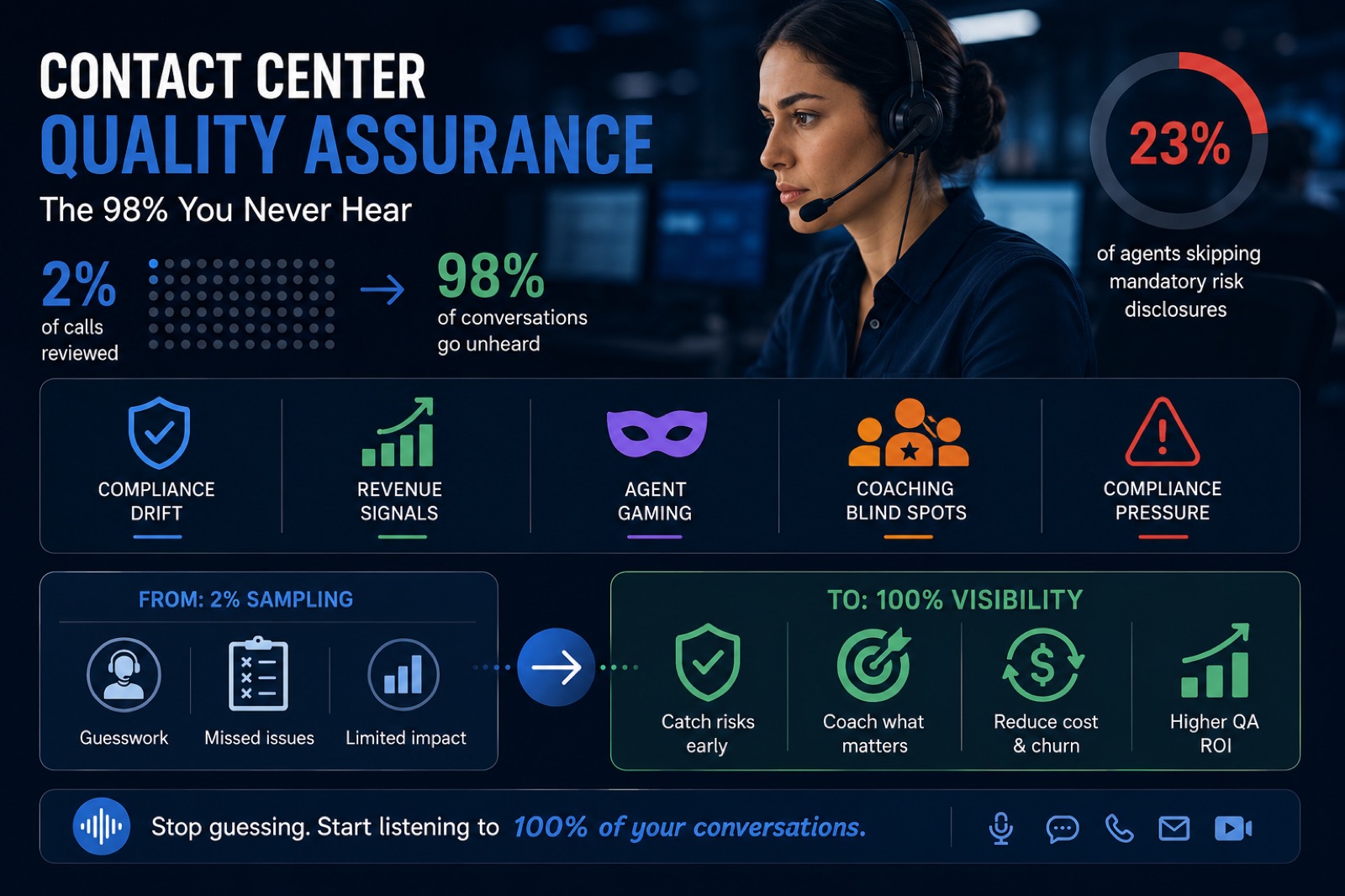
Most contact centers approach AI QA by sampling. Pick 50 bot conversations a week, have a human review them, score them on a rubric. This is the same 2-5% manual sampling problem we have been writing about for contact center quality assurance on human agents, transplanted to AI agents.
There are three structural failures with this approach.
The first is volume. A typical voice bot handles thousands of conversations per day. Sampling 50 a week tells you almost nothing about the long tail where the regulatory and churn risk lives. The bot can fail badly for an entire week before you notice.
The second is the wrong rubric. Most teams scoring AI conversations are using a rubric designed for human agents. “Did the agent greet the customer warmly?” is irrelevant for a bot. The right rubric measures: did the bot accurately identify intent, retrieve correct information, deliver it in a way that the customer understood, and escalate cleanly when needed. That requires a different framework, not the human QA scorecard with the word “agent” replaced by “bot.”
The third is no closed loop. Even when a bot scoring program identifies problems, the fix loop back to the model is broken. The QA team writes a report. The AI team is in a different department. The model gets retrained on the next quarterly cycle, by which point the problem has been costing money for months. Compare this to the human side: a coaching workflow where the agent gets feedback within 24 hours and demonstrably improves the next call. The AI side rarely has anything close to this.
COPC’s research is blunt: 48% of contact centers name integration challenges as the main cause of their AI falling short. Integration includes the QA feedback loop. If your AI QA program is not feeding back into the model, you are paying for monitoring with no improvement signal.
What Actually Works
Three things change the outcome of an AI QA contact center program.
Cover 100% of AI conversations, not 5%. Sampling is a manual constraint, not a real one. Automated scoring of every bot conversation is now cost-effective, and it surfaces the long tail of failures that sampling misses. This is where automated conversation analytics becomes essential rather than nice-to-have.
Score AI and humans on the same outcome metrics. Resolution rate, sentiment trajectory, escalation quality, compliance. When the AI and human teams are measured on the same yardstick, the comparison becomes useful. When they are not, the AI team can claim 92% accuracy while the human team is measured on CSAT, and neither side can prove or improve anything. We built our voice bot QA capability specifically because the customer doesn’t care whether they are talking to a bot or a human. They care whether their problem got solved.
Close the feedback loop in days, not quarters. When QA scoring identifies a failure pattern, the model needs to be updated fast. The contact centers that get AI ROI are the ones where the QA team and the AI team work in the same week, not the same fiscal year. The gap between top performers and average performers is rarely the model quality. It is the speed of the iteration loop.
Actionable Takeaways
If you are running an AI QA contact center program or evaluating one this quarter, do these five things this week.
- Audit your vendor accuracy claim. Ask your AI vendor exactly what their accuracy number measures. Get it in writing. If the answer is “intent classification on our internal test set,” that number does not apply to your environment. Demand a re-benchmark on your actual call logs before renewal.
- Measure resolution rate, not handle rate. Pull your bot’s calls from last month. For each resolved conversation, check if the same customer called back within 7 days about the same issue. The percentage that did not call back is your real resolution rate. It will be lower than your vendor’s accuracy number.
- Score bot calls on a bot-specific rubric. Stop using your human-agent QA scorecard for AI conversations. Build a rubric that measures intent accuracy, information retrieval, customer comprehension, and escalation quality. Score every conversation, not a sample.
- Map regulatory risk to intent distribution. List your top 50 intents by volume. List your top 50 by regulatory risk. Where the lists do not overlap, your AI QA needs to be heaviest on the second list, not the first. This is where audit findings hide.
- Set a 30-day feedback loop target. From when QA identifies a failure pattern to when the model is updated. If your current loop is longer than 30 days, the AI team and the QA team are not working closely enough. The fix is organizational, not technical.
The vendors will keep quoting accuracy numbers. That is fine. Your job is to measure what your customers experience, not what the model benchmark says. The contact centers that figure this out first are the ones that turn AI into the profit driver the board was promised. The rest will keep wondering why a bot that scores above 90% is still missing its return.