Most call center turnover conversations start with the wrong number. Leaders quote a 31.2% annual rate, calculate the replacement cost at $10,000 to $20,000 per agent, and start budgeting for retention bonuses. Then the same people leave anyway.
The number that actually matters is different: when in their tenure agents leave. New hires don’t quit at the two-year mark. They quit in their first year, many of them in their first three months. The bonus program didn’t reach them. The wellbeing initiative didn’t reach them. Whatever the exit interview says, the truth is simpler: they got hired, they got trained, they took calls, and nobody actually helped them get better at the job.
The Real Shape of Call Center Turnover
Metrigy’s projected 31.2% agent attrition for 2024 hides how the loss is distributed. It’s not a smooth 31% who leave one at a time throughout the year. The loss is concentrated in new hires.
SQM Group’s benchmarking found that 73% of the agents who leave a call center do so in their first year of employment, and SQM notes that the first 90 days are when most agents quit. Metrigy’s research shows that when agent turnover stays below 15%, customer satisfaction increases by 26%. Most centers lose their agents before the ramp investment has paid back.
Do the math. If your average agent takes 90 days to reach full productivity and you lose 40% of them at month 9, you’re getting roughly six months of full productivity per hire. Against a $15,000 replacement cost, that’s about $2,500 in ramp-adjusted cost per productive month. Now compare that to what a two-year-tenured agent costs you per productive month. It’s not close.
The first-year exit isn’t random. It comes where three things converge: the honeymoon is over, the classroom training is exhausted, and the coaching that should be replacing it hasn’t shown up. Agents look at the next 12 months, and they leave.
Why Training Fails Before Coaching Arrives
Contact center hiring, training, and coaching are usually three separate functions run by three separate teams. A recruiter closes a hire. Training runs a 3-6 week program. The agent hits the floor. QA reviews 2-5 calls per agent per month. Their supervisor coaches when they can. Somewhere in that handoff, the new hire falls through.
When new hires struggle on live calls, it is rarely a training-content problem. It’s a training-design problem. Classroom training teaches agents how to handle scripted scenarios. Real calls don’t come in scripted. The gap between what training covered and what the first live call demanded is where confidence collapses.
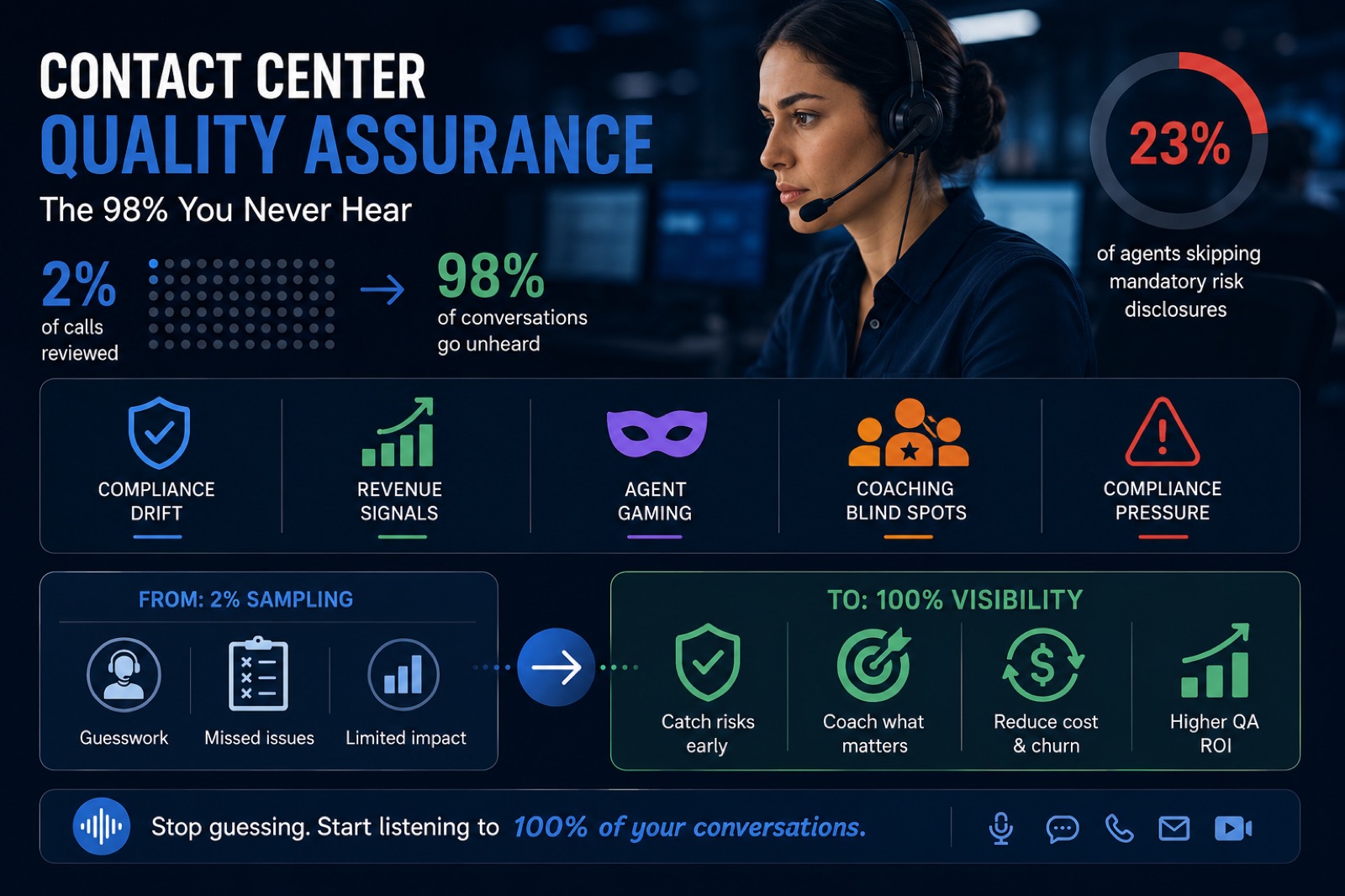
Then coaching should catch them. It doesn’t. Traditional QA reviews 2-5 calls per agent per month. If your new hire takes 60 calls a week, that’s a review rate of about 1 to 2%. The first bad calls, the ones where a coach could have said “here’s the specific move that would have saved this conversation,” went unseen. The agent knows they went badly. Nobody helps them decode why. Three months of this pattern and they update their LinkedIn.
What 100% Coverage Changes
When contact centers move from manual sampling to automated quality assurance at 100% coverage, the coaching timeline collapses: the calls worth coaching surface in days, not weeks.
With conversation intelligence for agent performance, supervisors stop hunting for calls to review: every call is scored, and the ones worth coaching come to them. The same team of supervisors, on the same coaching budget, can coach while the new hire still remembers the call. The difference is which calls they review and how fast they can find them.
When you can see every call, you can spot which specific behaviors correlate with agents who stay, and you can coach the new hires toward those behaviors while it still matters.
AI-powered QA can also be more accurate: McKinsey estimates that a largely automated QA process could achieve more than 90% accuracy, against 70 to 80% for manual scoring. That number doesn’t matter as an abstract benchmark. It matters because it’s what makes fast, specific, useful coaching possible.
What Actually Cuts First-Year Call Center Turnover
We’ve stopped believing in generic retention strategies. Signing bonuses, pizza days, and career-path posters don’t reach the specific new hire who took a hard call on Tuesday and never got told what they could have done differently. Here’s what does.
Rewire the first 90 days around observed behavior, not scheduled milestones. Most onboarding programs follow a fixed calendar: week 1 systems, week 2 products, week 3 shadowing, week 4 solo calls. New hires progress on time whether or not the previous week’s content stuck. Replace this with behavior-triggered progression. When call analytics show an agent has demonstrated a specific skill (empathy statements on complaints, proper hold procedure, correct disclosure), they advance. When analytics show a gap, they get targeted coaching before they advance. It’s slower for the top 20% and much faster for the bottom 20%, and both groups quit less.
Coach within 24 hours or don’t bother. The agent has already handled a dozen more calls with the wrong behavior baked in. Any coaching system that takes a week to surface which call to review is coaching the wrong problem too late. Automated flagging that identifies coachable moments within an hour of the call ending is the operational threshold.
Kill the compliance-heavy scorecard. The traditional QA scorecard is a compliance document. Did they greet correctly, use the customer’s name, disclose the recording, close the call. New hires master these mechanics in week two. The scorecard then adds noise for the next ten months. Rewrite it to focus on the behaviors that actually correlate with agent tenure and CSAT: recovery on tough calls, empathy under pressure, systems navigation speed, cross-sell integration where relevant. If your top-quartile-tenure agents don’t score meaningfully higher on your current scorecard than your quartile-that-quits, the scorecard is measuring the wrong things.
Track leading indicators, not lagging ones. Attrition is a lagging indicator. By the time you see the first-year spike, that cohort is already gone. Leading indicators visible in conversation data include: sentiment trajectory (does the agent’s tone degrade across their shift?), silence patterns (are they going quiet on tough sections?), escalation avoidance (are they transferring calls they should be handling?), and after-call summary length (are they rushing wrap-up to avoid the next call?). These show up before the resignation does. That window is when coaching still works.
Reward supervisors for retention, not just AHT. Supervisor bonus structures tied to team AHT and adherence reward the exact behavior that drives first-year quits. Supervisors squeeze productivity from new hires who are still learning. Tie a meaningful portion of supervisor comp to team retention through month 12, and behavior changes within a quarter.
The Business Case Nobody Runs
Contact center leaders run business cases for retention bonuses, career-path programs, and new office furniture. They rarely run the one that matters: what does moving from 2% to 100% QA coverage do to my first-year attrition?
Try the math on a 500-agent center at 35% attrition and $15,000 per replacement. That’s $2.6M per year in replacement cost. If 73% of those exits come in the first year, as in SQM’s benchmark, cutting first-year exits by 40% saves roughly $770K per year. That’s before you count the productivity difference between a new hire ramping and a tenured agent, the CSAT lift from stable teams, or the reduction in supervisor time spent recruiting instead of coaching.
Most contact centers still treat turnover as a hiring problem instead of a coaching problem. The centers that fix first-year attrition don’t do it by hiring better. They do it by making the first year worth staying for.
What To Do This Week
- Pull your attrition report and look at exits by tenure month, not annual rate. If most of your exits come in the first year, you have a new-hire coaching problem, not a general retention problem.
- Ask your QA team how many calls per new hire they reviewed in the first 90 days for the last three cohorts. If the number is under 15, coaching is not reaching your new hires.
- Run this experiment on your next hiring cohort: track the ratio of coached-to-uncoached calls in month 1 vs month 3 vs month 6. If the ratio is dropping (coaching frequency decays as tenure increases), you’re inverting the timing. New hires need MORE coaching in month 3 than month 1, not less.
- Compare your current QA scorecard against your top-quartile-tenure agents. If they don’t score meaningfully higher than your quit-quartile agents on the current items, redesign the scorecard around what tenured agents actually do differently.
- Model the ROI of moving your QA coverage from manual sampling to automated 100% analysis, using your actual attrition and replacement cost. If the numbers work, this becomes a next-quarter budget conversation, not a next-year one.
The first-year exit is not inevitable. It’s the visible consequence of a coaching gap you can measure and close. The centers that close it stop losing the hires they just spent three months and $15,000 to train.