Most contact centers have conversation analytics on voice. That is where the story ends. Chat sits in a different tool. Email lives in the CRM. Nobody has stitched them together, which means nobody actually knows what the customer is saying across a full journey. The average organization manages 3.9 different contact center technologies, and only 3% of contact centers run on a single platform, according to Puzzel’s State of Contact Centres 2026. The other 97% are guessing.
A customer emails on Monday, chats on Wednesday, calls on Friday. Three transcripts, three tools, three sentiment scores. No thread connects them. The agent who answers Friday has no idea what happened Monday. The QA program scores the Friday call in isolation. The coach sees a bad interaction and blames the agent. The customer churns and the analytics dashboard reports “high satisfaction.”
Why Single-Channel Conversation Analytics Is Not Enough
Voice-only analytics was a defensible choice in 2015 when 78% of contact center volume was still on the phone. That number is now 41%. Chat, email, messaging, and asynchronous channels handle the rest. If your analytics platform still only listens to voice, you are covering less than half of what your customers are telling you.
This shows up in three specific failure modes.
The first is coaching noise. When an agent gets flagged for a rude tone on a call, the coach sees one snippet. What they do not see is the three emails that preceded the call, each with the customer asking the same question and getting a scripted response. The agent inherited a frustrated customer and got scored as if the interaction started at hello.
The second is compliance blindness. Regulated industries need proof they disclosed rates, verified identity, and captured consent. If a customer gets that disclosure by email and confirms verbally on the phone, both artifacts matter. Split across two tools, neither is discoverable. In an audit, “we probably said it” does not hold up.
The third is churn misattribution. The signal that predicts customer exit rarely fires on a single channel. It builds across touches. Silence in chat, terse email, a caveated call. Any one of these looks fine. Together they are a churn cascade. Voice-only monitoring catches the last touch, calls it root cause, and misses the pattern.
The Data On Channel Fragmentation
COPC’s AI ROI research found that 48% of contact centers name integration challenges as the main cause of their AI falling short, not model quality. The models work. The pipes do not.
Consider what a modern support conversation looks like in banking. A customer starts with a chatbot to check a balance. The bot cannot answer why a fee posted. They escalate to a live chat with an agent. Twenty minutes later, dissatisfied, they call the branch line. During the call, the agent asks them to email documentation. The full “conversation” spans four systems in two hours, none of which talk to each other for analytics purposes.
Now try to answer basic questions:
- What was the customer’s sentiment at the start vs the end of the journey?
- Which touchpoint escalated the frustration?
- Did the agent’s proposed resolution actually match what the earlier bot promised?
- Did any compliance disclosure land in a channel where it could be retrieved later?
None of these are answerable with single-channel tools. All of them are answerable when the analytics layer sits above the channels, not inside one of them.
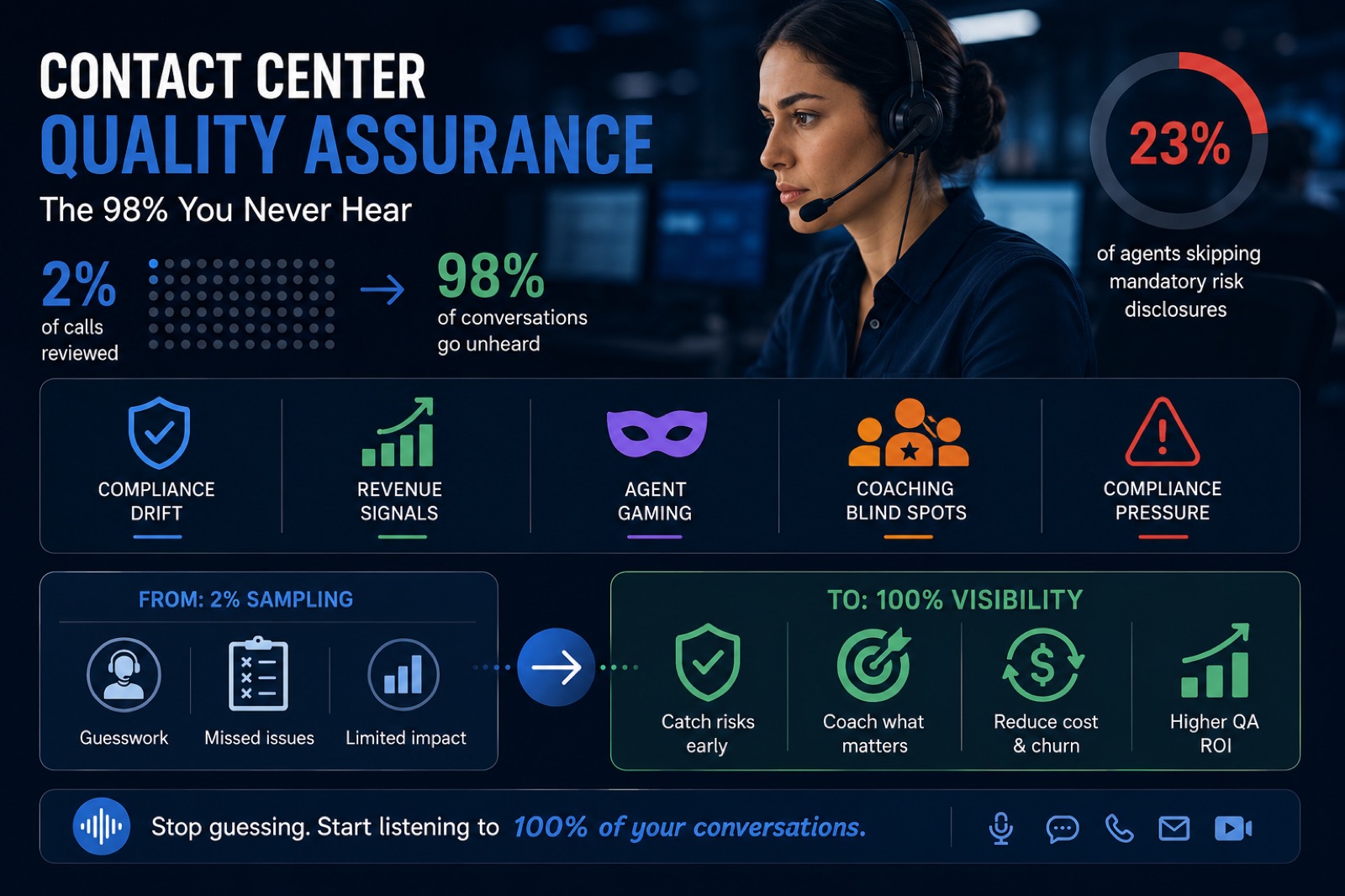
Industry data on the coverage gap is stark. SQM Group finds quality checks cover 1–2% of calls, done by hand, and manual monitoring cannot cross channels at all. When teams add automated quality assurance, they typically add it for voice first. Chat QA gets pushed to “next quarter.” Email QA rarely gets built. The result is a QA program that scores 30% of interactions from one channel and calls it representative.
What Actually Changes With Unified Conversation Analytics
Cross-channel intelligence is not a dashboard exercise. It is a data architecture decision. The channels have to feed one transcript index, one sentiment model, one entity extractor. Otherwise you get four scores that cannot be compared.
We built Ender Turing’s speech analytics and text analytics on the same underlying model layer for exactly this reason. Voice gets transcribed by our in-house ASR, tuned for contact center audio. Chat and email arrive as text. All three feed the same downstream pipeline: sentiment, intent classification, compliance markers, topic clustering. When a QA analyst opens a customer’s file, they see every touch across every channel scored on the same rubric.
The operational changes look like this.
Coaching gets richer. Instead of scoring a single call, coaches see the arc. “This customer emailed three times about the same issue before calling. The agent handled the call well given the context.” That reframing changes what “good” looks like.
QA calibration gets honest. When 100% of interactions across every channel are scored, the sample is not a sample. It is the population. Score drift, agent-to-agent variation, and coaching gaps become visible in ways that random 2% sampling cannot show. Unified cross-channel AI QA is the only way to catch issues that span channels.
Compliance becomes provable. When a customer disputes a charge, you can reconstruct the full conversation history in minutes, not days. Every disclosure, every consent, every promise, tagged and searchable. This is the difference between fighting a chargeback with “we probably” and fighting it with a timestamped transcript from the correct channel.
Churn signals get earlier. Churn patterns (conditional language, silence after a resolution offer, sentence-level sentiment drops, comparative mentions) fire across channels, not within them. A customer whose chat sentiment drops and whose next call opens with a caveat is a much stronger churn signal than either data point alone. Cross-channel conversation intelligence catches this. Single-channel does not.
What This Looks Like In Practice
Picture a mid-sized bank whose QA team scores 2% of calls and has no chat or email QA at all. Here is what changes when it moves to unified cross-channel intelligence across voice, chat, and email.
First, the coaching model shifts. Managers stop scoring interactions in isolation and start reviewing journeys. Weekly coaching sessions use cross-channel evidence, not one-off snippets.
Second, the compliance workload drops. A compliance officer no longer spends days pulling call recordings and chat logs by hand; cross-channel search does it, which frees time to investigate suspicious patterns instead of just documenting known ones.
Third, churn cascades become visible. Customers with normal-looking individual interactions get flagged by the pattern across channels, early enough for proactive outreach.
None of this requires replacing the underlying contact center platform. It requires layering one analytics model on top of every channel, feeding one model, and rebuilding the QA rubric to score journeys rather than events.
Objections Worth Addressing
“We do not have the data volume for cross-channel to matter.” Volume is a red herring. The value of cross-channel is not statistical significance, it is context. Even 500 interactions a day benefit from unified scoring if those interactions span channels for the same customers.
“Our channels are on different vendors, we cannot unify.” This is a real constraint but a solvable one. Modern conversation intelligence platforms ingest transcripts and text via API from any source. You do not need to consolidate the customer-facing channels. You need to consolidate the analytics layer that sits behind them.
“Chat and email QA will double our review time.” With manual QA, yes. With AI-powered call center quality monitoring extended to text channels, no. The same automation that made 100% voice review economically feasible works on text at even lower cost. The unit economics of text analytics are better than voice, not worse.
“We will start with voice and add channels later.” This is what everyone says. Two years later, the channels are still separate and the coaching program is still scoring the wrong things. If cross-channel matters, the sequencing matters.
What To Do This Week
Three specific actions for a CC leader reading this on a Monday morning.
Audit your coverage. Pull the numbers for what percentage of each channel’s interactions are being scored today. Voice, chat, email, messaging. If any channel is under 50% and any channel is at zero, you have a fragmentation problem. Document the exact gap before scoping the fix.
Reconstruct one cross-channel journey manually. Pick a customer who churned in the last quarter. Have someone pull every interaction they had across every channel, in order, and read it as a single story. Note what a coach or QA analyst would have needed to see to intervene. That artifact is the specification for your unified analytics deployment.
Rewrite one QA form for journey scoring. Take your most-used QA rubric and rewrite it to score a full customer journey instead of a single interaction. Force yourself to include cross-channel context items. This exposes which parts of your current QA are only defensible because they never see the full picture.
The 2% sampling problem does not get solved by sampling more calls. It gets solved by making 100% of every conversation, across every channel, visible to the same intelligence layer. Everything downstream (coaching, compliance, churn prediction, revenue signals) improves the moment that happens. Everything downstream stays broken as long as it does not.