According to Omdia’s 2025 Digital CX Survey, the top reason North American contact center leaders invest in AI is to reduce agents’ cognitive load and stress. In the same survey, 75% said they worry about AI’s impact on agents’ well-being. That is not a contradiction between two different groups. That is the same leaders saying both things at once. Something is broken in how AI in contact centers gets deployed, measured, and trusted, and it is not what the vendors want you to hear.
Leaders bought AI to fix a stress problem. The AI shipped, it did some things well, and then the stress moved. It did not disappear. It changed shape. Agents stopped worrying about handle time and started worrying about the copilot suggesting the wrong thing. QA teams stopped worrying about sample size and started worrying about whether the model was scoring them or their agents. The trust never showed up. This post is about why, and what the operations that actually made AI work did differently.
Why AI in Contact Centers Has a Trust Problem, Not a Tech Problem
The figure comes from Omdia’s survey, as reported by CX Today. The stat is not noise. The technology arrived faster than the trust infrastructure needed to manage it.
Trust infrastructure is a boring phrase. Here is what it means concretely. When you deploy a chatbot, who monitors what it says? When you deploy an agent copilot, who reviews whether its suggestions are correct? When you deploy an AI QA scoring model, who verifies the model is scoring things a human would agree with? For many contact centers, the answer is nobody. There is no owner. There is no cadence. There is no method. The AI runs, the metrics look good on the dashboard, and the agents quietly start distrusting every suggestion.
The result is a stress paradox that leadership did not predict. Handle time drops. Efficiency numbers improve. But agent NPS craters. Not because the copilot was bad. Because the agents could not tell when to trust it. Every suggestion became a decision. Every decision became a risk. The cognitive load moved from remembering policy to evaluating AI output, and the second load turned out to be heavier than the first.
The Data Behind AI in Contact Centers Today
The industry loves to talk about AI deployment rates. It is the wrong metric. Here is what the current data actually says.
- 79% of organizations now use AI in customer care (COPC, 2026). Using AI is not the same as operationalizing it: integrated into daily workflows and producing measurable business outcomes.
- 56% of contact centers are not realizing the return they expected from AI (COPC). More than half. This is not an early-adopter problem anymore. The technology has been mainstream in customer communication for three years.
- 48% name integration challenges as the main cause of their AI falling short (COPC). The AI works. The stack around it does not.
- The average organization manages 3.9 different contact center technologies. Only 3% of contact centers run on a single platform (Puzzel’s State of Contact Centres 2026, via CX Today). Every additional platform is a place where AI context gets lost.
- 91% of customer service leaders report pressure from executive leadership to implement AI (Gartner, 2026). Only 10% of contact center AI programs are high-maturity (UJET, 2024). The pressure is not producing outcomes. It is producing pilots.
There is a pattern here that most vendors will not name out loud. AI works when it is measured. It fails when it is deployed and forgotten.
The Analysis: Where AI Trust Actually Breaks
The trust paradox has three failure modes.
Failure mode one: silent drift. An AI model is trained on a snapshot of your business. Your business then changes. New products launch. Policies get updated. Compliance rules shift. Nobody retrains the model. Six months later, the AI is confidently giving advice that is subtly wrong, and nobody catches it because nobody monitors it.
Failure mode two: accuracy theater. Vendors ship AI products with an accuracy number attached. 92% accuracy. 95% accuracy. The numbers are almost always measured against internal test sets that do not reflect production reality. Score the same voice bot against production calls twice — once with the vendor’s methodology, once on whether the customer’s problem was actually resolved — and the two accuracy numbers can be far apart. Neither number is wrong. They measure different things. The vendor measures whether the bot understood the intent. Resolution measures whether the bot solved the customer’s actual problem. The customer only cares about the second one.
Failure mode three: no feedback loop from humans to AI. Every contact center has agents who work around the AI. They know when the copilot is wrong. They know which suggestions to ignore. That knowledge lives in Slack channels and break-room conversations. It never reaches the AI team. The AI does not improve because the people who know it best have no way to tell it what is wrong. In healthcare operations, this failure mode is especially costly. Agents build workarounds for medical coding suggestions, but the AI keeps making the same suggestions to new agents who do not know the workaround yet.
Each of these failure modes has a solution. None of them are technical. They are operational. They require someone whose job is specifically to make AI customer service work over time, not just deploy it once. Most operations do not have that role.
The Solution: What Actually Works in Hybrid AI Customer Service
The operations that made AI work had four things in common. None of them are novel. All of them are boring. That is the point.
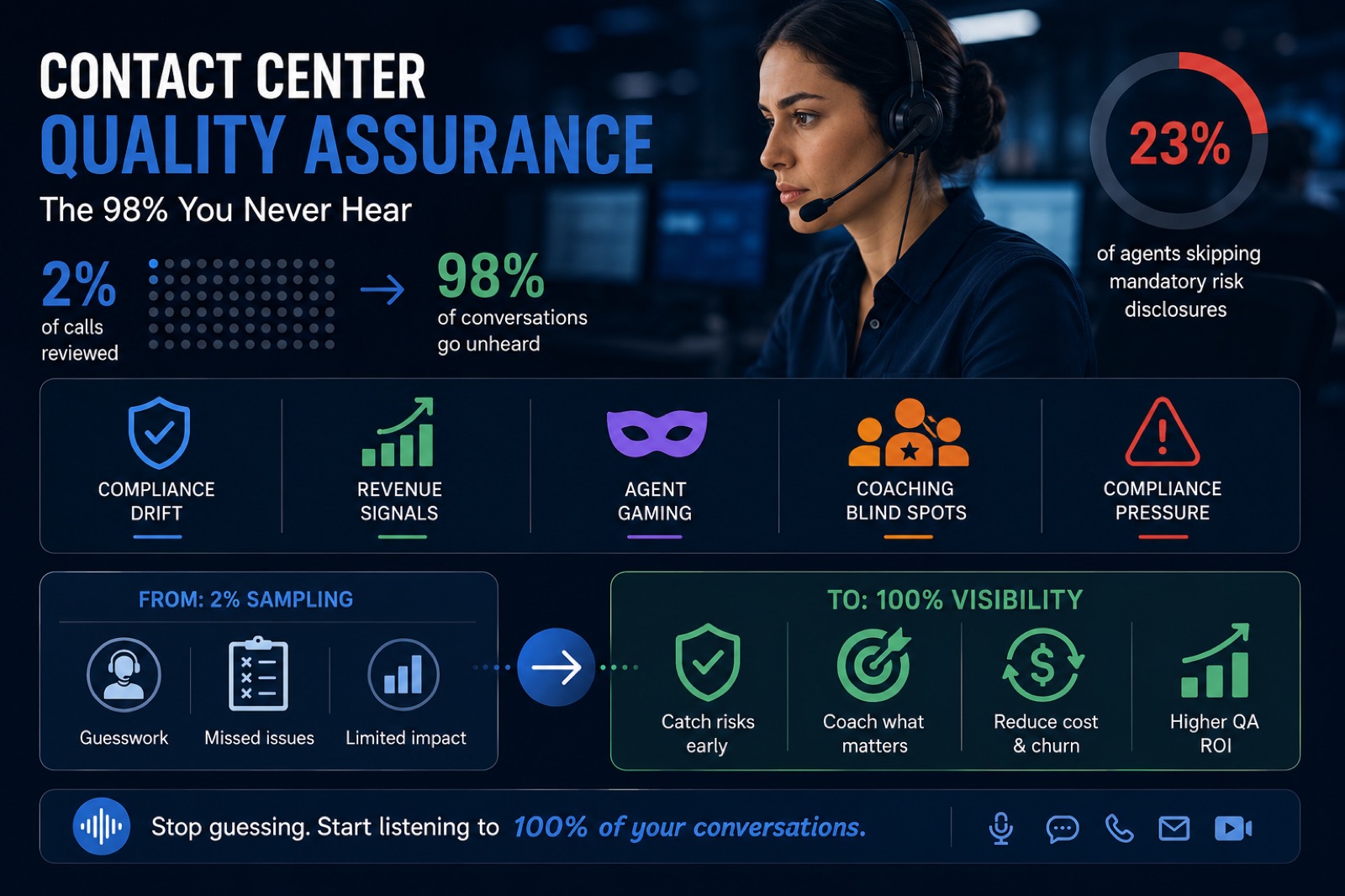
They monitored AI output the same way they monitored human output. If you sample 5% of human calls for quality, you sample 5% of AI conversations too. If you score agents on tone and empathy, you score chatbots on the same criteria. Every AI touchpoint gets held to human standards, not vendor-reported accuracy numbers. With automated quality assurance, that monitoring covers every conversation, human or AI.
They built a hybrid model with clear escalation paths. Good hybrid results are not accidental. They come from operations that decided in advance which conversations AI handles, which conversations humans handle, and which conversations require handoff. The handoff protocol is the critical piece. Bad handoffs kill customer trust faster than either pure AI or pure human service. Good handoffs make the customer feel like the AI was the assistant and the human was the expert.
They ran AI QA on their AI QA. This sounds recursive but it is essential. When you deploy AI QA for voice bots, you need to periodically verify that the scoring is aligned with what a human reviewer would score. Model drift is real. The operations that did quarterly calibration reviews caught scoring drift within a quarter. The ones that did not caught it when their customer NPS started declining and they had to reverse-engineer the cause.
They gave agents a channel to flag AI errors. Not a formal ticketing process. A one-click flag in the interface. When an agent hits “this suggestion was wrong,” it flows to a review queue that the AI team actually reads. In the operations that did this, agents stopped resenting the copilot. They started treating it like a junior team member they were helping to develop. That reframe changed the stress dynamic completely.
None of these solutions require net-new technology. They require operational commitment. AI in contact centers is not a technology problem in 2026. It is a management problem wearing technology’s clothes.
What To Do About It This Week
The trust paradox will not resolve itself. The vendors selling AI customer service tools have no incentive to fix it because their commercials are tied to deployment, not to operational maturity. Here is what to do this week if you are running a contact center and you want to move from the 75% who worry to the operations that actually made it work.
- Audit your AI monitoring. For every AI-driven touchpoint in your operation (chatbots, IVR, agent copilots, AI QA scoring, voice bots), name the person who owns quality monitoring. If the answer is “nobody” or “the vendor,” you have the industry’s most common failure mode. Fix it before you deploy anything else.
- Run a parallel scoring test on your AI QA. Pick 20 calls this week. Have your best human QA specialist score them. Have your AI QA system score them. Compare. If the agreement is below 85%, your AI QA is measuring something different than what you think it is measuring. Calibrate before you trust the numbers on the dashboard.
- Ask your agents about AI errors. Not in a survey. In one-on-ones. Ask them which AI suggestions they routinely ignore and why. Write down the top three failure patterns. Those patterns are your model retraining priority list.
- Measure the handoff. For every AI-to-human handoff in your operation, measure customer effort at the moment of transfer. If the customer has to re-explain the situation, your handoff is broken. Fix the context passing before you optimize anything else about the AI itself.
- Retire vanity metrics. “Accuracy” without a business outcome attached is a vanity metric. Replace it with “AI resolution rate” (percentage of AI-only conversations that resolved without human involvement) and “post-AI human resolution rate” (percentage of AI-handoff conversations that the human resolved successfully). These two numbers tell you whether the automation is actually working in your operation, or just running.
The trust paradox is not evidence that AI has failed the contact center. It is evidence that most operations deployed AI without deploying the operational discipline AI requires. The gap between the operations that made AI work and the leaders who worry about it is not technical. It is the difference between running AI and managing AI. The good news is that closing the gap is inside every leader’s control. It does not require a new vendor. It requires an owner, a cadence, and a method.
We built Ender Turing because we believe every contact center conversation, human or AI, deserves the same quality attention. If you are seeing the 75/75 paradox in your own operation, the fix starts with measurement. What you cannot see, you cannot manage.