81% of customer service reps deal with verbal and emotional abuse every day. 21% of female agents face sexual harassment or homophobic comments daily. And most agent retention strategies still score them on script adherence.
We’ve spent the last six years building conversation intelligence for contact centers, and this is the pattern that keeps repeating. Leaders ask us how to cut 40% attrition. They budget for coaching. They buy dashboards. They rewrite scripts. Then their QA team reviews five calls per agent per month and misses the one where the customer screamed for six minutes straight.
Agent wellbeing is not a soft metric. It is the single largest predictor of who quits in the next 90 days. And it is invisible to almost every quality program running today.
The Problem With How We Measure “Good”
Traditional contact center coaching evolved from a compliance mindset. QA scored what was easy to hear on a random sample: did the agent greet correctly, use the customer’s name, disclose the recording, close the call. It was manual. It was slow. It caught the wrong things.
Then AI arrived and most contact centers just automated the same wrong things at scale.
According to Metrigy, agent turnover was projected at 31.2% for 2024. That means a 100-agent center replaces its entire team about every three years. At $10,000-$20,000 per replacement (McKinsey), that’s $310,000 to $620,000 a year in hiring costs alone. For a 1,000-seat center running at 40% attrition, the number climbs to $4 million to $8 million per year in replacement cost. Keeping turnover below 15% goes with a 26% increase in customer satisfaction, according to Metrigy.
And yet turnover is still budgeted as a hiring cost, not treated as something to prevent.
The reason is uncomfortable. Most leaders don’t know why agents actually leave. Exit interviews capture “career growth” and “compensation” because those are safe to say. What agents don’t say in the exit interview: the calls got worse, coaching was punitive, nobody defended them when a customer went off, and the QA scorecard still docked them for handle time on the abuse call.
The Data Nobody Wants to Publish
The wellbeing data in contact centers is grim, and vendors don’t like publishing it because it makes their software look powerless.
HiveDesk’s 2025 study found that 81% of CSRs deal with verbal and emotional abuse every day. A separate Convoso survey put the number at 21% for female agents specifically facing sexual harassment or homophobic remarks daily. 60% of agents cite stress as the primary factor pushing them to look for a new job.
Meanwhile, in Omdia’s 2025 Digital CX Survey, reported by CX Today, reducing agents’ cognitive load and stress was the top reason North American contact center leaders gave for investing in AI, and 75% said they worry about AI’s impact on agent well-being. We have an AI trust problem with our own teams before we even talk about customer trust.
Layer these together and a picture emerges: agents are absorbing verbal abuse daily, getting training that doesn’t help them handle it, being scored by systems that don’t recognize it, and being told that the AI shipped to protect them is now watching them. Then leadership wonders why nearly a third of them leave every year.
The core failure is measurement. If you can’t see what agents actually experience on their calls, you cannot build an agent performance management program that keeps them. You are guessing.
What 100% Coverage Actually Reveals
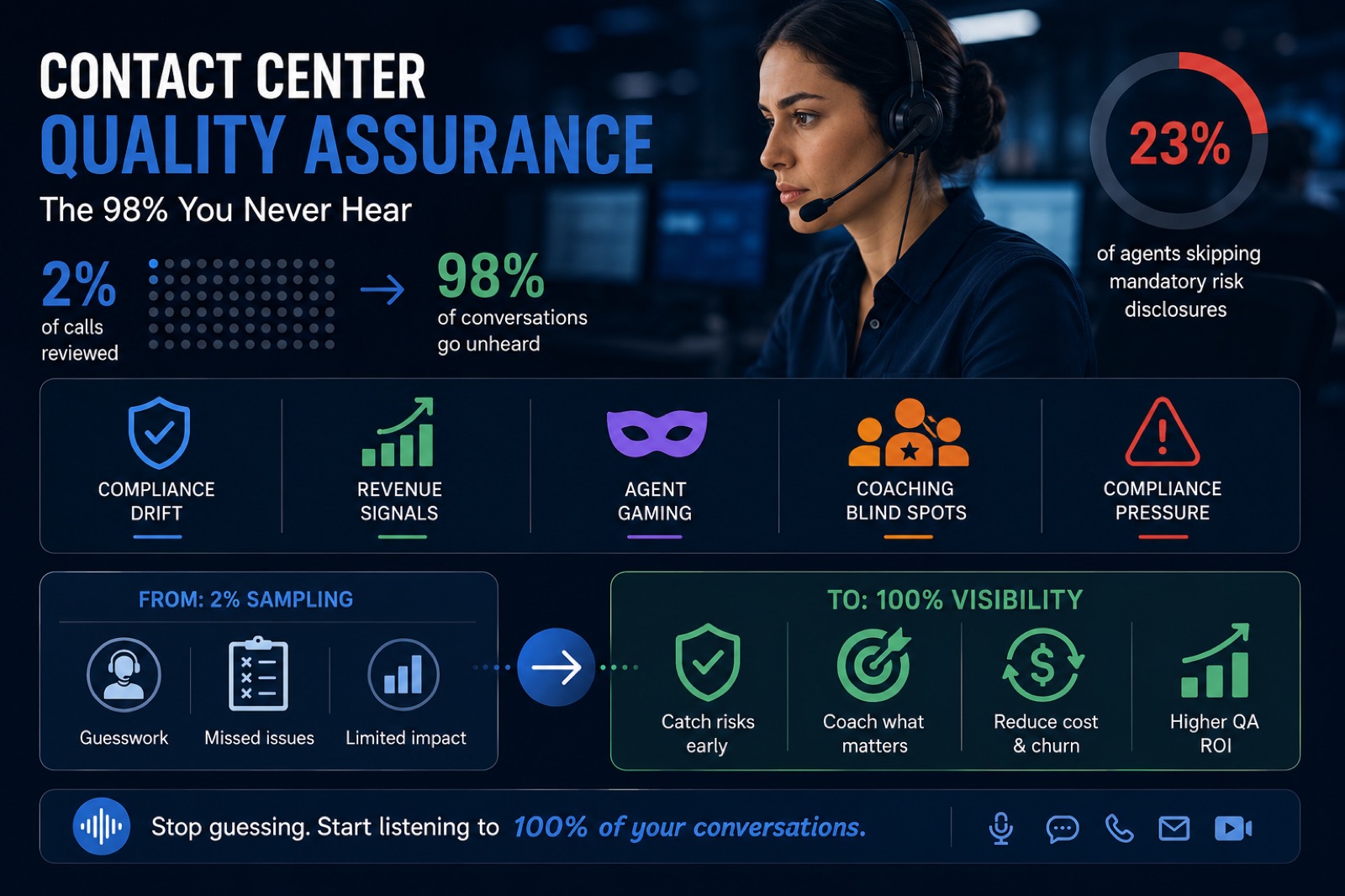
When you move from 2-5 calls per agent per month to reviewing every call, the patterns that emerge are not the ones the industry expected.
Picture a lending contact center with 320 agents across three languages, where supervisors sample roughly 3 calls per agent per month. Move it to 100% conversation analytics across voice and chat, and the first month can surface what sampling never shows:
- Calls with verbally abusive customer moments (raised voice, insults, threats) that no supervisor ever heard about
- Agents with the highest abuse exposure scoring lowest on empathy KPIs, because they are emotionally exhausted by call 40 of the shift
- “Underperformers” on the traditional scorecard who are actually the top handlers of the hardest calls
The coaching implications are enormous. Under the old system, those agents land on performance improvement plans. Under the new one, they get recognition, rotation off high-difficulty queues, and 1:1 support from a wellbeing lead.
This is what we mean when we talk about turning QA from punishment into development. It is not a slogan. It is what happens when contact center coaching stops being driven by a random 2% sample and starts being driven by what actually happened on every call.
Catching abuse patterns early and rotating agents away from concentrated exposure is a cheap intervention. The measurement is what’s missing.
Why AI QA Alone Is Not an Agent Retention Strategy
We build AI QA tools. We think they are essential. We also think most implementations get one thing badly wrong: they use AI to grade agents faster without changing what gets graded.
If your automated QA scorecard is still weighted toward greeting, name usage, recording disclosure, and handle time, congratulations. You now do compliance faster. You have not moved the needle on agent retention strategies. You just automated the wrong scoring rubric.
The real work is in the scoring model itself. A modern AI QA specialist approach needs to include:
- Abuse detection. Flag calls where the customer crosses a line, so supervisors can intervene and coaching can adapt.
- Emotional load per agent. Cumulative measure of how much difficult content an agent handled in a shift, not just call count.
- Recovery quality. How well the agent handled themselves during and after a hard call, weighted higher than script adherence.
- Coaching gap detection. Which specific behaviors this individual agent needs to build, based on their actual calls, not a generic playbook.
- Peer benchmarking on hard calls. How top performers handled the same customer archetype.
The reason most vendors don’t ship these dimensions is that they require language models tuned specifically for contact center conversations. Off-the-shelf ASR trained on podcast audio misses the subtle cues that matter. We built our own speech analytics stack from scratch precisely so we could hear what’s actually happening on noisy, overlapping, real-world calls.
What Works: Practical Agent Retention Strategies
If you’re a VP of Contact Center Operations reading this on Monday, here’s what to actually do.
Redefine what your QA program measures. Take your current scorecard. Cut it in half. The items you remove should be the easy-to-measure compliance items that don’t correlate with either CSAT or retention. Replace them with metrics that reflect what agents actually experience: abuse exposure, emotional load, coaching-specific behaviors, recovery quality. This is a two-week project, not a two-quarter one.
Move to 100% coverage before you buy anything else. If your QA team is still sampling calls, no amount of dashboards will help. The signal you need is in the 95%+ of calls nobody currently reviews. Any serious call center turnover analysis starts from the same point: the calls that predict quits are usually not in the sampled set.
Rotate exposure to hard calls. Once you can measure abuse exposure per agent, use it. Cap daily exposure. Rotate high-difficulty queues. Give agents recovery time after severe incidents. This costs almost nothing operationally and is one of the cheapest retention levers there is.
Coach on the actual weaknesses. Instant, automated coaching that identifies the specific skill gap for THIS agent based on THEIR calls works better than generic classroom training.
Make wellbeing a KPI for supervisors. Supervisor bonuses tied to agent retention (not just team AHT) change behavior faster than any training program. If your supervisors are incentivized to squeeze the last minute out of every call, they will burn out their team every year without noticing.
Kill the after-call paperwork. Auto-summaries into CRM cut after-call work. Agents get bathroom breaks. Agents get to breathe. Agents stay.
The Uncomfortable Bottom Line
Most agent retention strategies fail because they treat retention as an HR problem. It is a measurement problem. Until your QA program can see what actually happens on your agents’ calls (the abuse, the emotional load, the difficulty gradient, the recovery), every retention initiative you fund is built on 2% of the evidence.
The centers that cut attrition stop grading agents against a compliance rubric that ignores their reality, and start measuring what actually predicts who stays.
The technology exists. The data exists. The math exists. The blindspot is that most leaders are still measuring the wrong things at the wrong scale and calling it quality.
Fix the measurement first. Everything else follows.
What To Do This Week
- Pull your current QA scorecard. Highlight every item that measures compliance versus every item that measures agent experience. If the ratio is worse than 50/50, you have a scoring problem.
- Ask your QA team for the last month’s abuse-incident count. If they can’t produce a number, you have a coverage problem.
- Look up your center’s annual replacement cost using $10,000-$20,000 per hire against your actual attrition rate. Compare that number to your QA and coaching budget. The gap tells you where to invest next quarter.
- Identify your five highest-abuse-exposure agents from the last 30 days. If you can’t identify them, you are not measuring what matters. Start there.
- Book 30 minutes with your top three performers and ask them what would make them stay another two years. Their answers rarely involve money. They usually involve being seen.