Picture a mid-market SaaS company losing roughly 11% of its book of business each year and treating it as a market reality. Pricing pressure, competition, the usual story.
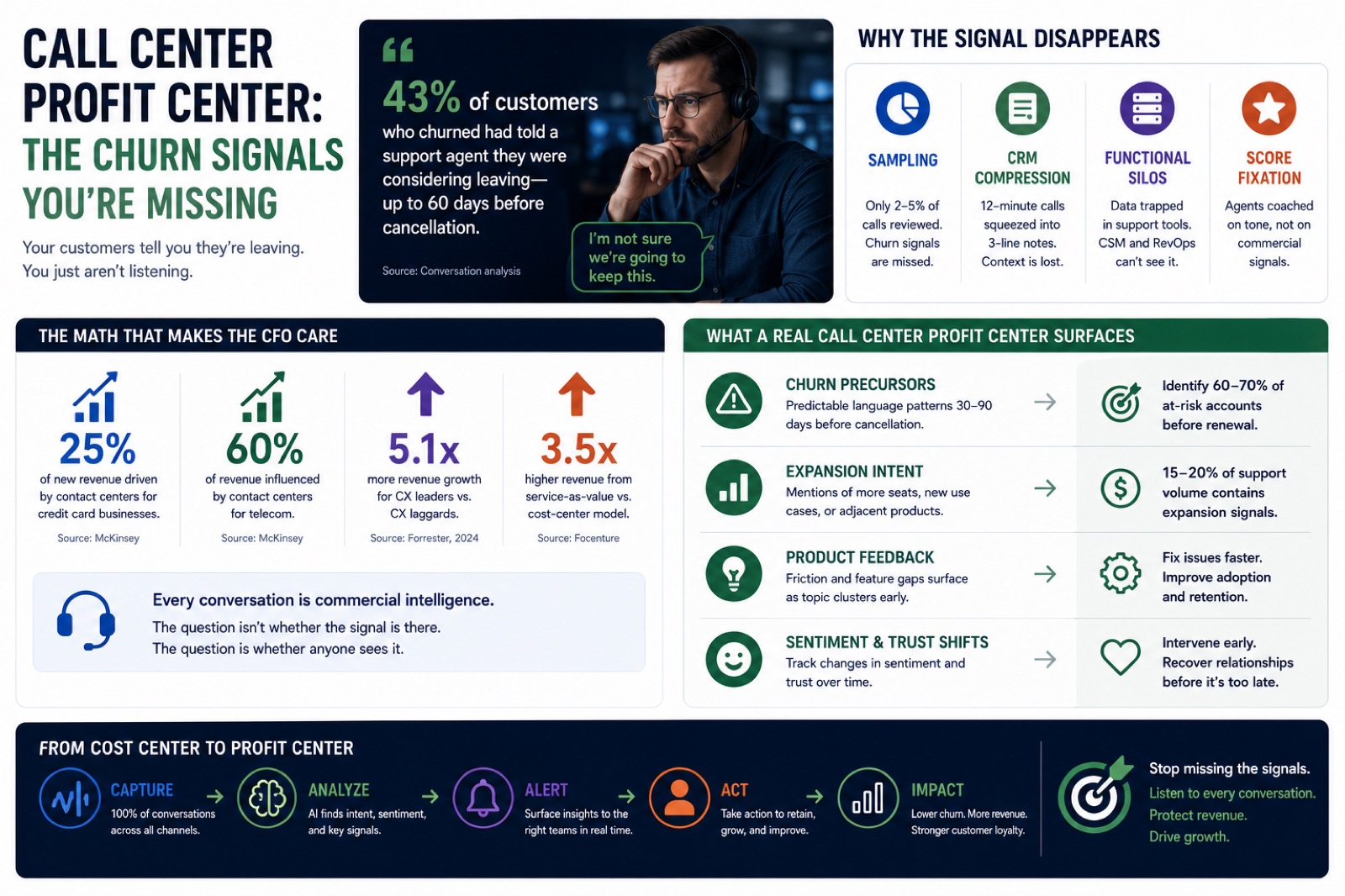
Run sentiment and intent analysis across the calls, chats, and emails its support team handled, and you may find customers who told a support agent they were considering leaving. Not in a survey. Not in an exit interview. On a recorded call, sometimes 60 days before the renewal, with a phrase as direct as “I’m not sure we’re going to keep this.” The agent acknowledges the comment, resolves the immediate ticket, and the conversation moves on. The CRM note says “issue resolved.”
Nobody on the revenue team ever sees that data. The customer success team doesn’t get an alert. The renewal manager walks into the negotiation cold. That’s the gap between a call center as a cost center and a call center profit center. It’s not a tooling gap. It’s a listening gap.
The Math That Makes the CFO Care
Most CFOs treat the contact center as a line item to compress. Headcount, technology, real estate, attrition. The pressure is downward. Reduce average handle time. Push more volume to bots. Cut a percentage point off the operations budget every year.
That math is incomplete.
McKinsey made the point years ago: inbound service call centers generated up to 25% of new revenue at some credit card companies and up to 60% at some telecom companies. The conversations happening across voice, chat, and email are where customer intent surfaces first. Renewal decisions, expansion appetite, churn risk, product feedback that drives roadmap. All of it lives in language.
Forrester found that customer experience leaders’ revenue growth was 5.1 times that of CX laggards (2010–2015 data). Accenture put the multiplier at 3.5x for companies that see service as a value center, versus those that see it entirely as a cost center. Those numbers are not measuring service quality in isolation. They are measuring what happens when leadership treats every conversation as commercial intelligence rather than a ticket to close.
The contact center is the only function in the company that touches every customer, every day, in their own words. Marketing can guess at intent from clicks. Product can guess from usage data. Sales can guess from pipeline activity. The contact center hears it directly. The economic question is whether that signal reaches the people who can act on it.
In most companies, it does not.
Why the Signal Disappears
There are four reasons churn signals get lost between the call and the renewal meeting. Every CFO should be able to answer for each one.
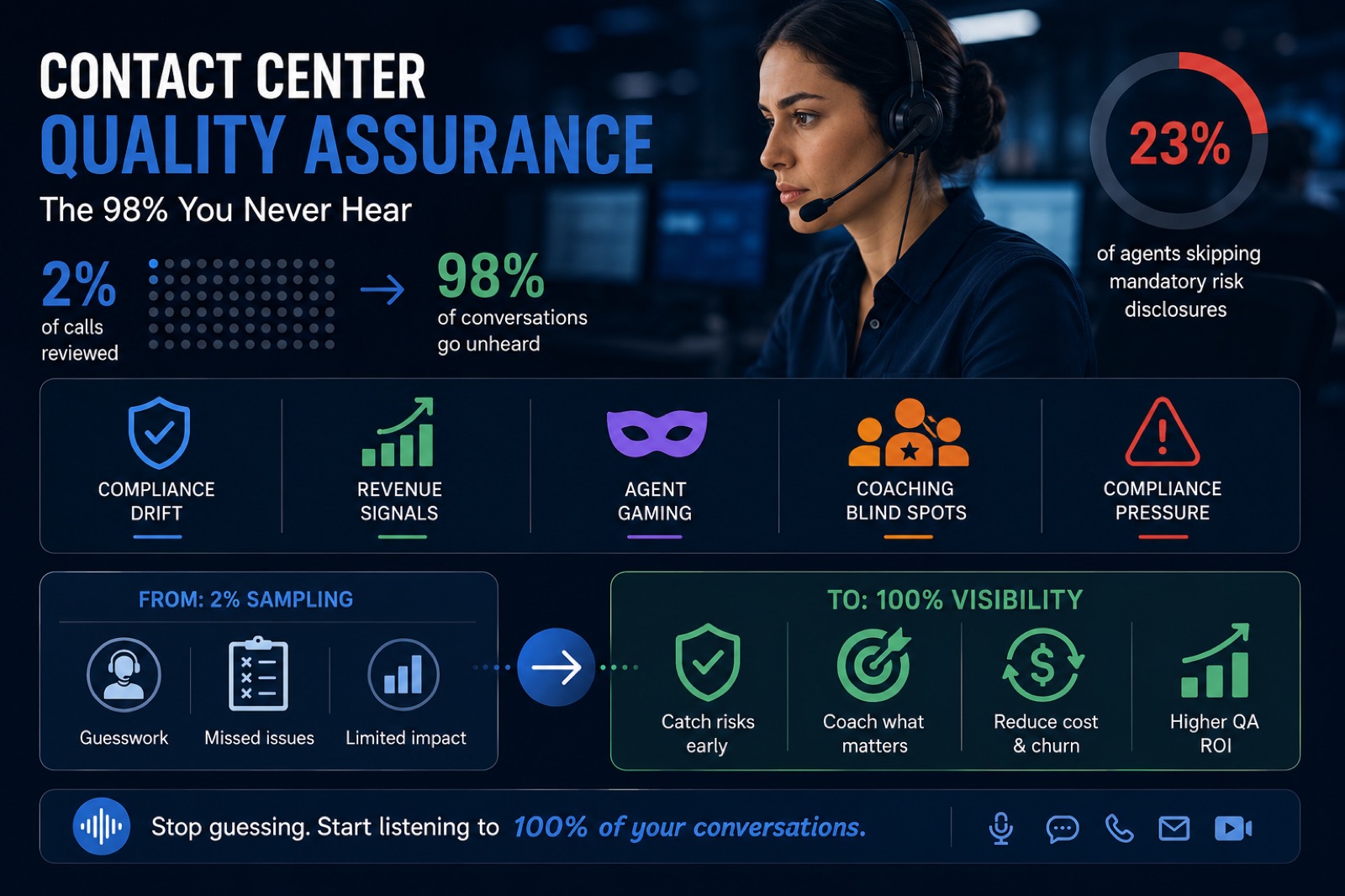
Sampling. Quality assurance teams review 2-5 calls per agent per month. In a 200-seat center handling 20,000 monthly conversations, that’s 2-5% coverage. The math is brutal: if a churn signal appears in 5% of calls, manual sampling has roughly a 10% chance of catching it for any given agent in any given month. The signal is there. Nobody is listening to it.
CRM compression. When agents do log conversation outcomes, they compress 12-minute calls into three-line summaries. “Customer asked about pricing. Resolved.” That summary cannot capture sentiment shift, hesitation phrases, or competitor mentions. The data structure was designed for ticket triage, not commercial intelligence. Auto-generated conversation summaries help, but most centers still rely on manual notes.
Functional silos. When churn signals are captured, they sit in support tooling that customer success and revenue ops cannot easily query. The integration work to surface “high churn risk” alerts to a CSM dashboard is rarely prioritized because the contact center is funded as a cost center, not a revenue function. The data is technically available but operationally invisible.
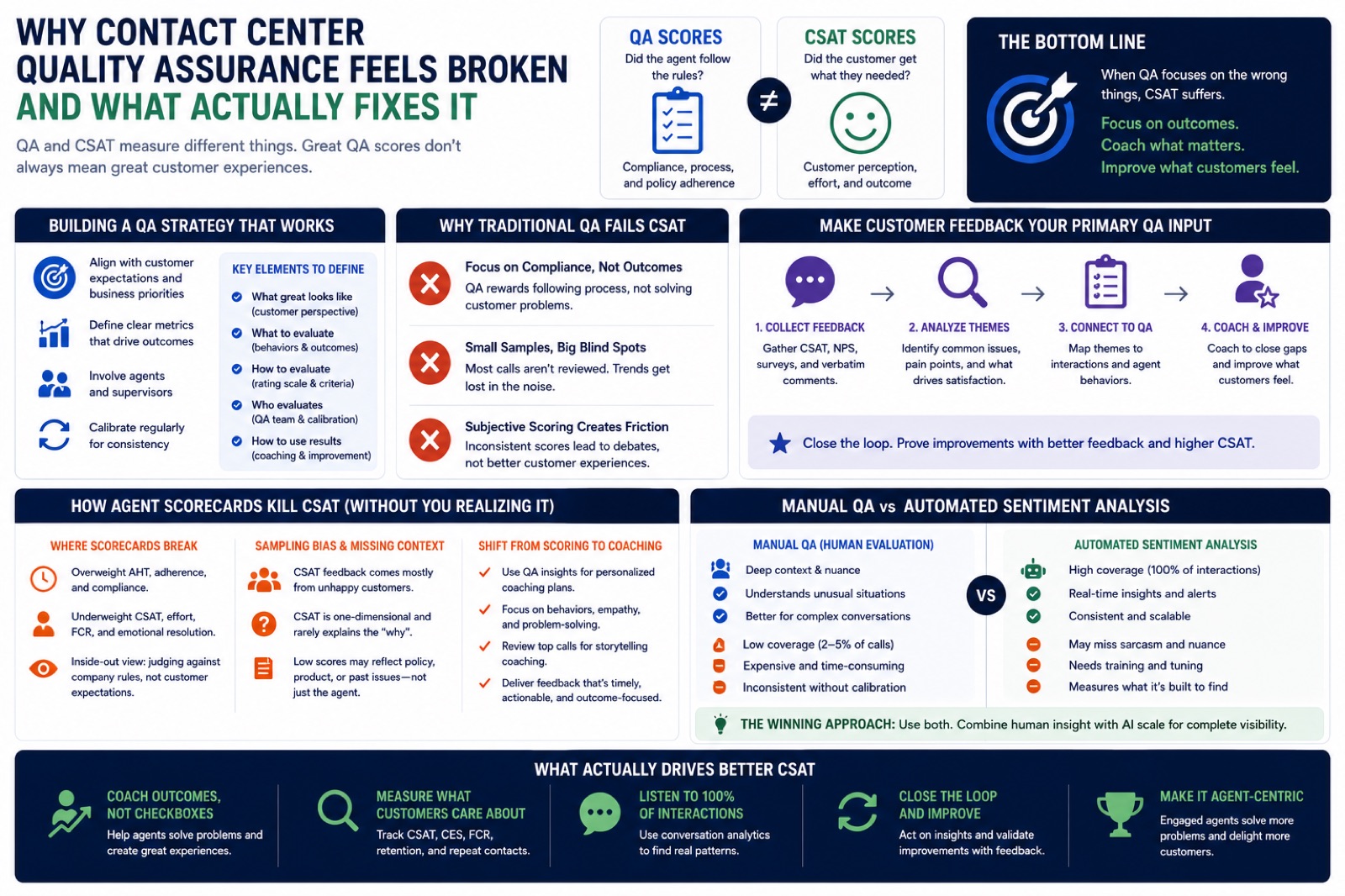
Score fixation. QA programs measure tone, script adherence, and call disposition. They do not measure commercial signal capture. Agents are coached on whether they thanked the customer, not whether they flagged a comment that suggested the customer was evaluating alternatives. The incentive structure points away from the signal.
The result is a system optimized for compliance theater and customer satisfaction surveys, not for the upstream economic intelligence that lives in the conversations themselves.
What a Real Call Center Profit Center Actually Surfaces
When 100% of conversations are analyzed with conversation intelligence, the patterns that emerge are operational, not abstract.
Churn precursors with measurable lead time. Customers who later cancel show predictable language patterns 30-90 days before the cancellation event. Phrases like “we’re reviewing options,” “I’ll need to check with my team,” “the team upstairs is asking questions.” These are not generic complaints. They are pre-decision signals, and they cluster in measurable ways. SaaS companies running this analysis report being able to identify 60-70% of at-risk accounts before the renewal conversation begins. That window is enough to deploy customer success intervention while it still has commercial weight.
Expansion intent. The same analysis surfaces customers who mention adjacent products, more seats, additional use cases, or feature gaps in tools they are evaluating. These are warm leads that the contact center is generating for free, then losing because nobody routes them to the right place.
Product feedback at scale. When a feature is causing repeated friction, it shows up as topic clusters in support conversations weeks before it appears in a CSAT survey or NPS comment. Product teams running speech analytics on support data get intelligence that is faster, higher-fidelity, and unfiltered by survey bias.
Compliance and regulatory exposure. For financial services, healthcare, and regulated industries, full-conversation monitoring catches disclosure violations and policy drift that manual sampling misses. The FCA fined firms 176 million GBP in 2024, a 230% increase over 2023. Most violations were operational drift that could have been caught months earlier with proper monitoring infrastructure. The cost of monitoring is small relative to the cost of one enforcement action.
The point is not that conversation intelligence is a feature. The point is that the conversations are already happening, the signal is already in them, and the question is whether the company has the listening infrastructure to convert that signal into commercial action.
The Revenue Math, Specifically
A 200-seat contact center handling 20,000 calls per month and a $50M revenue book provides a clean illustration.
Assume a 10% annual gross churn rate, which is mid-pack for B2B SaaS. That’s $5M in revenue walking out the door each year. If conversation intelligence identifies 40% of those churning customers in the 30-90 day window before cancellation (an assumption for this illustration), and customer success intervention saves half of those identified accounts, the recovered revenue is $1M annually. That is the floor case.
Add the expansion signal layer. If 15% of inbound support volume contains expansion intent, that’s 3,000 conversations per month containing warm sales signal. If 5% of those become qualified leads and 20% close at average contract value of $25K, the math compounds quickly. We’re talking $9M in incremental annual revenue from a function that today is treated as a cost.
Now look at the cost side. A 200-seat manual QA program, fully loaded, runs $400K-600K per year. Conversation intelligence platforms with 100% coverage replace that with a system that costs $150K-250K depending on volume and integrations. The QA function gets cheaper, the data set gets 25-50x larger, and the commercial output gets unlocked.
The CFO question is no longer “should we spend on conversation intelligence.” It’s “what is the opportunity cost of not deploying it?” For most companies of this size, the answer is several million dollars per year of unrecovered revenue and unidentified expansion. That is the gap between cost center and contact center ROI measured at the bottom line.
Building the Profit Center: What Organizational Change Looks Like
The technology is the easier half. The harder half is changing how the contact center reports into the business.
Most contact centers report into operations or customer service leadership, with an indirect line to the CFO for budget purposes. The metrics flow upward as cost-per-contact, average handle time, occupancy, and CSAT. Revenue intelligence flows nowhere. To convert the function into a profit center, three things need to change.
Reporting lines. The conversation intelligence layer should report into commercial operations alongside marketing analytics and sales operations. The data set is commercial. The consumers are revenue and CS leadership. Continuing to bury it inside support means it gets used for ticket optimization, not revenue optimization.
Metrics framework. Add three commercial metrics to the contact center scorecard: at-risk customers identified per quarter, expansion signals routed to sales, and product feedback signals delivered to product. These are not vanity metrics. They are leading indicators for revenue and retention. The existing operational metrics stay; you are adding the commercial layer that has been missing.
Compensation and recognition. Top agents who consistently surface high-quality commercial signal should be recognized for it. Most centers reward call closure speed and CSAT alone. Adding signal-quality recognition (which can be measured automatically by speech analytics) shifts agent behavior toward listening rather than ticket closure. This is the same insight that made consultative sales work in the 1990s, applied to the support function.
These are organizational moves, not technology projects. The technology can be deployed in 60-90 days. The organizational shift takes longer because it requires the CFO and the head of operations to agree that the contact center is generating revenue intelligence the rest of the business needs.
The Vertical Intelligence Multiplier
Generic conversation intelligence is useful. Vertical intelligence is transformational.
A speech analytics platform that doesn’t understand banking compliance vocabulary will miss disclosure violations buried in financial advice conversations. A platform that doesn’t understand medical lab terminology will miss the difference between a routine billing question and a HIPAA-adjacent escalation. A platform that doesn’t understand SaaS contract language will miss the renewal-risk phrases buried in technical support tickets.
This is why pre-trained models tuned for specific industries materially outperform generic transcription wrapped in keyword search. The accuracy gap on domain-specific terminology can be 15-30 percentage points, and that gap shows up directly in signal quality. We have written before about why purpose-built ASR matters for contact center audio specifically. Noisy lines. Overlapping speech. Regulated vocabulary. Generic models trained on podcast audio do not perform here.
For CFOs evaluating vendors, the question to ask is not “do you support speech analytics.” Every vendor will say yes. The question is “what does your model accuracy look like on our specific industry’s vocabulary, on calls with two speakers, on lines with background noise.” If the answer is hand-waving, the signal quality will be poor and the ROI math will not work.
What CFOs Should Do This Quarter
Five concrete actions, ranked by impact.
1. Audit your conversation data coverage. Ask the head of contact center operations: of all customer conversations across voice, chat, and email last month, what percentage was analyzed by any system? If the answer is under 20%, you have a commercial blind spot, not just a quality gap.
2. Run a churn-signal pilot on 90 days of recorded calls. Take the customers who churned in the last quarter and run their last 6 months of conversations through a conversation intelligence platform. Quantify how many churn precursors were detectable in the 30-60 day window. If the number is meaningful, you have your business case.
3. Map current data flows. Where does support conversation data go today? Who consumes it? If the answer is “QA team for sample scoring and CSAT survey for monthly reporting,” you have identified the silo. The fix is not technology. It’s reporting structure.
4. Pick one revenue signal to operationalize. Don’t try to operationalize all four (churn, expansion, product feedback, compliance) at once. Pick churn risk for the first quarter. Build the pipeline from conversation intelligence to CSM dashboard to intervention playbook. Measure what it saves. That gives you the proof point to expand into the others.
5. Move the conversation intelligence function out of QA. This is the structural move. As long as conversation intelligence reports up through quality assurance, it will be used for quality assurance. Move it into commercial operations or revenue operations. The same data, in a different reporting line, generates a fundamentally different output.
The conversations your customers are having with your contact center this quarter contain the most valuable forward-looking commercial data your company will generate. The renewal risks, the expansion intent, the product friction, the competitive intel. It is in your possession. The question is not whether to listen. The question is whether you have built the operating model to act on what you hear.