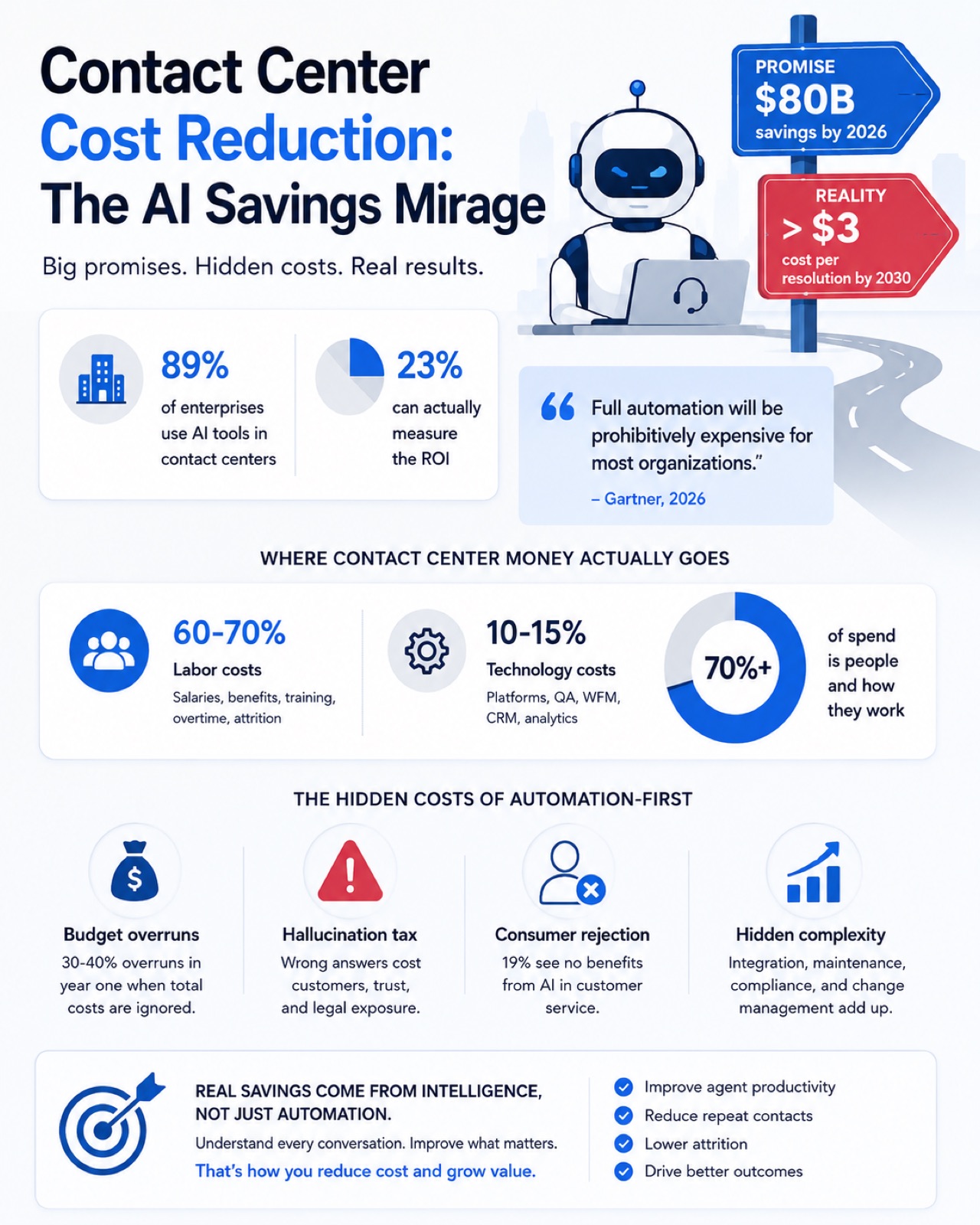
In 2022, Gartner made a bold prediction: conversational AI would deliver $80 billion in contact center cost reduction by 2026. Four years later, the same firm published a correction that should make every CFO pay attention. By 2030, Gartner now says, generative AI’s cost per resolution will exceed $3, making it more expensive than many B2C offshore human agents. The analyst firm that sold the dream is now walking it back.
And yet 89% of enterprises have adopted AI tools in their contact centers. Only 23% can actually measure the ROI (Larridin, 2025). That gap between adoption and accountability is where money disappears.
The problem isn’t that AI doesn’t work. It’s that most organizations are measuring the wrong costs, ignoring the hidden ones, and optimizing for the wrong outcomes. Real contact center cost reduction doesn’t come from replacing agents with bots. It comes from understanding what’s actually happening in every conversation and acting on it.
The $80 Billion That Never Showed Up
Let’s start with the original promise. Gartner’s August 2022 prediction was specific: conversational AI would reduce contact center agent labor costs by $80 billion in 2026, with approximately 1 in 10 agent interactions automated (up from an estimated 1.6% at the time).
Fast forward to January 2026 and Gartner published a very different prediction. Patrick Quinlan, Senior Director Analyst, put it bluntly: “Customer service leaders are determined to use AI to reduce costs, but return on those investments is far from guaranteed. Full automation will be prohibitively expensive for most organizations.”
The numbers back him up. COPC’s 2025 global survey found that 56% of contact centers are failing to realize expected ROI from their AI implementations. And it’s getting worse, not better. 42% of companies abandoned most of their AI initiatives in 2025, up from 17% in 2024. That’s a 2.5x increase in the abandonment rate in a single year (Beam.ai).
So what happened between the $80 billion prediction and the reality?
Three things converged. First, implementation costs ballooned. Enterprise AI deployments run $500,000 to $2 million, with integration adding another 20-50% to the budget (SearchUnify). Second, organizations discovered that maintaining AI is not a one-time expense. Knowledge graphs, training data, and model updates require continuous investment. Third, and this is the one nobody talks about, the cost per token fell 280x over two years while total enterprise AI spend rose 320% in the same period (Epoch AI). Cheaper inputs, higher total bills. Agentic AI models now consume 5-30x more tokens per task than the chatbots they replaced.
The math broke because the ambition scaled faster than the efficiency.
Where Contact Center Money Actually Goes
Before chasing AI-driven contact center cost reduction, it helps to understand where the money actually flows. Labor eats 60-70% of total contact center costs. In some operations, it’s closer to 95%. That’s salaries, benefits, training, overtime, and the massive drain of attrition.
The turnover numbers are staggering. The industry runs at 30-45% annual attrition. At a 1,000-seat operation with 40% turnover, you’re spending roughly $4 million to $8 million per year just replacing the people who left. Each replacement costs $10,000 to $20,000, according to Callforce, when you factor in recruiting, onboarding, the three to six months of reduced productivity while new agents ramp up, and the quality gap their inexperience creates.
Technology, by comparison, is a fraction. Most centers spend $75-$200 per user per month on their contact center platform. Quality assurance tools, workforce management, CRM licenses, and analytics layer additional costs on top. But the combined technology spend rarely exceeds 10-15% of the total operating budget.
Here’s what that means for cost reduction strategy: any approach that doesn’t address labor efficiency, attrition, or agent productivity is attacking the smallest part of the problem. Automating 10% of interactions (Gartner’s projection for 2026) might trim the edges. But if your agents are still churning at 40%, your supervisors are still listening to 2% of calls, and your coaching is still based on random samples, you haven’t touched the 70% that actually drives spend.
The Hidden Costs of the Automation-First Approach
The automation-first approach to contact center cost reduction has a hidden cost structure that most business cases ignore.
Year-one budget overruns. Organizations that fail to account for total cost of ownership see budget overruns of 30-40% within the first year. Hidden costs often equal or exceed the platform subscription fees (SearchUnify). Compliance alone, including GDPR, HIPAA, and SOC 2 requirements, adds $5,000 to $25,000 at implementation plus ongoing monitoring.
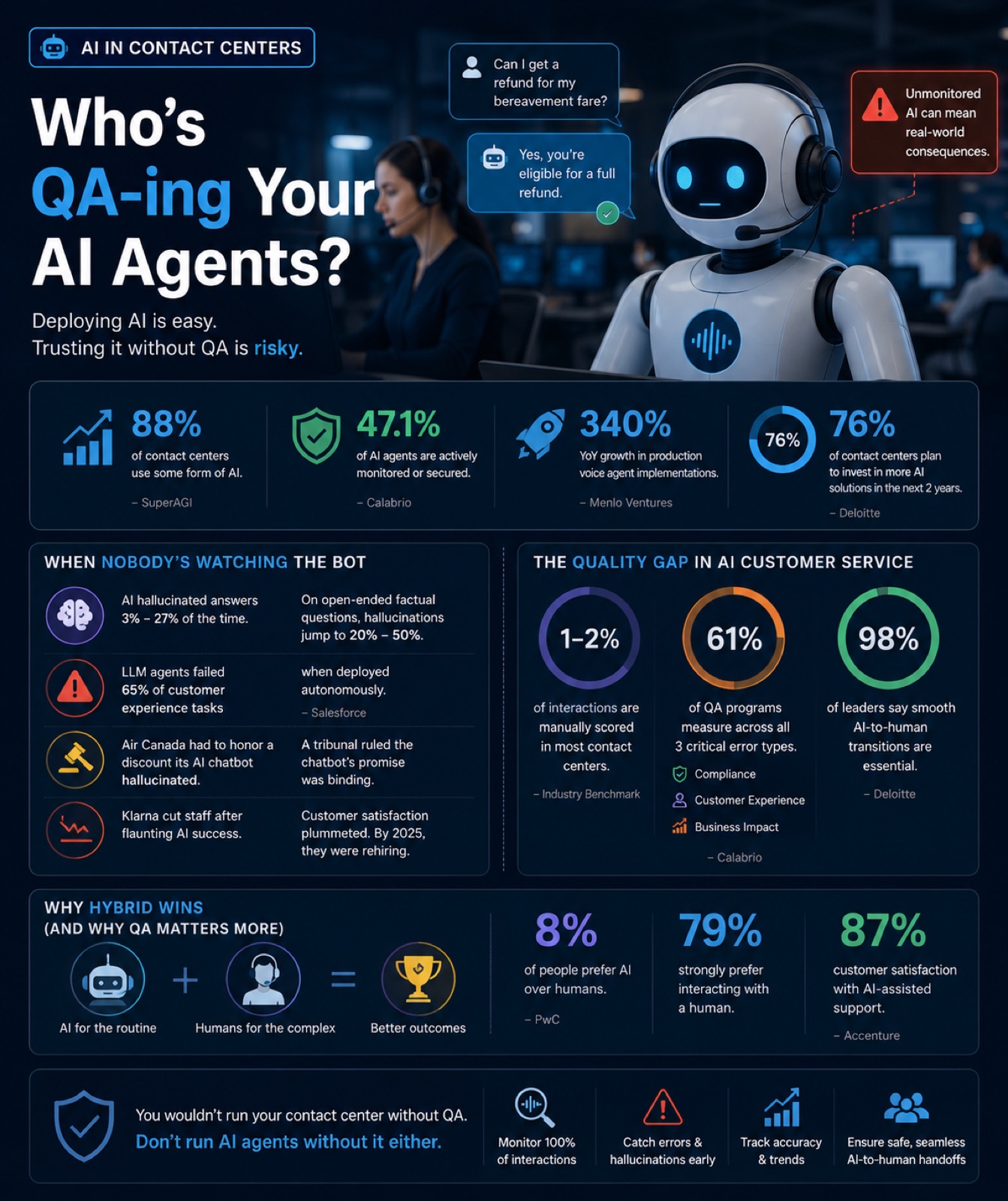
The hallucination tax. 51% of organizations reported at least one negative consequence from AI inaccuracy in 2025, up from 44% the year before. In customer service, the stakes are direct. 85% of customer service leaders say a single unresolved issue is enough to lose a customer. When your bot hallucinates a refund policy or invents a product feature, the remediation cost isn’t just the escalation to a human agent. It’s the customer you lose, the legal exposure from the Air Canada precedent (where courts ruled companies are liable for their chatbot’s errors), and the trust you can’t buy back.
Consumer rejection. Qualtrics’ 2025 study of 20,000 consumers across 14 countries found that 19% who used AI for customer service saw no benefits. That failure rate is almost 4x higher than for AI used in any other task (only 5% saw no benefit elsewhere). Consumers rank AI customer service among the worst applications for convenience, time savings, and usefulness. And 53% cite data misuse as their top concern when companies use AI to automate interactions, up 8 points year over year.
The regulatory boomerang. Gartner predicts that by 2028, regulatory changes ensuring the right to speak with a human will increase assisted service volume by 30%. That means organizations investing heavily in full automation today may face rising human agent demand driven by regulation. More agents needed, not fewer.
What Actually Drives Contact Center Cost Reduction
If automation isn’t the silver bullet, what is? The answer is less exciting than a chatbot demo but far more effective. Real contact center cost reduction comes from three things: reducing attrition, increasing agent productivity, and extracting revenue from conversations you’re already having.
Cut Attrition, Cut the Biggest Cost
When agent turnover stays below 15%, customer satisfaction increases by 26% (Metrigy). But most centers run 30-45%. The gap between where they are and where the data says they should be represents millions in unnecessary replacement costs.
What drives attrition? Not salary. Not workload. Coaching quality. When agents feel like QA is punitive, when feedback arrives two weeks after the call, when the same mistakes get flagged without real development support, people leave. Only 0.6% of contact center budgets go to technology that prevents turnover while 43% goes to labor. That’s like spending all your money on gas but nothing on maintaining the engine.
The shift from manual QA (2-5 calls per agent per month, random selection) to automated quality assurance changes this equation. When you analyze 100% of interactions, you can identify specific coaching opportunities in real time. You can see which agents struggle with objection handling, which ones nail empathy but miss compliance, which ones are avoiding calls. That level of specificity makes coaching actionable and makes agents feel supported instead of surveilled.
Make Every Agent More Productive
The second lever is productivity, and the biggest productivity drain isn’t handling time. It’s after-call work. CRM notes, call summaries, disposition codes, follow-up tasks. Agents spend minutes per call on documentation that is frequently wrong. Our previous analysis covered the revenue implications of this gap.
Auto-generated call summaries that push directly to your CRM save 60-90 seconds per interaction. At 50 calls per agent per day across a 500-seat center, that’s over 400 agent-hours reclaimed every single day. The data quality improvement is the bonus. Accurate CRM records feed better analytics, better lead scoring, better follow-up. The productivity gain compounds.
Beyond documentation, behavior analytics catches invisible productivity drains: call avoidance patterns, excessive hold usage, AHT gaming where agents rush calls to hit metrics while destroying first-call resolution. These patterns are invisible in sample-based QA. At 100% coverage, they’re obvious.
Find Revenue in the Calls You Already Have
Contact centers process thousands of conversations daily. Inside those conversations are signals that never reach a dashboard: cross-sell opportunities mentioned but not captured, churn warnings buried in frustration, product feedback that could reshape a roadmap, competitive intelligence from customers comparing you to alternatives.
McKinsey found that inbound service call centers generated up to 25% of new revenue at some credit card companies and up to 60% at some telecom companies. But 97% of calls go unanalyzed. The revenue signals are there. Nobody’s listening.
Conversation intelligence that extracts topics, sentiment, and intent from every interaction turns the contact center from a cost center into a profit center. Not by automating the agents away, but by making every conversation count.
The ROI math here is different from the automation ROI math. You’re not trying to eliminate labor costs. You’re trying to extract value from labor that’s already happening. The AI cost per resolved ticket is irrelevant when the AI is surfacing a $50,000 cross-sell opportunity that would have been missed entirely.
The Smart Contact Center Cost Reduction Playbook
The organizations getting real results aren’t the ones replacing agents with bots. They’re the ones building an intelligence layer on top of their existing operations.
Here’s what that looks like in practice:
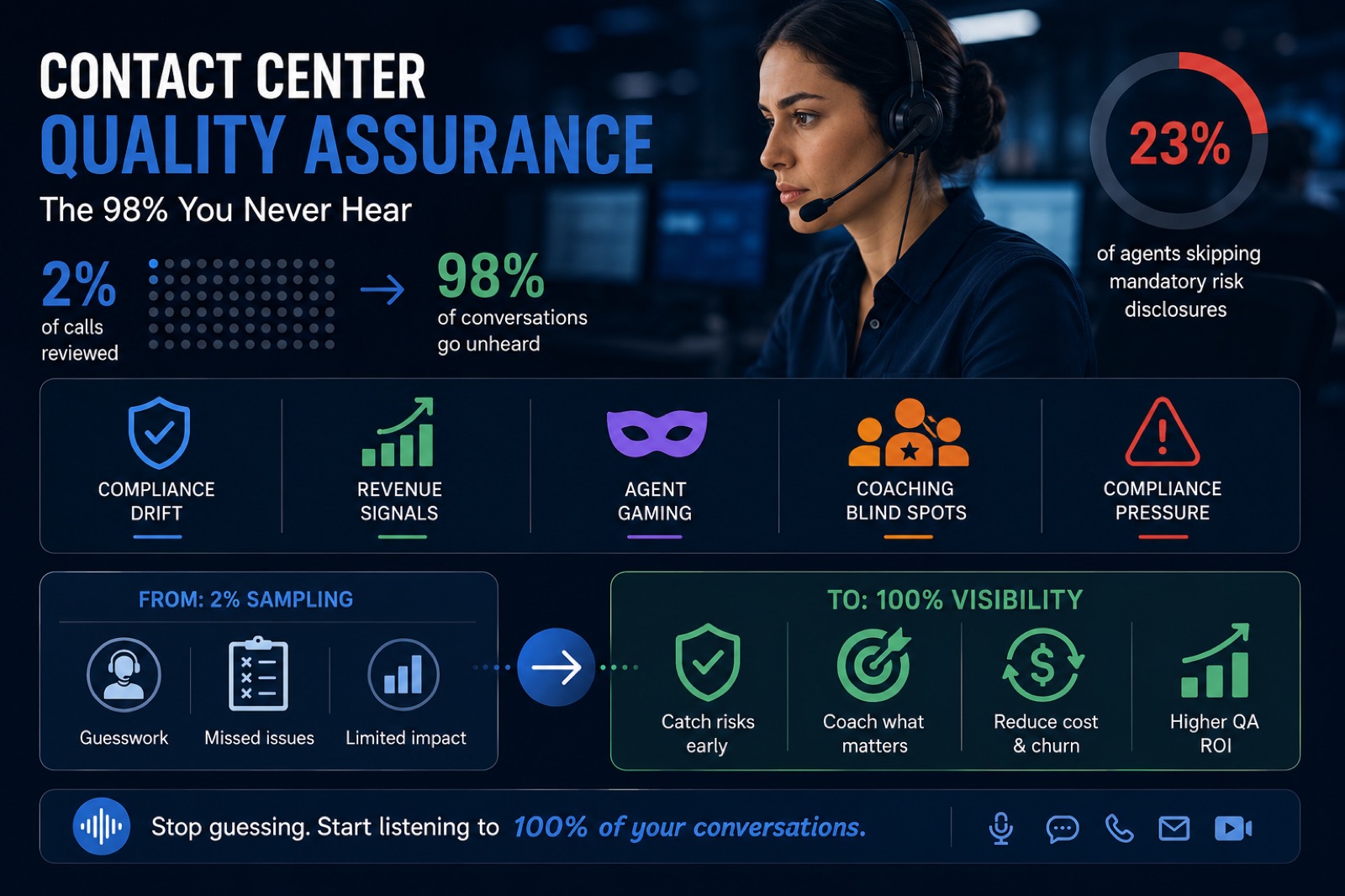
100% conversation analysis instead of 2% sampling. AI-powered QA reviews every conversation instead of a sample. The cost of analyzing every call is a fraction of the cost of missing compliance violations, coaching opportunities, or churn signals in the 98% you never reviewed.
Real-time coaching instead of delayed feedback. When an agent struggles with an objection handling scenario, they get guidance during the call or immediately after. Not in a scheduled one-on-one two weeks later when nobody remembers the context.
Automated documentation instead of manual busywork. Call summaries generated from the actual conversation, not from an agent’s fatigued memory at the end of a shift.
Revenue intelligence instead of cost cutting. Topic extraction, sentiment analysis, and intent detection across all conversations feed product teams, marketing teams, collections teams, and sales teams with data they’ve never had access to.
The cost structure of this approach is fundamentally different from the automation-first playbook. You’re not paying per resolution. You’re not scaling inference costs with every conversation. You’re deploying analysis that gets more valuable as volume increases, because patterns emerge from scale.
What to Do on Monday Morning
If your contact center is chasing AI-driven cost reduction and the numbers aren’t adding up, here’s where to start.
1. Audit your actual AI costs. Not just the platform fee. Include implementation, integration, maintenance, training data, hallucination remediation, and the human escalation cost when AI fails. Compare that total against what you’re actually saving. If the math doesn’t work, you’re not alone. 56% of centers are in the same position.
2. Measure attrition as a cost line. Take your headcount, multiply by your attrition rate, multiply by your per-agent replacement cost ($10K-$35K). That number is probably your single biggest controllable expense. Then ask: what’s our coaching quality score? If you don’t have one, that’s the problem.
3. Move from sample-based to full-coverage QA. The jump from 2% to 100% isn’t incremental. It’s a phase change. Problems that are invisible at 2% become obvious at 100%. Coaching becomes specific. Compliance becomes provable. The cost is lower than most leaders expect.
4. Track revenue signals, not just cost savings. Cross-sell mentions, churn indicators, competitive intelligence, product feedback. If you’re not extracting these from conversations, you’re sitting on a data asset worth more than whatever your chatbot saves on handle time.
5. Budget for the intelligence layer before the automation layer. Understand what’s happening in your conversations before you try to automate them away. Organizations that skip the intelligence step end up automating broken processes, which is how so many end up among the 56% of contact centers not getting the return they expected.
The $80 billion in AI savings may eventually arrive. But for most contact centers, the faster path to cost reduction isn’t waiting for AI to get cheaper. It’s using intelligence to make every human conversation more effective, every coaching session more targeted, and every piece of conversation data a source of revenue instead of an unread recording.
The organizations winning at contact center cost reduction in 2026 aren’t the ones with the most AI. They’re the ones that understand what’s actually happening in their conversations.