Picture a mid-size bank with 47,000 calls a quarter. Its CRM captures summaries for about 12,000 of them. The other 35,000? Gone. Not deleted. Just never analyzed, never scored, never connected to a business outcome. Inside them sit upsell mentions, churn risk signals and compliance gaps that nobody hears.
That bank doesn’t have a “contact center cost problem.” It has a contact center ROI problem. The returns are hiding in plain sight.
Most CC leaders still pitch their budgets as cost reduction stories. Cut AHT by 15 seconds. Reduce headcount by 10%. Deflect 30% of calls to self-service. And the board nods, because that’s the language they expect from a cost center. But McKinsey’s research tells a different story: inbound service call centers generated up to 25% of new revenue at some credit card companies and up to 60% at some telecom operators. The revenue is already flowing through your phone lines. You’re just not measuring it.
Here is where contact center ROI actually comes from.
The Cost Center Trap: Why Contact Center ROI Gets Measured Wrong
The problem starts with how contact centers report to the C-suite. The standard dashboard shows AHT, abandon rate, CSAT, and cost per contact. Every one of those is a cost metric. They tell you how efficiently you’re spending money. None of them tell you how much money the contact center is generating.
This creates a self-fulfilling prophecy. The board sees cost metrics, treats the CC as a cost center, and allocates budget accordingly. DMG Consulting finds that people-related expenses generally account for 55 to 65% of a contact center’s budget, and only 20% is spent on technology. That 20% has to cover everything from telephony and workforce management to quality assurance and analytics. With that kind of investment ratio, little is left for the infrastructure that tracks revenue signals.
Meanwhile, every conversation between your company and a customer contains data that product, marketing, sales, and finance teams would pay to access. But that data lives in audio files and chat logs that nobody reads. 97% of customer interactions go unanalyzed, according to conversation intelligence industry data. The revenue intelligence is there. The extraction pipeline isn’t.
The shift from contact center cost reduction to contact center ROI starts with one question: what are customers actually telling us, and who in the organization needs to hear it?
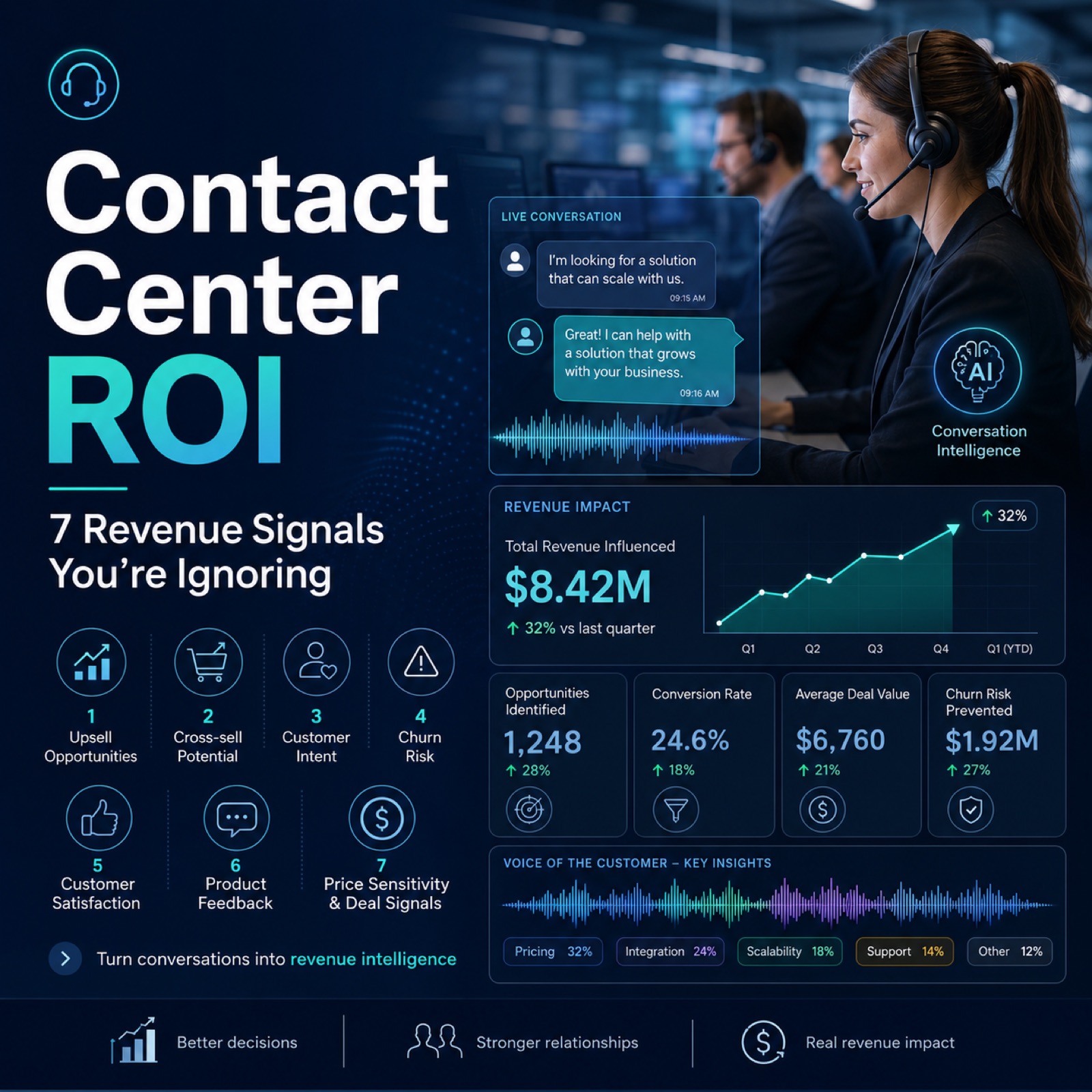
Signal 1: Cross-Sell and Upsell Moments Your Agents Miss
When a customer calls about their current plan, they often signal openness to buying more. “I’ve been thinking about adding coverage for my daughter.” “Is there a version of this that includes international calls?” “My colleague mentioned you have a premium tier.”
Most agents hear these signals. Some act on them. But without conversation analytics tracking these moments across every interaction, you have no idea how many opportunities slip through.
Suppose cross-sell mentions appear in 6-9% of inbound service calls. In a center handling 50,000 calls per month, that’s 3,000-4,500 opportunities. If agents convert even 10% of those into sales, at an average order value of $200, you’re looking at $60,000-$90,000 per month in incremental revenue from a channel most companies treat as pure expense.
The key is detection at scale. A human QA team reviewing 2% of calls will catch a handful of these. Automated speech analytics catches them all and builds a pattern: which products get mentioned most, which agents convert best, and which call flows create the opening.
Signal 2: Churn Warnings That Arrive Before the Cancellation
Customers don’t churn in silence. They warn you. Sometimes for months.
“I’ve been looking at other options.” “Your competitor offered me this.” “I’m just frustrated at this point.” “If this happens one more time, I’m done.”
These phrases get buried in call recordings that nobody listens to. By the time the customer actually cancels, the retention team scrambles with a discount offer that’s too late and too generic.
Conversation intelligence changes the timing. Sentiment analysis across 100% of interactions builds a churn risk score per customer. Not based on a single bad call. Based on patterns: declining satisfaction trend over 3-4 interactions, increased mention of competitors, escalation frequency, unresolved repeat contacts.
Vodafone’s implementation of customer analytics reportedly cut churn by 37% by identifying at-risk accounts earlier. The difference between catching a churn signal 60 days before cancellation versus 6 days is the difference between a proactive save and a desperate discount.
For a company with 100,000 subscribers at $50/month average revenue, reducing annual churn from 18% to 12% saves $3.6 million per year. That’s contact center ROI that shows up directly on the P&L.
Signal 3: Product Feedback Worth Millions That Dies in Call Notes
Your product team reads NPS surveys. They scan support tickets. Maybe they join a customer advisory board call once a quarter. But the richest source of product feedback in the company is the contact center, and it’s almost entirely ignored.
Contact center agents hear the same feature requests, complaints, and workarounds hundreds of times a month. “I wish I could just do this in the app.” “Why does it make me call for something this simple?” “The new update broke my workflow.” These are product signals. They represent demand. And they’re 10x more honest than a survey response because the customer isn’t performing. They’re venting.
Topic extraction and trend analysis across thousands of calls surfaces these patterns. A single product friction point can generate a large share of call volume. If fixing one removes 4,000 contacts a month, at $7 per contact that’s $28,000 monthly in direct cost savings. But the real value is the 4,000 customers who no longer have a reason to be frustrated.
The mechanism is simple: tag every conversation with topics, track topic frequency over time, and route trend reports to product teams weekly. The data already exists. The pipeline to product teams doesn’t.
Signal 4: Compliance Gaps That Cost More Than Revenue Gaps
This isn’t a revenue signal. It’s a revenue protection signal. And it belongs in any honest conversation about the financial returns your contact center generates.
Penalties start per call and scale to millions: the TCPA sets damages of $500 for each unlawful call, and a court can triple that when the violation is willful, and the FCA fined Lloyds Banking Group’s insurers £90.7 million for renewal letters that promised a competitive price nobody had checked. Under the EU AI Act, failing to tell customers they are talking to an AI can cost up to €15 million or 3% of worldwide turnover.
Most compliance teams manually check 50-100 calls per week. In a center handling 10,000 calls per week, that’s a 1% sample. The other 99% are unchecked.
Automated quality management that monitors 100% of interactions for compliance keywords, disclosure scripts, and regulatory requirements doesn’t just catch violations. It proves due diligence. When the regulator asks “how do you ensure compliance across all interactions?” the answer matters. “We sample 1%” is a risk. “We monitor 100% with automated flagging and human review of exceptions” is a defense.
That’s risk reduction that the CFO understands.
Signal 5: Agent Performance Data That Predicts Revenue Outcomes
Not all agents generate equal revenue. This sounds obvious. But most contact centers can’t tell you which agents convert best, which agents save the most at-risk customers, or which agents generate the highest post-call satisfaction scores.
With 100% conversation analysis, these patterns become visible. And they’re surprisingly actionable.
The gap between the top and bottom 20% of agents on cross-sell revenue is usually wide, and it rarely comes from talent. It comes from specific behaviors: asking one additional discovery question, acknowledging the customer’s concern before transitioning to a recommendation, and using the customer’s name during the offer. These are coachable, replicable skills.
The contact center ROI here is twofold. First, you scale what works by turning top performer behaviors into coaching playbooks for everyone else. Second, you connect agent performance management directly to business outcomes instead of process compliance scores that measure whether someone said the right greeting.
When coaching shifts from “did you follow the script?” to “here’s what your top-performing colleagues do differently on retention calls,” agents respond. They see the connection between their behavior and business impact. And that’s also how you build agents who stay.
Signal 6: Lead Quality Intelligence That Marketing Never Gets
Marketing teams measure campaigns by clicks, conversions, and cost per lead. But the quality of those leads only becomes apparent during the sales conversation. And that conversation data almost never flows back to marketing.
Here’s what that looks like in practice. Suppose a fintech runs two parallel campaigns. Campaign A generates 500 inbound calls. Campaign B generates 300. By traditional metrics, Campaign A wins. But conversation analysis shows Campaign A’s callers mostly asking about free trials and pricing (low intent), and Campaign B’s asking about implementation timelines and integration (high intent). Campaign B is the one that converts.
Without conversation intelligence feeding back to marketing, the company would have doubled down on Campaign A. The data to make the right call existed. It was sitting in call recordings.
Connecting inbound call topics and intent signals to active campaign data is one of the highest-ROI uses of speech analytics. It turns the contact center into a real-time campaign effectiveness sensor.
Signal 7: Customer Effort Patterns That Predict Lifetime Value
Gartner’s research established years ago that customer effort is the strongest driver of customer loyalty, or disloyalty. Not satisfaction. Not delight. Effort. The customers who have to call back twice, get transferred three times, and repeat their account number to four different people don’t just leave. They leave and tell 15 others about it.
But most contact centers measure effort with post-call surveys that 8-12% of customers complete. The other 88-92% of effort experiences go untracked.
Conversation intelligence measures effort directly from the interaction data. How many transfers? How many times did the customer repeat information? Was the issue resolved on the first contact or did it take three? What was the sentiment trajectory across the interaction?
Mapping these effort signals to customer segments reveals patterns. High-effort customers in their first 90 days churn at 4x the rate of low-effort customers. Customers who experience two or more high-effort interactions within 30 days have a 67% probability of reducing spend within six months.
That’s predictive intelligence. And it comes from the same call data that’s currently sitting unanalyzed in your recording system.
The Math: What Contact Center ROI Actually Looks Like
Let’s put real numbers on a 200-seat center handling 80,000 calls per month.
Cross-sell/upsell capture: 5% mention rate = 4,000 opportunities. 8% conversion = 320 sales. At $150 average value = $48,000/month incremental revenue.
Churn prevention: 2% of calls flag churn risk = 1,600 at-risk customers identified. 25% successful intervention = 400 saves. At $600 annual customer value = $240,000 annual retained revenue.
Contact reduction from product fixes: Top 3 product issues generating 10% of volume = 8,000 unnecessary calls. Fix 2 of 3 = 5,000 calls eliminated. At $7/contact = $35,000/month savings.
Compliance risk avoidance: Conservative estimate of 1 avoided regulatory event per year = $100,000-500,000 in penalty avoidance.
Agent performance optimization: Top performer behavior replication across 200 agents. 10% improvement in revenue-per-call metrics = variable but typically $200,000-400,000 annually.
Total annual impact: $1.5-2.5 million from a channel that was budgeted as a $4-6 million expense. That’s not cost reduction. That’s a 30-50% offset that transforms how the board sees your operation.
Accenture found that companies treating service as a value center see 3.5x more revenue growth than those that see it entirely as a cost center. The gap isn’t strategy. It’s data infrastructure. Companies that analyze 100% of conversations can see the revenue. Companies sampling 2% can’t.
What to Do This Quarter
If you’re a CC leader who wants to shift from cost center reporting to revenue contribution reporting, here are four steps that don’t require a board presentation or a six-month initiative.
Build one revenue dashboard. Pick the easiest signal to track. Cross-sell mentions are usually the simplest starting point. Show it to your CFO alongside the traditional cost dashboard. The contrast between “we cost $4.2M” and “we cost $4.2M but generated $580K in cross-sell referrals” changes the conversation immediately.
Connect your conversation data to one other team. Product, marketing, or sales. Pick whichever team has the biggest data gap. Route weekly topic trend reports from your conversation analytics platform to their Slack channel. When the VP of Product says “we had no idea customers were asking for that,” you’ve established the contact center as an intelligence source, not just a service desk.
Benchmark your analysis coverage. What percentage of calls does your team actually analyze today? If it’s under 5%, the revenue signals aren’t visible yet. Moving from 2% to 100% with AI-powered quality assurance is the infrastructure investment that makes everything else possible.
Calculate one revenue signal retroactively. Pull three months of call recordings. Run them through conversation analytics. Count the cross-sell mentions, churn warnings, and product feedback themes. Then show leadership: “This was in our data the entire time. We just weren’t looking.”
The contact center industry is at an inflection point. The technology to extract revenue intelligence from every conversation exists today and delivers conversation intelligence ROI within the first quarter. The question is whether your organization will keep treating 97% of its customer conversations as noise, or start treating them as the revenue intelligence goldmine they actually are.