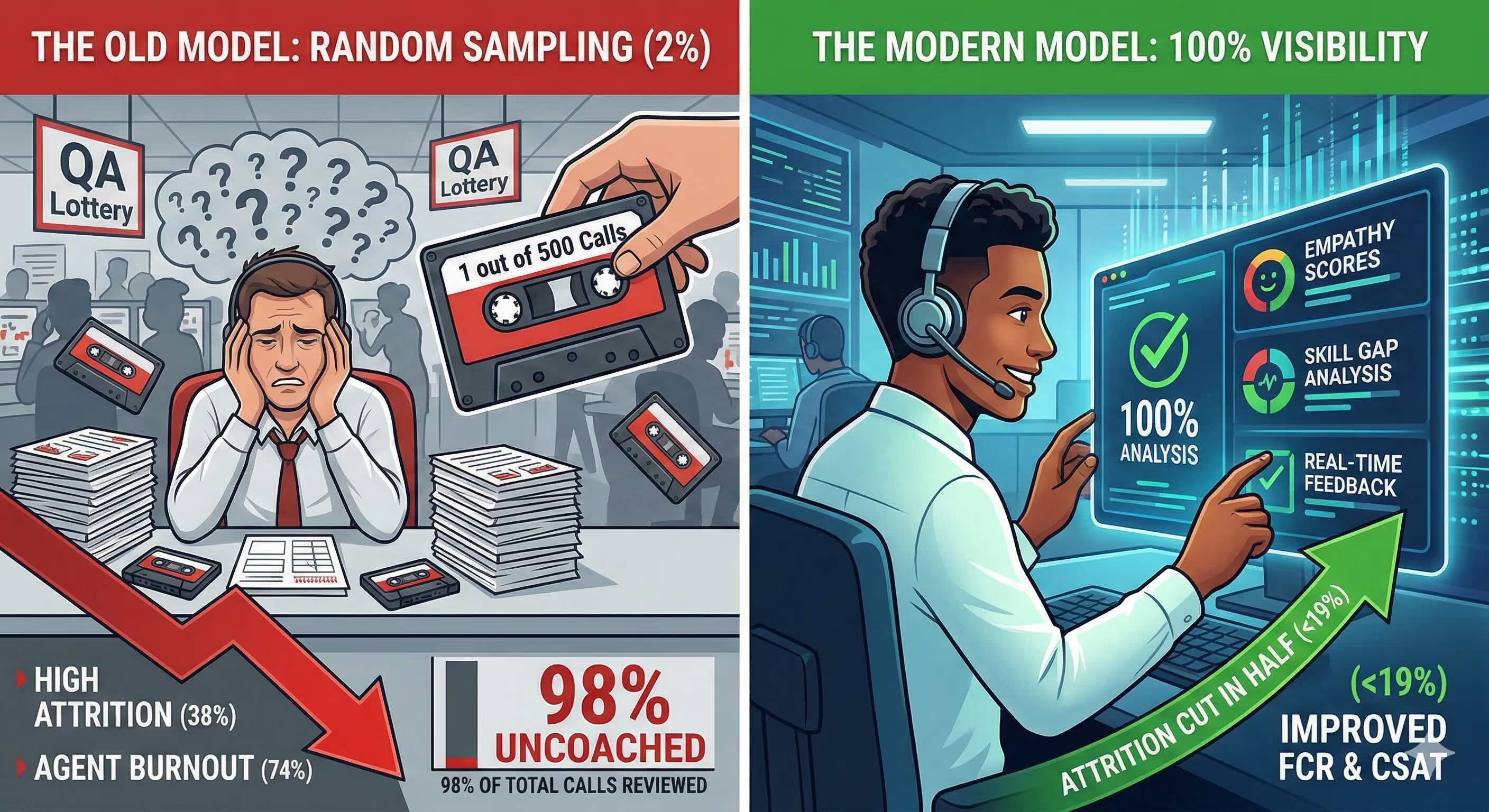
Run the numbers for a 400-seat contact center with 38% annual agent turnover. At roughly $14,000 per replacement once you factor in recruiting, training, lost productivity during ramp-up, and the downstream hit to customer satisfaction, that’s $2.1 million walking out the door every twelve months. The fix isn’t higher salaries. It isn’t pizza Fridays. It’s contact center coaching that’s actually grounded in what agents do on calls, not what a QA analyst thinks they heard on 3 randomly selected recordings.
Here’s the problem: most contact centers still treat coaching as an afterthought bolted onto a broken QA process. And the data on where that leads is brutal.
74% of Agents Are at Risk of Burnout. Contact Center Coaching Is Part of the Reason.
Burnout is the pressure point. Plivo’s 2025 benchmarking report put 74% of agents at risk of it. Salesforce says 56% report actively experiencing it.
But here’s what most CC leaders miss: coaching itself can be a burnout accelerator when it’s done wrong.
Think about how contact center coaching typically works. A QA evaluator listens to 2-5 calls per agent per month. They fill out a scorecard. Two weeks later, the agent sits in a session where someone plays a call they barely remember and tells them what they did wrong. The feedback is stale. The sample is statistically meaningless. And the agent walks away feeling judged, not developed.
Calabrio found that 70% of agents now receive regular coaching and training sessions and 69% say they make a real difference. That’s good news. But “regular coaching” and “effective coaching” aren’t the same thing. When 60% of agents say their training provides no value, according to SymTrain, something is fundamentally broken in how we deliver development.
The gap isn’t effort. It’s data.
The 2% Sampling Problem Poisons Everything Downstream
Most contact centers review 1-3% of total interactions. Let’s be generous and call it 3%. In a center handling 50,000 calls per month, that’s 1,500 calls evaluated. The other 48,500? Nobody heard them. Nobody scored them. Nobody coached on them.
Now imagine you’re an agent who handled 800 calls last month. Your QA team scored 3 of them. One happened to be a rough Monday morning call where your kid was sick and you were distracted. That call becomes “the data” your coaching is built on. The 797 calls where you performed well? Invisible.
This isn’t coaching. It’s a lottery system that randomly assigns praise or punishment.
The downstream effects compound. SQM Group names agent attrition, burnout and turnover among the major barriers to strong first call resolution. Average FCR across industries sits at about 70%. That means 30% of customers call back about the same issue. Every one of those repeat contacts costs money, burns agent time, and erodes customer trust.
When turnover runs at 41.2% annually (the 2022 global average in Gitnux’s market data), you’re constantly cycling in inexperienced agents who haven’t developed the pattern recognition that makes veteran agents effective. You can’t coach your way out of a retention problem when the coaching itself is built on a blind sample.
What Changes When You See 100% of Conversations
The shift from 2% sampling to 100% conversation analysis isn’t just a technology upgrade. It rewrites how coaching works in practice.
The shift is simple to state: when coaches can see everything, they stop looking for mistakes and start finding opportunities.
Here’s the difference. With 2% sampling, a coach walks into a session armed with a single scorecard and a call recording. The dynamic is inherently adversarial. The agent is defending their worst moment.
With 100% analysis, the coach walks in with data across hundreds of interactions. They can show the agent: “Your empathy scores are consistently high on billing calls but drop 40% on technical support calls. Let’s listen to two of each and figure out why.” That’s development. That’s useful. That’s the kind of coaching 69% of agents say actually works.
Three specific things change:
Coaching becomes evidence-based, not anecdotal. Instead of “I think you could improve your greeting,” it’s “Across 400 calls this month, your calls that opened with the customer’s name had 22% higher satisfaction scores than calls that didn’t.” Hard to argue with. Hard to feel attacked by.
Self-coaching becomes possible. When agents have access to their own performance dashboards, scoring trends, and curated playlists of best-practice calls from top performers, they don’t wait for a monthly sit-down. They course-correct in real time. Alpharun’s 2026 industry trends analysis says AI assistance cuts new agents’ ramp time from months to weeks.
Behavior patterns surface before they become problems. Call avoidance, AHT gaming, selective transfers. These are survival behaviors agents develop when they feel unsupported. They’re also invisible at 2% sampling. At 100% coverage, they show up in the data weeks before they’d be caught manually. That gives managers a window to intervene with coaching instead of discipline.
The Business Math: Why CFOs Should Care About Coaching
Contact center leaders struggle to get budget for coaching programs because the ROI isn’t always obvious. Here’s how to make it obvious.
The cost of doing nothing: A 150-agent center running at just 10% annual turnover spends $1.8 million per year on replacement costs alone, per Insignia Resources’ 2025 analysis. Most centers run at 30-45%. Do the multiplication.
The customer impact: QevalPro’s 2025 research found that centers implementing structured agent performance management see 15-25% CSAT improvement within six months and 20-30% reduction in repeat contacts. Repeat contacts are one of the most expensive line items in any CC budget. Cutting them by 20% often pays for the coaching program three times over.
The retention math: When agent turnover stays below 15%, customer satisfaction increases by 26%, according to Metrigy research. Experienced agents resolve issues faster, escalate less, and recognize cross-sell opportunities that rookies miss. McKinsey found that inbound service call centers generated up to 25% of new revenue at some credit card companies and up to 60% at some telecom companies. That depends on agents staying long enough to develop that instinct.
The speed-to-competency argument: If traditional training takes 90 days to produce a competent agent, and AI-assisted coaching brings that down to 2-4 weeks, you’ve recovered roughly 60 days of productive capacity per new hire. In a center hiring 50 agents per year to backfill turnover, that’s 3,000 recovered productive days. At an average loaded cost of $150/day, that’s $450,000 in recovered productivity alone.
One healthcare BPO documented a 12% turnover improvement within three months of implementing AI-powered coaching.
Five Shifts That Separate Modern Contact Center Coaching From the Old Model
Not all coaching transformations require ripping out your tech stack. Some of the highest-impact changes are structural.
1. From random sampling to complete visibility
This is the foundation. Everything else depends on it. If your coaching data comes from 2% of interactions, your coaching program is guessing. AI-powered QA that scores every single call, chat, and email gives coaches the complete picture. At Ender Turing, we process this in any language, because the agent handling Romanian calls deserves the same coaching quality as the agent handling English ones.
2. From delayed feedback to real-time signals
The average gap between a call happening and an agent receiving feedback on it is two to four weeks. By then, the agent has handled 400 more calls and built new habits, good or bad, without any course correction. Real-time scoring and alerts collapse that gap to hours or even minutes.
3. From scorecard policing to skill gap identification
Traditional QA scorecards measure compliance. Did the agent say the required greeting? Did they read the disclaimer? This catches process violations but misses the skills that actually drive outcomes: active listening, de-escalation, empathy calibration, problem-solving speed. Modern conversation analytics detect these softer skills at scale and flag specific development areas per agent.
4. From one-size coaching to personalized development paths
Not every agent struggles with the same thing. A five-year veteran who’s burning out needs different support than a new hire who hasn’t learned the product catalog yet. With 100% visibility into individual performance trends, coaches can build personalized paths. The veteran might need empowerment and autonomy. The new hire might need curated playlists of best-practice calls from top performers in their specific product area.
5. From punitive QA to agent-led development
This is the cultural shift that underpins everything. When agents have dashboards showing their own trends, access to self-coaching tools, and auto-generated CRM summaries that eliminate after-call busywork, the entire QA relationship flips. Agents stop seeing QA as the compliance police and start using it as a growth engine. Calabrio’s data confirms this: 67% of agents now have monthly manager check-ins, up from 49% the previous year. The appetite for development is there. The delivery mechanism needs to catch up.
What to Do About It This Week
If you’re a CC leader reading this, here are five things you can act on before Friday:
Audit your coaching-to-data ratio. How many calls per agent per month does your QA team actually review? If it’s under 10, your coaching program is running on anecdotes. Calculate what percentage of total interactions that represents. Most leaders are surprised by how small the number is.
Calculate your real turnover cost. Don’t just count recruiting and training. Add: productivity loss during ramp-up (typically 60-90 days at 50-70% efficiency), overtime for remaining agents covering gaps, customer satisfaction dip from inexperienced agents handling complex calls, and knowledge loss from departing veterans. The real number is usually 2-3x what HR reports.
Ask five agents what they’d change about coaching. Not in a survey. In a conversation. You’ll hear the same themes: feedback comes too late, it focuses on what went wrong instead of how to improve, and the sample feels unfair. These are solvable problems.
Benchmark your FCR against the 70% industry average. If you’re below it, agent turnover is almost certainly a contributing factor.
Run a pilot. Pick one team of 20-30 agents. Give them access to 100% call analysis, self-coaching dashboards, and real-time feedback for 90 days. Measure turnover, CSAT, and AHT against a control group. The data will make the business case for you.
The contact center industry spends 43% of its budget on labor and 0.6% on technology to retain that labor. The math has never made sense. Modern coaching, built on complete conversation data instead of random sampling, is how you fix it. Not with more pizza. Not with higher pay. With coaching that’s actually worth an agent’s time.