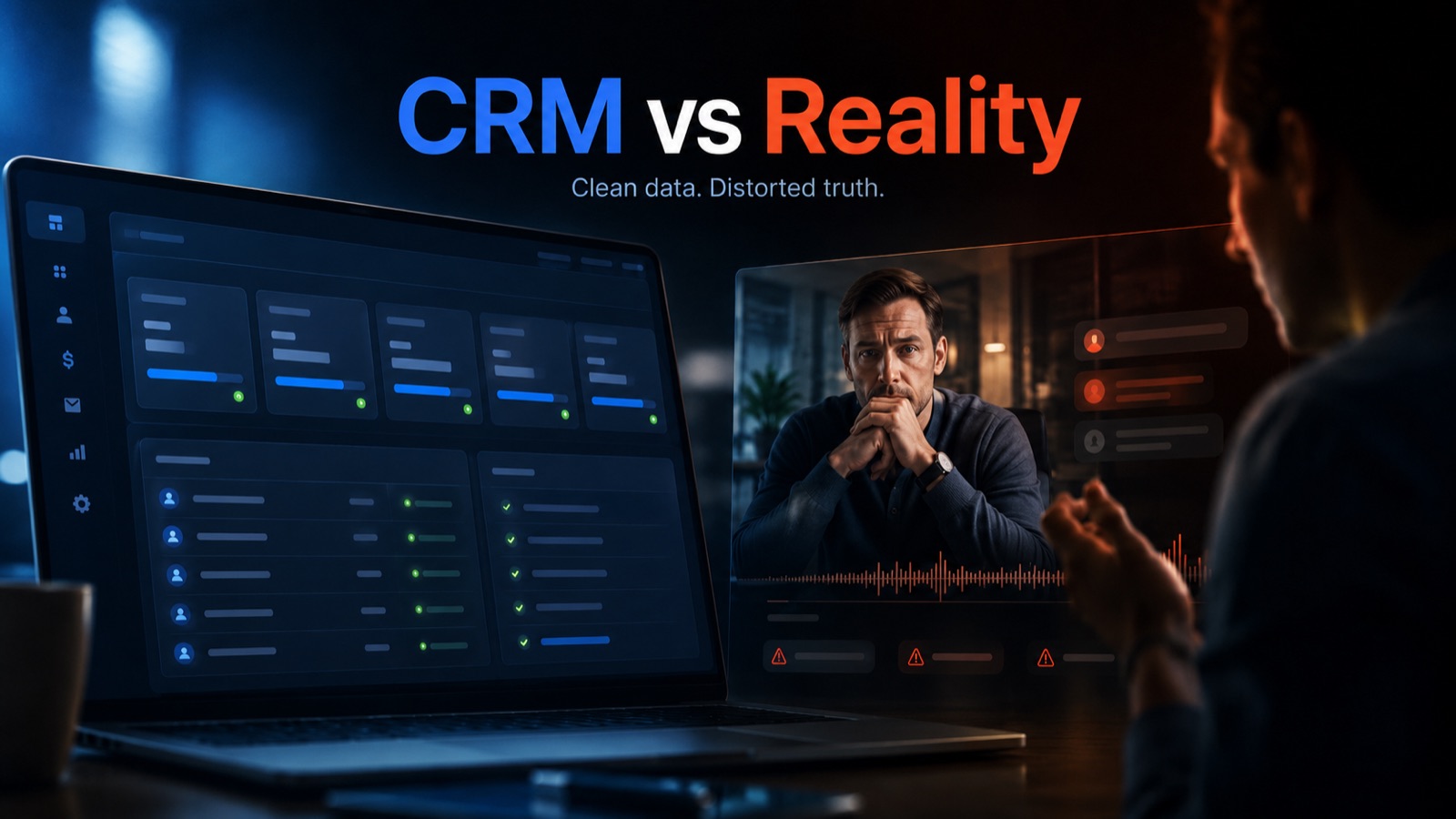
Many speech analytics deployments run a glorified search engine. The platform was sold as “AI-powered conversation intelligence.” The actual production config is a list of 12 banned phrases, 8 compliance triggers, and a daily report nobody reads past Tuesday. The vendor ships a polished dashboard. The buyer ships a renewal. The board still has no idea why churn moved 3 points last quarter.
In many of them, speech analytics is scoped as compliance theater. Coverage is wide: every call transcribed, every transcript indexed. But interpretation is narrow. The platform answers “did the agent say the disclosure” and nothing else. The signal that actually matters (why customers call twice, where deals die, which agents are quietly outperforming the script) goes unused. This post is about why that happens, what it costs, and how to refocus a deployment before the renewal cycle so the platform earns its line item.
How Speech Analytics Got Trapped In Compliance
Conversation intelligence arrived in most contact centers through the compliance door. A regulator fined someone. Legal asked for proof that disclosures were read. Procurement found a vendor. The first config was a keyword list. That config never changed.
The trap is that compliance keyword spotting works just well enough to justify the contract but not well enough to move any number on the executive scorecard. You get a green dashboard that says “98% mini-Miranda compliance” and a quarterly report that gets filed. Meanwhile, McKinsey found that inbound service call centers generated up to 25% of new revenue at some credit card companies and up to 60% at some telecom companies. None of that signal shows up in a keyword report.
The compliance team is happy because audits get easier. Everyone else is paying for software they cannot use. The CFO eventually notices.
What Coverage Without Interpretation Actually Costs
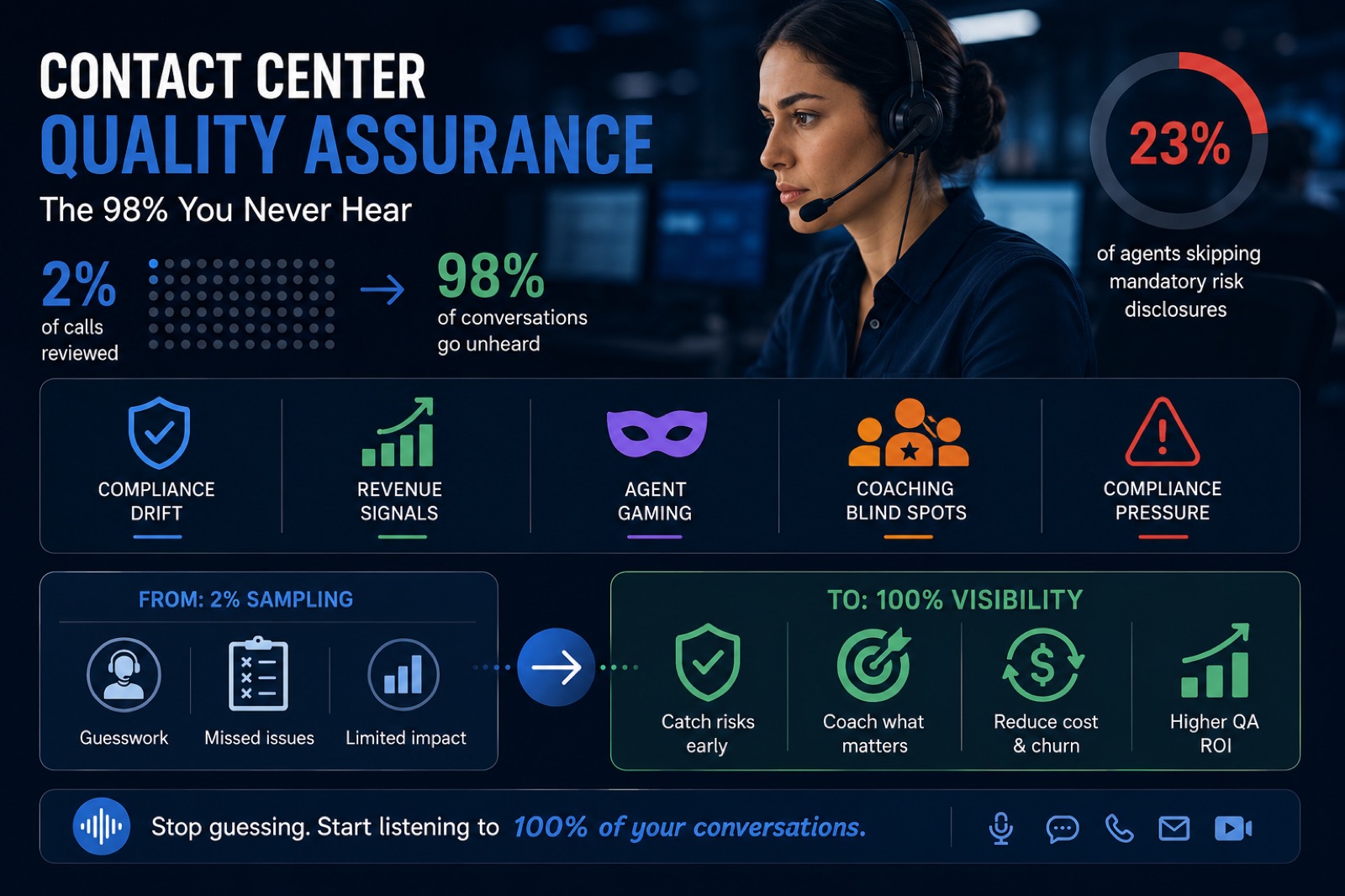
Wide coverage with narrow interpretation is the worst possible economic position. You pay for transcription on 100% of conversations and only act on 2% of the insight. The math gets ugly fast.
A 500-seat contact center handles roughly 2.5 million calls a year. At an average handle time of 6 minutes, that is 15 million minutes of audio. The transcription bill, whether bundled or line-item, covers all of it. The interpretation layer in most deployments looks at maybe 60 keyword hits per day. So roughly 99.999% of the transcribed content sits in cold storage, indexed but unread.
What lives in that cold storage:
- Churn predictors. Forrester found that CX leaders’ revenue growth was 5.1 times that of laggards (2010–2015 data), and most of the leading indicators surface in language patterns (“I’m just tired of explaining this”, “we are looking at other options”) that no keyword list catches.
- Coaching signal. The difference between a top quartile agent and a bottom quartile agent rarely shows up in what they say. It shows up in how they redirect, when they pause, whether they repeat what the customer just said. None of that is a keyword.
- Process failure. A customer saying “this is the third time I’ve called about this” is a workflow defect. A keyword search for “third time” misses 80% of the variants (“I called yesterday”, “told the last person”, “your colleague said”). Pattern detection catches them all.
This is the gap. The platforms can read 100% of calls. Most are configured to read 2%. The other 98% is the 100% call monitoring opportunity that compliance scoping leaves on the table.
The Three Capabilities That Separate Searching From Seeing
A speech analytics deployment earns its keep when three capabilities are turned on. Most deployments turn on one.
Topic modeling, not keyword matching. Topic models cluster what customers are calling about regardless of phrasing. “My card is broken”, “the chip doesn’t work”, “the reader won’t read it”, and “POS failure” all roll into one operational signal. Keyword lists fragment that signal across 40 different reports nobody reconciles. It is common to find centers with three separate dashboards tracking different vocabulary for the same underlying issue.
Emotion and sentiment scoring tied to outcomes. Sentiment scores in isolation are noise. A customer can sound frustrated and still resolve happily. Sentiment scoring becomes valuable when it is joined to the outcome variable: did the call resolve, did the customer churn within 90 days, did the deal close. That join is where the platform stops being a compliance tool and starts being a churn predictor.
Agent behavior pattern detection. Top performers do not say different things. They do them differently. They acknowledge before they explain. They confirm understanding twice. They name the customer’s emotion. None of that lives in a transcript search. It lives in turn-taking patterns, in pause distributions, in the ratio of customer talk time to agent talk time. Automated QA that surfaces these patterns lets coaching scale past the 2-5 calls per agent per month that manual review can sustain.
A deployment running all three capabilities behaves like an intelligence platform. A deployment running only the first looks like a search bar. The price tag is the same. The business impact is not.
What “Use The Audio, Not Just The Transcript” Actually Means
Here is a piece of nuance most procurement teams miss. A lot of platforms claim to do conversation intelligence but only operate on the transcript. Once the audio becomes text, the prosody is gone. The rising tone of frustration, the pause that means “I am about to give up”, the overlap that means the customer interrupted. Transcript-only platforms throw all of that away in the first 30 seconds of processing.
That matters because the highest-value signal in a contact center conversation often is not in the words. It is in the audio. Conversation analytics models that use acoustic features alongside lexical ones can detect frustration that a transcript alone misses.
This is also where in-house ASR matters. Generic speech-to-text engines are tuned on news audio and podcast recordings. Contact center audio is different: compressed, noisy, with overlapping speakers, domain jargon, and accents that vary by deployment. We build our own ASR at Ender Turing because third-party engines benchmarked on clean audio fall short on real contact center calls. That gap compounds through every downstream model. Better audio in, better signal out.
You do not need to insist on in-house ASR. You do need to ask the vendor what their accuracy is on your audio, not their demo audio. Most won’t run that test. The ones who do are the ones worth the contract.
Five Speech Analytics Fixes Before Your Next Renewal
If you have a speech analytics deployment that feels like a sunk cost, here is an audit worth running. It takes a week, costs nothing, and usually reframes the conversation with the vendor.
- List what your platform actually reports on this week. Be specific. Count the dashboards, count the alerts, count the people who look at them. If the list is shorter than 10 items, you are running keyword spotting, not analytics.
- Ask your QA team what they wish they could see. The answer will not be “more keywords.” It will be “why repeat callers keep coming back” or “which coaches actually move scores” or “who is gaming AHT.” Those are topic models, outcome joins, and behavior patterns, not searches.
- Run one accuracy test on your own audio. Pull 100 real calls. Have the vendor transcribe them. Have a human score the transcript. If word error rate is above 15%, every downstream model is operating with broken inputs. Renegotiate.
- Pick one revenue or retention metric and wire it backward. Churn within 90 days. Upsell conversion. First call resolution. Pick one. Tag every call with that outcome. Let the platform tell you which conversation features predict it. This is where the platform becomes a business tool instead of a compliance tool.
- Pilot one automated QA scorecard that grades 100% of calls. Compare its rankings to your current 2% manual sample. If the AI catches issues your sample misses, you have your case for expanding coverage.
This is the discipline. Stop asking what your platform finds. Start asking what business question it answers. If the answer is only “are agents reading the disclosure,” you have a $200K compliance tool. If the answer is “where is revenue leaking and how do we coach to it,” you have an intelligence platform. Same software in most cases. Different scope, different ROI, different renewal conversation.
The contact centers that win the next two years are not the ones with the fanciest dashboard. They are the ones that stopped scoping speech analytics as a search engine and started using it as a microscope on the 100% of conversations that already happened. The platform is already paid for. The audio is already captured. The interpretation layer is the cheapest upgrade in the building.