Take 12 weeks of routing data from a contact center running a mature AI customer service deployment. AI handles a share of contacts to full resolution. Beyond that share, resolution rates tend to collapse. Not gradually. A cliff.
The industry keeps selling containment rates like they’re monotonically improving. They aren’t. Deployments tend to hit a ceiling, and the shape of the failure is familiar: the AI holds the customer for minutes, produces a response that doesn’t fit, and hands off a person who is now angrier than if they’d waited in queue from the start. This is the complexity cliff. It’s real, it’s structural, and most CX roadmaps still budget as if the cliff doesn’t exist.
Why AI Customer Service Hits a Structural Ceiling
The reflex is to blame the model. Better prompts, more training data, a newer LLM. Some teams cycle through vendor after vendor chasing a few more points of resolution. It doesn’t work, because the cliff isn’t a model quality problem. It’s an information-availability problem.
AI customer service handles well what has three characteristics: the question is bounded, the answer is in one system, and the customer already knows what they’re asking for. Password resets. Order status. Balance inquiries. Shipment tracking. This is the work below the cliff. Every eligible query in this bucket can be resolved cleanly because all three conditions hold.
Above that line, at least one condition breaks. The question isn’t bounded (“my invoice looks wrong” — wrong how?). The answer requires stitching three systems together (billing, CRM, product usage). Or the customer doesn’t actually know what they need. They know they’re frustrated and want someone to figure it out. Language models are extraordinary at pattern matching. They are ordinary at diagnosis under uncertainty. The gap between those two skills is the cliff.
Companies don’t fail at AI customer service because the models are bad. They fail because they budgeted for 80% containment and got the cliff.
AI Customer Service Resolution by Contact Type
Break resolution down by contact type, and the cliff comes into view:
- Simple transactional (order status, balance, hours): The AI is genuinely better than a human here. Faster, no queue, no misroute.
- Account changes with single-system writes (update address, cancel subscription): Still strong. Failure mode is usually authentication or edge-case exceptions.
- Billing disputes: This is where the cliff starts. The AI can look up the charge but can’t reason about intent, promotional overlaps, or partial credits.
- Multi-system troubleshooting (why isn’t my service working): AI can walk the customer through the top three fixes. The rest need a human who can see the whole environment.
- Emotional or high-stakes calls (fraud, medical, complaints, cancellations with retention potential): The AI can gather information. It cannot save the account.
The blended average across all contact types is a ceiling, not a starting point. Every further point of resolution costs more than the last, because you’re now trying to solve problems the technology wasn’t designed for.
The math nobody likes: your remaining agents now handle every contact the AI couldn’t resolve, all of them harder, at longer handle times, with 30% less overall headcount because the AI ROI case assumed it. That’s not a productivity gain. That’s a burnout machine.
Why the Standard Response Makes It Worse
The standard response to the cliff is to push the AI harder into complex work. Chain more tools, add more knowledge bases, extend the conversation before handoff. Every one of those decisions makes the cliff worse, not better.
Longer AI attempts mean angrier handoffs. A customer handed off quickly arrives with the sentiment they started with. A customer handed off after several minutes of AI back-and-forth tends to arrive angrier, before the human even says hello. The AI didn’t fail politely. It burned trust, and the agent inherits the debt.
More tools mean more hallucination surface area. A model wired to twelve backend systems has twelve places to confidently produce wrong numbers. Picture an AI that cites a customer’s balance to two decimal places, pulled from a stale cache that hasn’t refreshed in 8 hours. The customer makes a payment based on that number, and the chargeback takes weeks to resolve.
Extended AI conversations kill the human’s context. When a human agent receives a transcript of 6 minutes of AI back-and-forth, they don’t read it. They skim it, miss the actual issue, and ask the customer to explain again. This is the “start over tax,” the reason customers now say things like “just transfer me to a person” as their first sentence. They’ve learned that AI containment attempts are pure friction cost.
The correct response to the cliff isn’t to make the AI try harder. It’s to make the handoff earlier, cleaner, and richer with context. This is where most roadmaps are still misaligned.
What Actually Works Above the Cliff
Companies that have accepted the cliff and designed around it show a different pattern. Five behaviors set them apart:
1. Aggressive early handoff triggers. Route to a human at the first signal of complexity: sentiment drops, second clarifying question fails, or the query touches more than one system. Don’t let the AI grind. Every extra AI turn past the failure point burns trust exponentially, not linearly.
2. Full-context transfers. The human doesn’t get a transcript. They get a structured summary: what the customer asked, what the AI tried, what data the AI pulled, what the customer’s stated frustration level is. This is the difference between a 30-second recovery and a 3-minute re-diagnosis. Auto-generated summaries make this economically feasible; a person can’t write summaries fast enough at scale, but a well-configured model can. That is the job of automated call summarization.
3. Quality monitoring across both surfaces. The AI’s conversations get scored on the same rubric as the human’s: clarity, resolution, empathy, compliance. This is not optional. Without it, the AI could be losing customers at scale and nobody would see it until churn showed up 90 days later. AI QA for voice bots is table stakes now, not a nice-to-have.
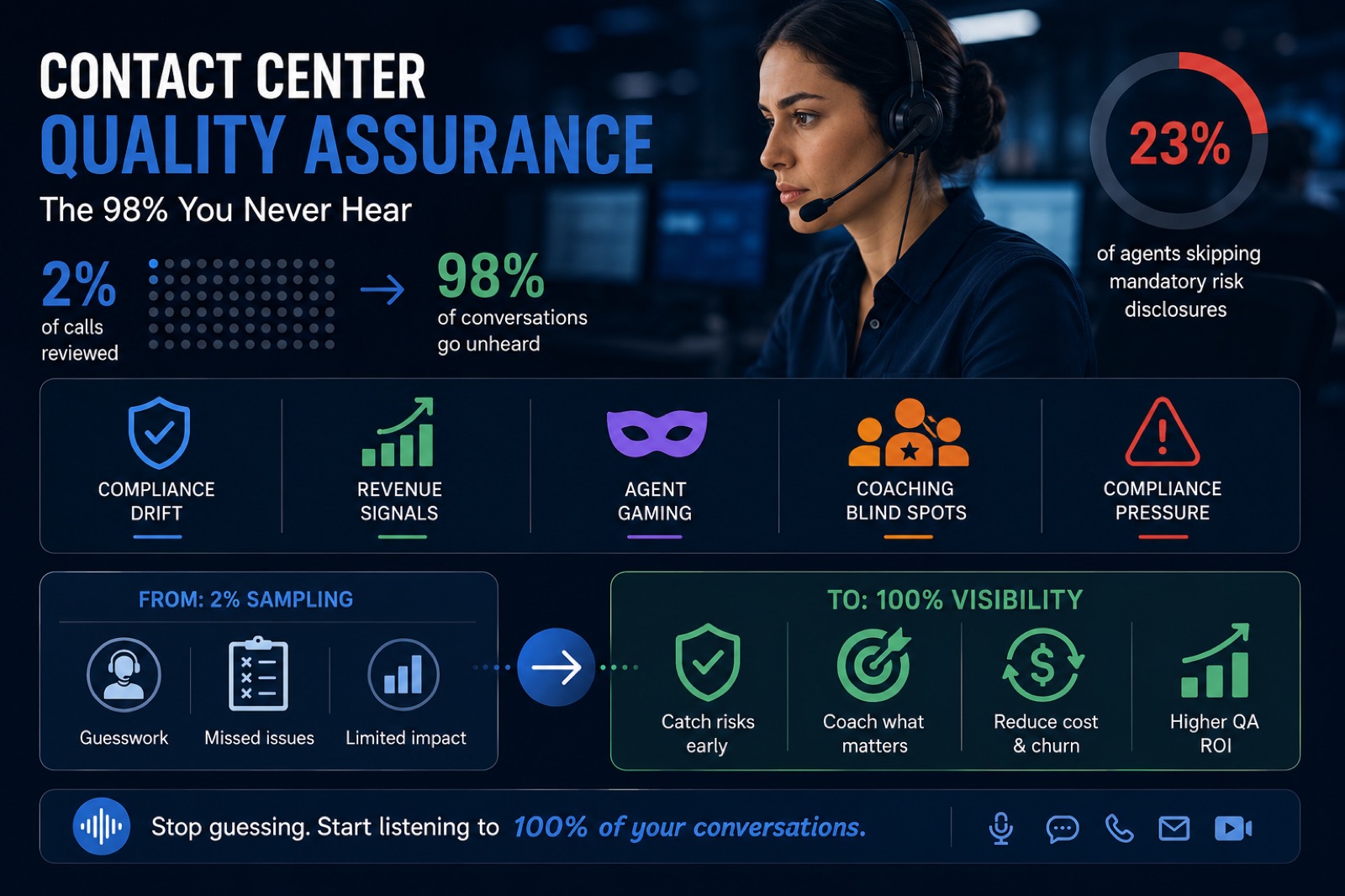
4. Complexity-tier staffing. The remaining humans are not the same humans you had before. Tier 1 disappears; the surviving agent pool needs to handle what used to be Tier 2 and 3. Salary bands go up. Training investment goes up. The agent coaching problem inverts: instead of coaching quantity (handle time, adherence), you’re coaching quality on rare, high-stakes calls where a single mistake costs the account. The old QA sampling model (reviewing 2-5 calls per agent per month) becomes actively dangerous. You need to see everything, because every call now matters.
5. Honest reporting up the chain. The CFO who signed the AI deal was told containment would hit 80%. When it hits the cliff instead, someone has to say that. The centers that adjust successfully are the ones that report the cliff early, reset the model, and re-scope the ROI case around what actually works. The ones that don’t spend the next 18 months chasing phantom containment gains and losing customers.
The Uncomfortable Strategic Question
If AI plateaus at the cliff, and everything above it is harder, higher-stakes, and more expensive per contact, is the AI investment still worth it?
The answer is yes, but only if you understand what you bought. You didn’t buy 80% containment. You bought a triage layer that handles the easy work well and creates space for humans to do the hard work with more attention. That’s still valuable. The contacts that resolve in AI are contacts that used to consume agent time. Freeing that time is real ROI.
But you didn’t buy a headcount replacement. You bought a headcount reshaping. If your business case assumed cutting the CC by 50%, that case was wrong. If it assumed cutting Tier 1 and reinvesting in fewer, better-paid, better-trained agents who handle only complexity, that case can work.
The companies that will win this next phase of customer communication are the ones running the honest math. Not “AI replaces agents.” Not “AI handles everything.” A blend: AI handles the bounded, single-system, customer-knows-what-they-want work. Humans handle the diagnosis, the emotion, and the cross-system stitching. Both surfaces get monitored, coached, and improved with the same rigor. The cliff stops being a problem when you design for it instead of pretending it isn’t there.
What To Do This Week
- Pull your last 30 days of AI containment data by contact type, not aggregate. Aggregate numbers hide the cliff. Break it down by intent category and you’ll see where the ceiling actually is.
- Measure sentiment at handoff, not just at close. If handoffs are landing angrier than cold starts, your AI is losing time and trust before the human ever engages. Shorten the trigger.
- Audit 20 AI-only conversations against your human QA rubric. Score them the same way you score agents. You will find gaps that aren’t showing up in any dashboard.
- Rebuild the handoff payload. If your agents receive a raw transcript, they’re re-diagnosing every call. Move to a structured summary with intent, attempted resolution, customer sentiment, and next best action.
- Reset the ROI case with real containment. Take your actual measured containment rate (not the vendor projection), rework the labor and quality math, and share it up. The board would rather hear a corrected number now than a churn number in six months.
The complexity cliff isn’t a bug in your AI deployment. It’s the shape of the problem. The centers that accept that shape and design around it will outperform the ones still promising the executive team an 80% number that isn’t coming.