Picture a senior agent at a lender who resigned on a Tuesday. She had the highest first-contact resolution on her team for eleven straight months. The exit notes ran four lines: strong performer, good attitude, leaving for a hybrid role closer to home. Nobody wrote down what she actually did on a call that the other nineteen people on her floor did not do. Contact center coaching in most organizations has no mechanism for capturing that. Her scorecard recorded whether she followed the script. It never recorded the part where she stopped following it, which was the part that worked.
This happens in every center, several times a year, and it never shows up in a budget line.
The Scorecard Was Built to Catch Violations, Not to Find Method
Quality scorecards were designed for a compliance era. Did the agent use the approved greeting? Did they verify identity in the first thirty seconds? Did they read the disclosure? Every item is binary and every item is a rule the agent can break. That design is good at one job: finding the agent who is doing something wrong.
It is structurally incapable of the opposite job. A scorecard cannot tell you what a great agent did that was never on the form. There is no checkbox for "reset the customer's expectation about the refund timeline before they asked, which prevented the second call." There is no field for the specific four-word phrase that stops an escalation demand cold. Those behaviors score the same as everyone else's, because the form has nothing to score them with.
So the top performer's number looks good. Her CSAT is high, her repeat-contact rate is low, her handle time is unremarkable. Managers can see that she is better. They cannot see how she is better, and "how" is the only part that transfers to anyone else.
Ask a QA Director to name the single most effective de-escalation technique currently in use on their own floor. Most cannot answer, not because they are inattentive, but because the system they run was never built to surface that answer.
What Contact Center Coaching Loses When Someone Resigns
The standard replacement cost model puts an agent exit at $10,000 to $20,000, a range McKinsey ties to an organization’s geography, employee tenure and the training the role requires. A 1,000-seat operation running at 40% attrition burns roughly $4 million to $8 million a year on that math alone.
That model treats every departing agent as interchangeable. Replace a body, absorb a cost, move on.
It is wrong at the top of the distribution. When a bottom-quartile agent leaves, the operation loses a seat. When a top-decile agent leaves, the operation loses a seat plus a method that existed nowhere except in that person's voice, on recordings nobody will ever listen to again. The seat gets refilled in six weeks. The method does not come back at all.
Try to price it. If one agent resolves a particular complaint type in a single contact and the team average takes 2.4 contacts, and that complaint type runs 400 times a month, her approach was worth roughly 560 avoided interactions per month. At a loaded cost of $6 per contact, that is about $3,400 monthly, or $40,000 a year, from one behavior on one intent from one person. None of that appears in the $10,000 to $20,000 figure.
Multiply across the eight or ten people in a 500-seat center who are genuinely exceptional, and the undocumented-method loss plausibly exceeds the entire recruiting budget. No finance team tracks it, because the loss is invisible by construction.
The Numbers Nobody Puts in the Attrition Model
Three facts sit next to each other and almost nobody in the industry puts them in the same sentence.
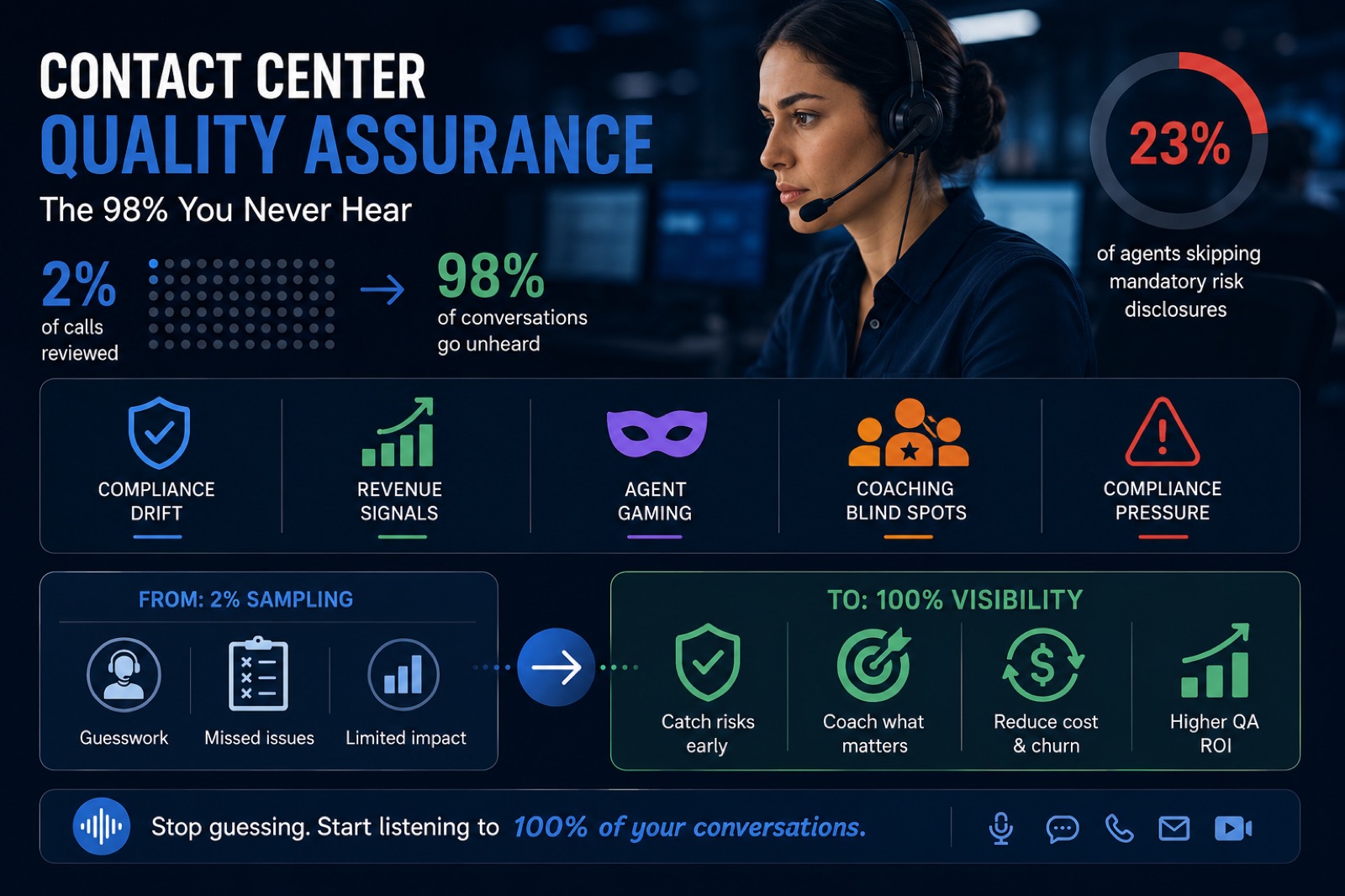
- 80% of contact centers still rely on manual call monitoring, reviewing 2 to 5 calls per agent per month. Call that 2% coverage on a generous day.
- Human QA scoring is 60% to 75% reliable, meaning two evaluators grading the same call disagree with each other often enough that the score is closer to an opinion than a measurement. Automated scoring lands at 90% to 95% consistency.
- Annual turnover runs 30% to 45% across the industry, and Metrigy research found that when agent turnover stays below 15%, customer satisfaction increases by 26%.
Put them together and the picture is bleak in a specific way. You are sampling 2% of the evidence, grading that 2% with a process that disagrees with itself a quarter of the time, and losing roughly a third of your people every year. Any method a great agent develops has to survive that gauntlet to get noticed. Almost none do.
There is a fourth number that explains why this persists. Centers spend about 43% of budget on agent labor and roughly 0.6% on technology intended to reduce turnover. The industry buys the thing it loses and barely invests in keeping it, or in capturing what it knows.
Why Contact Center Coaching Programs Lift the Bottom and Ignore the Top
Walk into any coaching session and watch who gets attention. It goes to the agent whose scores dropped, the agent who failed a compliance check, the new hire struggling in week six. That is rational triage. The bottom of the distribution has the most obvious room to improve and the most immediate risk.
But it produces a strange outcome. Coaching content comes from the training deck, and the training deck comes from what management believed was best practice at the time it was written, usually by people who left the floor years ago. The actual best practice is out on the floor right now, being performed by a handful of people, and it never travels upward into the material.
We disagree with the conventional wisdom that coaching is primarily a remediation function. Remediation raises the floor a little. Method transfer raises the whole distribution, and it costs nothing to acquire because you already own the recordings.
The other reason the top gets ignored: nobody wants to ask a high performer to explain themselves, and when you do ask, the answer is usually unhelpful. "I just talk to them like a person." That is not a coachable instruction. The behavior is real but the agent has no introspective access to it. She cannot tell you that she sets a specific expectation at second 40 of every billing dispute call, because she does not know she does it. Only the transcript knows.
How to Capture the Method Before the Method Resigns
This is a measurement problem before it is a coaching problem, and it is solvable with the recordings already sitting in your archive.
Define top performance on outcomes, not on scorecard
Rank agents by first-contact resolution and repeat-contact rate within a single intent category, not by QA score. QA score measures conformity; you are hunting for productive non-conformity. Run the ranking per intent, because the person who is best at retention saves is rarely the same person who is best at technical troubleshooting.
Analyze 100% of their conversations, not a sample
A behavior that appears in 30% of a top agent's calls will show up maybe once in a 3-call monthly sample, and a single instance looks like noise. It only reads as a pattern across hundreds of calls. This is the practical argument for automated quality assurance over manual review: not that it is faster, but that pattern detection is impossible at 2% coverage. Conversation analytics applied across the full volume turns an anecdote into a documented technique.
Extract the mechanics, not the vibe
What you want out of the analysis is concrete: at what point in the call does she state the resolution timeline, does she name the next step before or after the apology, what does she say in the eight seconds after a customer threatens to cancel.
Test the transfer before you roll it out
Give the extracted behavior to four mid-performers, hold everyone else as a control, and measure the same outcome metric for six weeks. Roughly half of what looks like a top-performer technique is actually a top-performer trait and will not transfer. Finding that out on four people is cheap. Finding it out after a floor-wide training day is not.
Put the real examples into the coaching library
Agent performance management improves when the reference material is a clip of a colleague on your own floor handling your own products, rather than a scripted role-play recorded by a vendor in 2019. Agents treat the first as evidence and the second as theater.
What to Do Monday
Five things, all doable inside two weeks, none requiring new budget approval.
- Pull last quarter's data and rank agents by first-contact resolution within your three highest-volume intents. Do not use QA score. Expect the list to differ from your official top performers list, and treat that difference as the finding.
- Pick your single best agent on the highest-volume intent and have someone listen to 20 of their calls end to end. Not score them. Listen for what they do that is not on the form. Write down verbatim phrasing.
- Check your own exit process for a knowledge-capture step. Almost certainly there is none. Add one for anyone in the top decile: a structured 45-minute recorded conversation about how they handle the three hardest call types.
- Calculate your own undocumented-method exposure. Count how many top-decile agents left in the past 12 months. That is the number of methods you no longer have.
- Set one measurable target. Metrigy’s 15% attrition threshold is the useful line, since CSAT gains appear below it. If you are at 35%, the first milestone is 25%, and method transfer is one of the few levers that improves performance and retention at the same time, because agents who are coached with real material report the training as useful instead of performative.
The lender that lost the agent on Tuesday still has every one of her calls on disk. Eleven months of the best first-contact resolution on the floor, fully recorded, entirely unexamined. The method did not leave the building. Nobody went looking for it.
Related reading: customer service improvement and the reputation drag, and the rest of our writing on contact center operations.
Sources: McKinsey, “Customer care: The future talent factory”, Metrigy on contact center turnover, SQM Group FCR benchmark 2024