Picture a contact center director whose bot now contains 46% of contacts. Her CSAT is up. Her cost per contact is down. And her new-hire washout rate is climbing. Nobody on her leadership team connects those facts until she puts them on the same slide.
This is the part of hybrid AI customer service that nobody put in the business case. The easy calls were never just cheap volume. They were the training ground. Password resets, balance inquiries, order status: that was where a nervous 23-year-old learned to hear a customer’s tone, navigate four systems at once, and build the muscle memory that makes a hard call survivable. Automate 100% of that away and you have not removed low-value work. You have removed the on-ramp.
The industry is about to discover that it deleted its own apprenticeship, and it will discover this through attrition numbers, not through strategy decks.
Hybrid AI Customer Service Removed the Practice Field
Walk any contact center floor in 2022 and watch a new hire’s first month. Weeks one and two were classroom. Week three they took live contacts under a supervisor’s eye. Those contacts were deliberately easy. Not because anyone designed it that way, but because 60% of inbound volume was easy, so a randomly routed queue handed the rookie a gentle mix by default.
The rookie got maybe 300 contacts in that first month. Roughly 200 of them were simple. Those 200 taught pace, tooling, and phrasing at low stakes. The 100 harder ones taught judgment, and the rookie could afford to fumble them because the easy ones had already built confidence.
Now route that same rookie into a center where the bot contains 46% of volume. The queue that reaches humans is pre-filtered for difficulty. Every contact is one the AI could not resolve: an angry escalation, a policy exception, a multi-system billing dispute, or a customer who has already spent four minutes failing with the bot and arrives hot. The rookie’s first 300 contacts are now 300 hard ones.
Nobody planned this. It is a second-order effect of a first-order decision, and second-order effects do not show up in vendor ROI calculators.
The Data: What Happens When Tier One Disappears
Start with what we already know about the economics. Annual agent turnover in this industry runs 30% to 45%. Replacement cost per agent sits between $10,000 and $20,000 by McKinsey’s estimate. At a 1,000-seat center running 40% attrition, that is $4 million to $8 million a year walking out the door before you count the productivity gap of a floor that is perpetually one-third undertrained.
Now layer in the containment shift. When AI handles the simple 40-60%, handle time on the remaining human contacts rises 2 to 3x. That number gets quoted as an efficiency footnote. It is actually a difficulty measurement. Longer handle time on a filtered queue means the average human contact is structurally harder than it was three years ago.
Metrigy’s research found that when agent turnover stays below 15%, customer satisfaction increases by 26%. The causality runs both directions, and the mechanism matters: tenured agents handle hard contacts better, and centers that keep agents accumulate the tenure that hard contacts require. Which is precisely the resource that a filtered queue burns fastest.
Here is the compounding problem. COPC reports that 79% of organizations now use AI in customer care, while 56% of contact centers are not realizing the return they expected from it. Most operators are running AI containment without running the surrounding measurement. They can see that containment went up. They cannot see that their new-hire survival curve collapsed, because nobody instrumented the relationship.
Why the Old Onboarding Model Cannot Survive This
The traditional ramp assumed a difficulty gradient that the queue supplied for free. Take easy contacts, build speed. Take medium contacts, build judgment. Take hard contacts, build expertise. Six months to proficiency, and the queue did most of the teaching.
That gradient is gone. AI customer service ate the bottom of it. What is left is a cliff, and training departments are still running curricula designed for a slope.
Three assumptions in the standard onboarding model are now wrong.
Volume teaches. It used to. A rookie learned by repetition on low-stakes contacts. When every contact is high-stakes, repetition teaches stress response, not skill. Agents in filtered queues report decision fatigue at contact counts that used to feel light.
Supervisors can spot-check. With most centers still on manual call monitoring at 2 to 5 calls per agent per month, a supervisor reviewing a rookie’s work sees maybe 1% of it. That sampling rate was thin when calls were easy and mostly fine. On a queue where every call is complex, 1% sampling is close to useless. The supervisor sees a random hard call, gives feedback on that one, and misses the pattern across the other 99%.
Tenure will backfill itself. Centers have always assumed that today’s rookies become next year’s seniors. If first-90-day attrition doubles, that pipeline breaks quietly, and you find out 18 months later when you have nobody qualified to handle the escalation tier or to become a team lead.
We disagree with the common industry framing here, which treats this as a training budget problem. It is not. Adding two weeks of classroom time does not fix a queue that offers no low-stakes reps. The fix has to change what happens after the rookie takes the headset, not before.
Rebuilding the Ramp Without the Easy Calls
The centers handling this well are doing four specific things, and none of them involve slowing down AI adoption.
They manufacture the practice field synthetically. Since the queue no longer supplies easy contacts, they build them. Simulated customer conversations, scored automatically, run daily during weeks two through six. Not role-play with a trainer, which does not scale and depends on the trainer’s mood. Structured simulation with the same rubric the live QA program uses, so the score means the same thing before and after go-live.
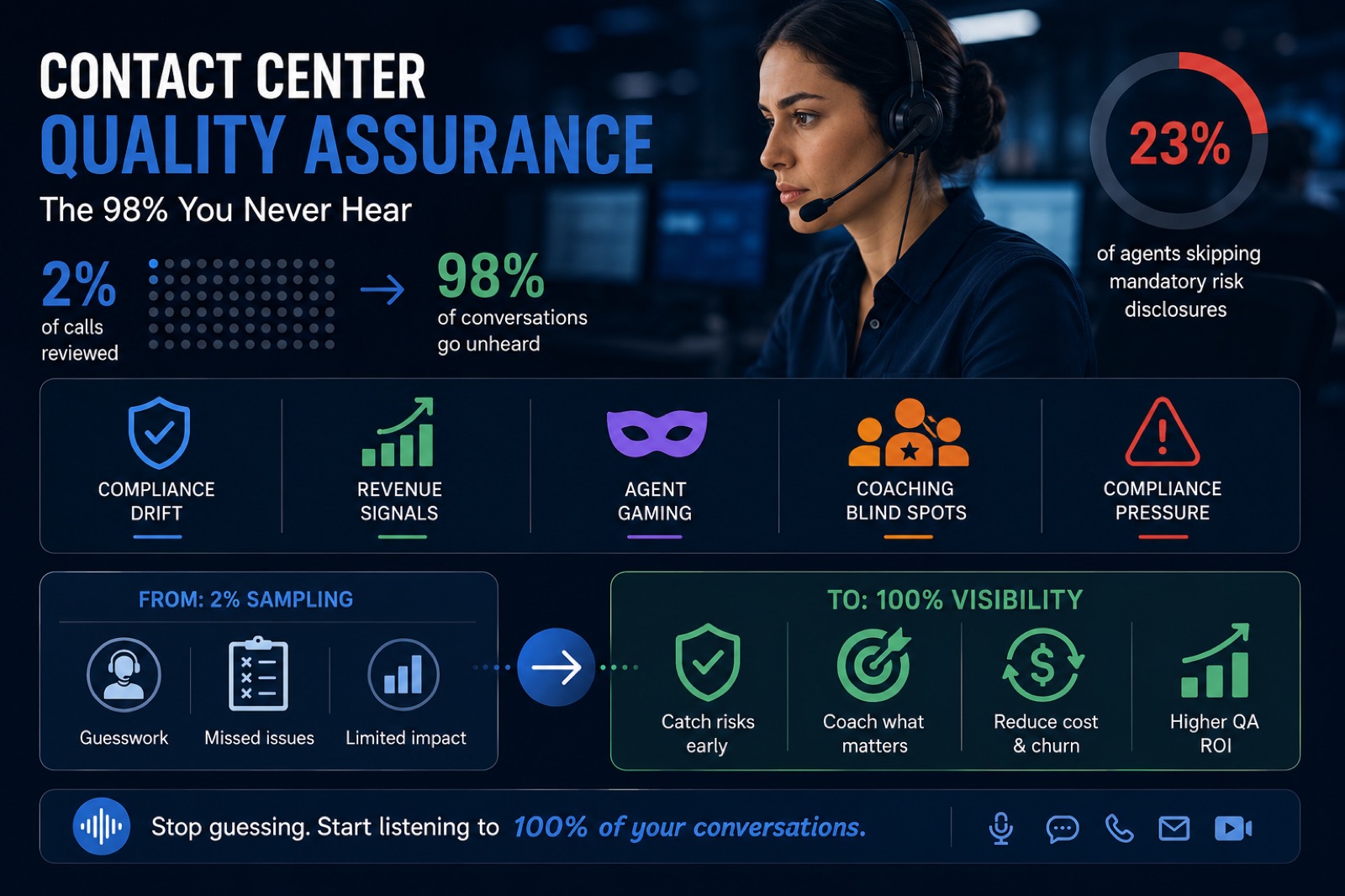
They score 100% of new-hire contacts, not 2%. This is where automated quality assurance stops being a compliance tool and becomes a development tool. When every one of a rookie’s first 300 contacts gets scored, the coaching conversation changes from “here is a call you handled badly” to “here is the specific behavior showing up in 40% of your escalations.” McKinsey estimates that a largely automated QA process could achieve more than 90% accuracy, against 70 to 80% for manual scoring. On a hard queue those numbers stop being nice-to-have.
They front-load context instead of front-loading knowledge. When the bot escalates, the agent gets the transcript, the emotional state, and the exact step where containment failed. A rookie who inherits full context on a hard call is working a materially easier problem than a rookie who starts cold. Most operators still hand off a phone call and a ticket number. That gap between what the bot knew and what the human receives is where the difficulty spike actually lives, and it is fixable with instrumentation rather than training.
They rebuild the difficulty gradient inside routing. A few centers now score contact complexity at routing time and deliberately send a controlled mix to agents under 90 days. Not the easiest contacts, which no longer exist, but the least compound ones. Single-system, single-intent, no prior escalation history. This is a routing policy decision, not a technology purchase.
Underneath all four sits the same requirement: you need conversation intelligence across every contact, not a sample, or you cannot measure difficulty, score simulations against real behavior, or tell whether a rookie is struggling with tooling or with judgment. Those two failures look identical on a supervisor’s spot-check and require opposite interventions.
What Hybrid AI Customer Service Means for Your 2027 Headcount Plan
Most 2027 workforce models assume agent headcount falls with containment and everything else stays constant. Containment goes to 55%, headcount drops 30%, savings booked. The models rarely adjust the attrition assumption, the ramp-time assumption, or the supervisor-to-agent ratio.
All three need to move. Ramp time to proficiency is lengthening, not shortening, because the job got harder. Supervisor ratios need to tighten for the first 90 days, because the coaching load per new hire went up even as total headcount went down. And if your model still uses a historical 35% attrition figure while your containment plan pushes toward 55%, the model is wrong in the direction that costs the most.
There is a hiring profile question underneath this too. If the entry-level job now requires judgment on day one, the candidate you screened for in 2022 is not the candidate you need in 2027. That either means paying more per seat, which most cost cases did not budget for, or building the ramp infrastructure that lets an ordinary hire reach that bar. The second path is cheaper. It just requires deciding to do it before the attrition data forces the issue.
The centers that get this right will end up with fewer agents who are considerably better and considerably more expensive, supported by real agent performance management infrastructure. The ones that get it wrong will run a permanent revolving door on the hardest queue in company history and wonder why CSAT stalled even though containment kept climbing. We covered the adjacent version of this problem, where AI hands off contacts it should never have taken, in our breakdown of the complexity cliff.
What To Do About It This Week
Five actions, all executable inside a normal operating week:
- Pull first-90-day attrition for the 12 months before and after your containment jumped. If you cannot isolate the containment date, use the month your bot crossed 25% of volume. Most operators have never plotted these two series together. The shape of that chart is the entire argument.
- Measure the difficulty of your human queue. Take last month’s contacts, split by whether the customer interacted with the bot first, and compare average handle time, transfer rate, and escalation rate. If the bot-preceded contacts are 2x harder, your rookies are absorbing that difference personally.
- Move new-hire QA coverage from sampling to 100% for the first 90 days. Even if you keep manual sampling for tenured agents, the newest cohort is where full coverage pays back fastest. This is the highest-return change in contact center coaching available right now, and it does not require touching your AI stack.
- Audit what the human agent receives at handoff. Sit with three agents and watch five escalations each. If they open cold with no transcript and no context, fix that before you fix training. It is the cheapest difficulty reduction available.
- Add a complexity dimension to your routing rules for agents under 90 days. Start crude. Single-intent contacts with no prior touch in seven days, routed preferentially to the newest cohort. Measure washout rate for one quarter against the previous one.
The easy call is not coming back. That is the correct outcome for customers and for cost. But the industry built its entire talent pipeline on top of work that no longer exists, and the bill for that arrives as call center turnover among people who never got the chance to become good at this job. The centers rebuilding the ramp now will own the next decade of this business, because the scarce resource in a hybrid operation was never the AI. It was always the person who picks up when the AI gives up.