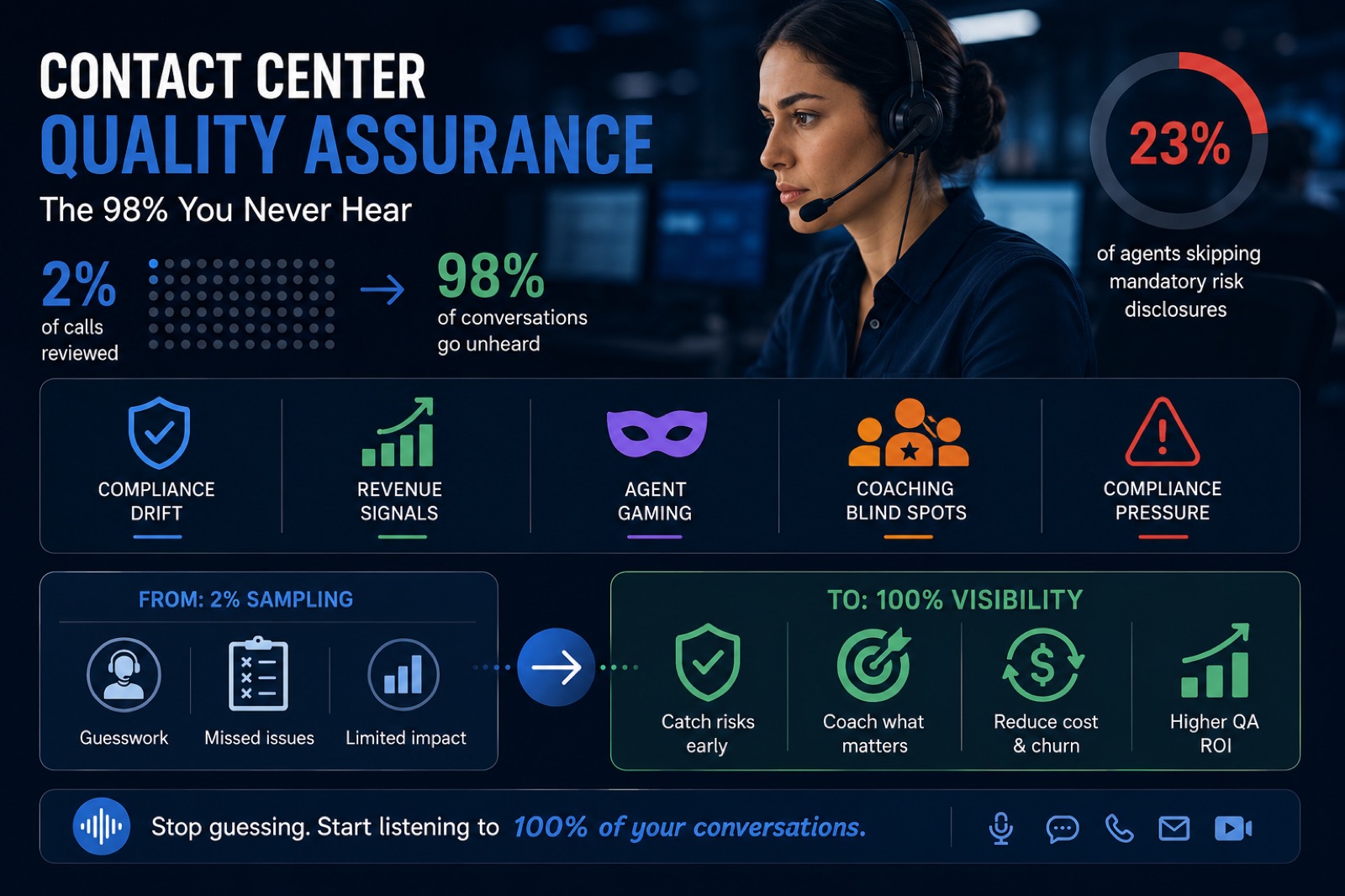
AutoQA — automated quality assurance — scores contact-center conversations against a QA scorecard with AI instead of a reviewer's spot check. A QA director evaluating AutoQA will ask about speed and coverage. Fewer ask the question that decides whether the score means anything: how do you know the AI is scoring the call the way a trained human reviewer would?
That gap matters more than it looks. Manual QA programs built calibration into the job by default — a human listened, a human scored, and the disagreement between two human reviewers was the known error bar everyone lived with. AutoQA removes the second reviewer and replaces "we listened" with "the model listened." The calibration question doesn't go away. It just goes unanswered unless someone asks it directly.
What is AutoQA?
In a contact center, AutoQA is automated quality assurance: every call, chat or email is scored against the same scorecard a QA team already uses — greeting, identity verification, required disclosures, resolution, tone — by software rather than by a person listening to a sample. It is not the same thing as QA automation in software engineering, where "automated QA" means test scripts that check code before a release. The name overlaps; the jobs don't.
What changes is coverage. Manual QA reviews a handful of conversations per agent each month, so the scorecard measures whichever calls someone happened to pull. Automated quality assurance in a call center scores all of them, so the scorecard finally measures the operation. That coverage is only worth having if the scores are right — which is what the rest of this article is about.
What is SI (super intelligence) for AutoQA?
SI (super intelligence) is a newer name some organizations use for AI, so SI for AutoQA and AI AutoQA are the same thing: software that listens to every conversation and scores it against your scorecard. The new name doesn’t change the question that decides whether the score means anything: how often it agrees with your own reviewers.
What accuracy actually means for AutoQA
Vendors like to quote a single accuracy number and move on. The number worth asking for is agreement, not accuracy in the abstract — specifically, how often the AI's score on a given scorecard point matches what the customer's own reviewers would have given the same call. Ender Turing scores 100% of conversations, and its automated scorecards typically reach 95%+ agreement with a customer's own reviewers — the two numbers only mean something together, because coverage without agreement is just being wrong about more calls. The agreement figure is useful because of what happens next: an accuracy-improvement workflow rewrites the point definitions that are causing disagreement, using the same reviews that measured the gap. The output is closer wording on the scorecard, not a black-box confidence score nobody can act on.
That distinction — agreement plus a visible fix path, instead of a single accuracy claim — is the actual product to evaluate. A vendor who can show 95% and can't show how the other 5% gets closed is asking you to trust a number, not a process.
Does AutoQA replace QA analysts?
No — it changes what they spend their time on. Instead of listening to samples, reviewers calibrate: they review the calls where the AI and a human disagree, rewrite scorecard points that are ambiguous, and settle disputed scores. The split has to be visible in the product, not just in the sales deck. Look for three things:
- A dispute path. An agent or supervisor who disagrees with a specific score needs somewhere to say so on that call, not a general feedback form. If disputes don't route anywhere or don't change anything, the AI score is final in practice even if the vendor says it isn't.
- Agreement reported per scorecard point, not one number for the whole scorecard. A single headline figure hides the two or three points that are doing the disagreeing, and those are exactly the points whose wording needs work. Per-point agreement tells a supervisor where to look; a scorecard average tells them nothing they can act on.
- Script-adherence scoring you can audit against the transcript. Compliance rules that check for required disclosures or consent language should show you the exact phrase in the transcript, not just a pass or fail. If you can't see why a call failed, you can't calibrate against it.
None of this replaces human judgment on the criteria that matter — it makes the division of labor auditable instead of implied.
The volume trade nobody names out loud
The reason contact centers put up with manual QA's small sample size for years is that a human-scored call felt trustworthy even at two to five calls per agent per month. AutoQA changes the trade: you get far more calls scored against every scorecard point, and in exchange you're now trusting a model instead of a manager's spot check. That's a fair trade only if the accuracy question gets answered with evidence, not reassurance. More coverage without calibration just means you're wrong about more calls, faster.
The second half of the trade is cost, and it decides whether the program survives its first budget review. Manual QA reviews a sample — commonly one or two percent of conversations — and that sample is what quality work costs today. Scoring everything has to land near that envelope, or full coverage is a worse deal than the sampling it replaced. This is an engineering question, not a model-shopping one: a vendor who routes every conversation through the largest available model has to charge for it, and a scorecard point with a clear definition does not need a frontier model to answer it correctly. Ask for the cost per scored conversation at full volume, not the license price per seat. A CFO will ask it eventually; it is cheaper to ask it first.
What to ask before you buy AutoQA
Before signing an AutoQA contract, ask the vendor for the per-point agreement rate against your own reviewers on a pilot batch of your own calls — not an aggregate number from someone else's book of business. Ask what happens to a scorecard point that scores low agreement: does a human rewrite it, does the model retrain, or does it just sit there. Ask where a supervisor disputes a specific score and what changes when they do. Ask what one scored conversation costs at your full volume. If the answers are vague, the calibration work probably isn't happening yet.
Contact centers that get this right end up with something manual QA never gave them: full-coverage scoring they can actually defend when a score gets challenged. Ender Turing's quality management platform builds the dispute path and the accuracy-improvement loop into the same workflow, so the calibration question has an answer before a customer asks it.