Gartner projects AI will save contact centers $80 billion in agent labor costs in 2026. The same firm warns that by 2030, generative AI’s cost per resolution could exceed the cost of offshore human agents. Both numbers can be true at the same time, and if you are a CFO signing next year’s contact center budget, you need to understand why.
Operators book the savings side of that equation without pricing in the cost side. The results are predictable. Q1 shows a great efficiency chart. Q3 shows a bill from your inference provider that nobody modeled. Q4 shows a board deck that quietly stops mentioning contact center ROI.
The paradox is not that AI is expensive. It is that the cost curve looks nothing like the labor curve, and most contact center finance models were built for labor.
The $80B Contact Center ROI Number Hides a Smaller Story
The headline is real. Gartner’s 2022 forecast credits the savings to conversational AI automating whole or partial agent interactions.
Read the footnotes and the picture changes. Gartner’s own projection is that about 1 in 10 agent interactions will be automated by 2026, up from an estimated 1.6% in 2022. The $80B assumes that ratio climbs. It also assumes vendor pricing holds.
Neither is safe.
Enterprise ASR and LLM inference costs are volatile. Providers have raised prices twice in eighteen months. When Anthropic, OpenAI, and the hyperscalers reprice, your per-conversation cost jumps overnight, and there is no equivalent to the two-week notice a BPO gives you before a rate change.
The 10% automation rate is not stuck because of technology. It is stuck because integration is hard. COPC reports that 48% of contact centers name integration challenges as the main cause of their AI falling short. When the average organization manages 3.9 different contact center technologies and only 3% of contact centers run on a single platform (Puzzel, 2026), deflection stalls fast.
Which means most operators book the $80B in the plan and never see it in the P&L.
Why the Cost Curve Bends the Wrong Way
Offshore labor costs scale linearly. Add a seat in Manila, pay for a seat in Manila. Rates move a few percent per year. You can forecast three years out with a spreadsheet.
AI costs do not behave that way. There are four cost lines most contact center finance models miss:
- Inference cost per conversation. A single voice conversation processed through ASR plus a reasoning model can cost between $0.08 and $0.40 depending on length, retries, and model tier. Multiply by a million calls a month and the number gets real. When providers raise prices, this line moves without warning.
- Model maintenance. Every model needs retraining on your data. Vocabulary drift, product launches, new compliance rules each trigger a retraining cycle. Budget teams routinely underestimate this by 4-6x.
- Quality assurance for the AI itself. Somebody has to monitor the AI agents. Voice bot quality is a real cost center now. Most operators discovered this after deployment, not before.
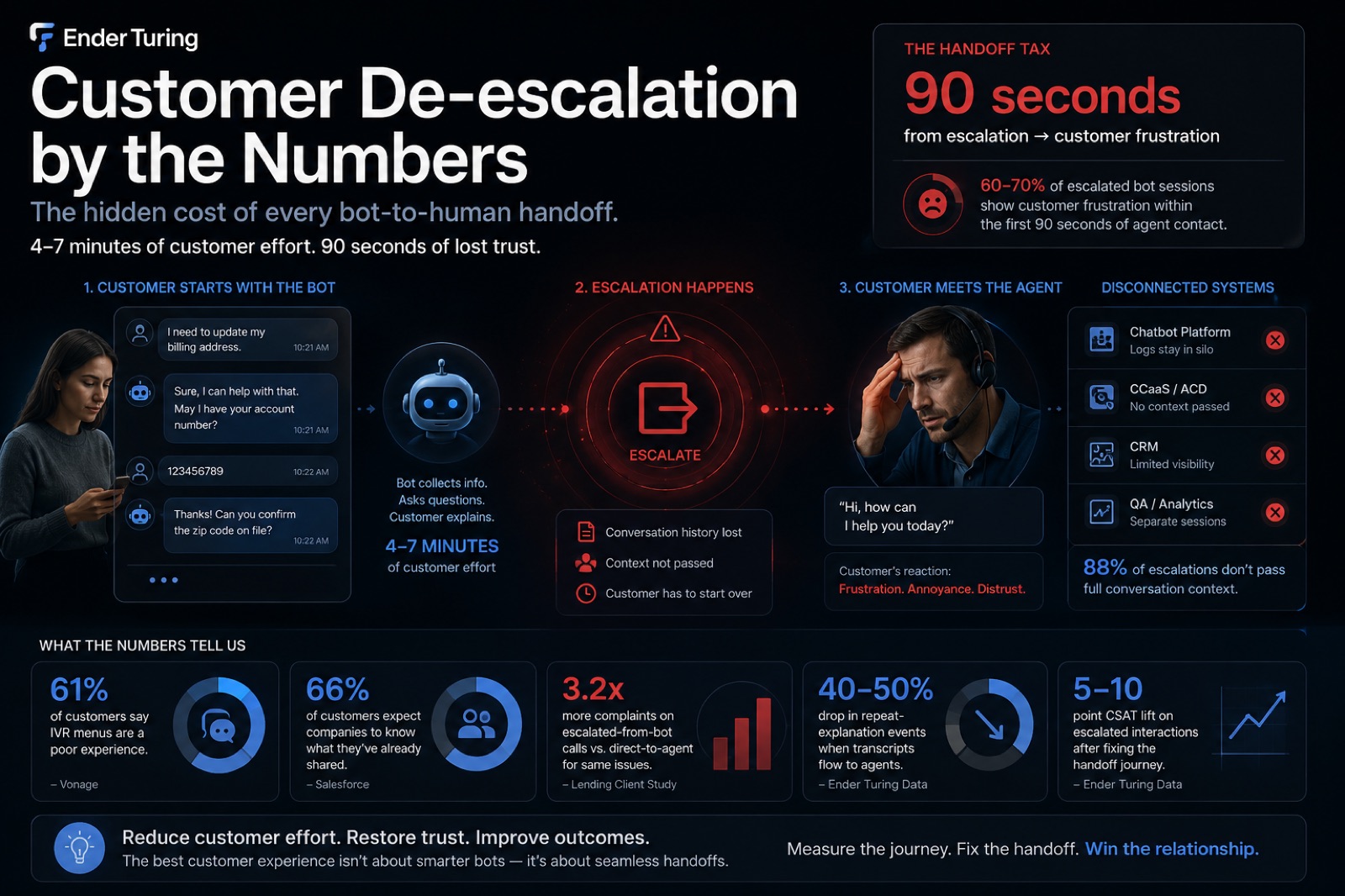
- Human escalation math. When AI handles 60% of contacts, the 40% that reach humans are the hardest ones. Handle time on escalated contacts is 2-3x higher. Your remaining agents burn out faster. Attrition climbs. Replacement cost per agent is already $10K to $20K per McKinsey, and stronger agent performance management is one of the few levers that pulls this number down. That number moves against you.
The Gartner warning about 2030 is not about AI getting more expensive in absolute terms. It is about all four lines compounding while offshore labor drops in relative importance because operators cut those seats first.
If you deflect 60% of volume, cut 50% of offshore headcount, and your inference bill triples, the math flips. That is the paradox.
What Separates Winners From Losers on Contact Center ROI
COPC found that 56% of contact centers deploying AI are not realizing the return they expected. The 44% that succeed are not using different technology. They measure differently.
Three patterns separate the operators actually capturing returns from AI investments.
They price the full cost stack before signing the vendor. The winning teams model inference, retraining, integration, monitoring, and escalation cost math on day one. They negotiate inference pricing floors and ceilings into the contract. They demand transparency on model updates because updates change cost profiles. When a vendor cannot answer “what is our per-conversation cost at 2 million monthly interactions,” they walk away.
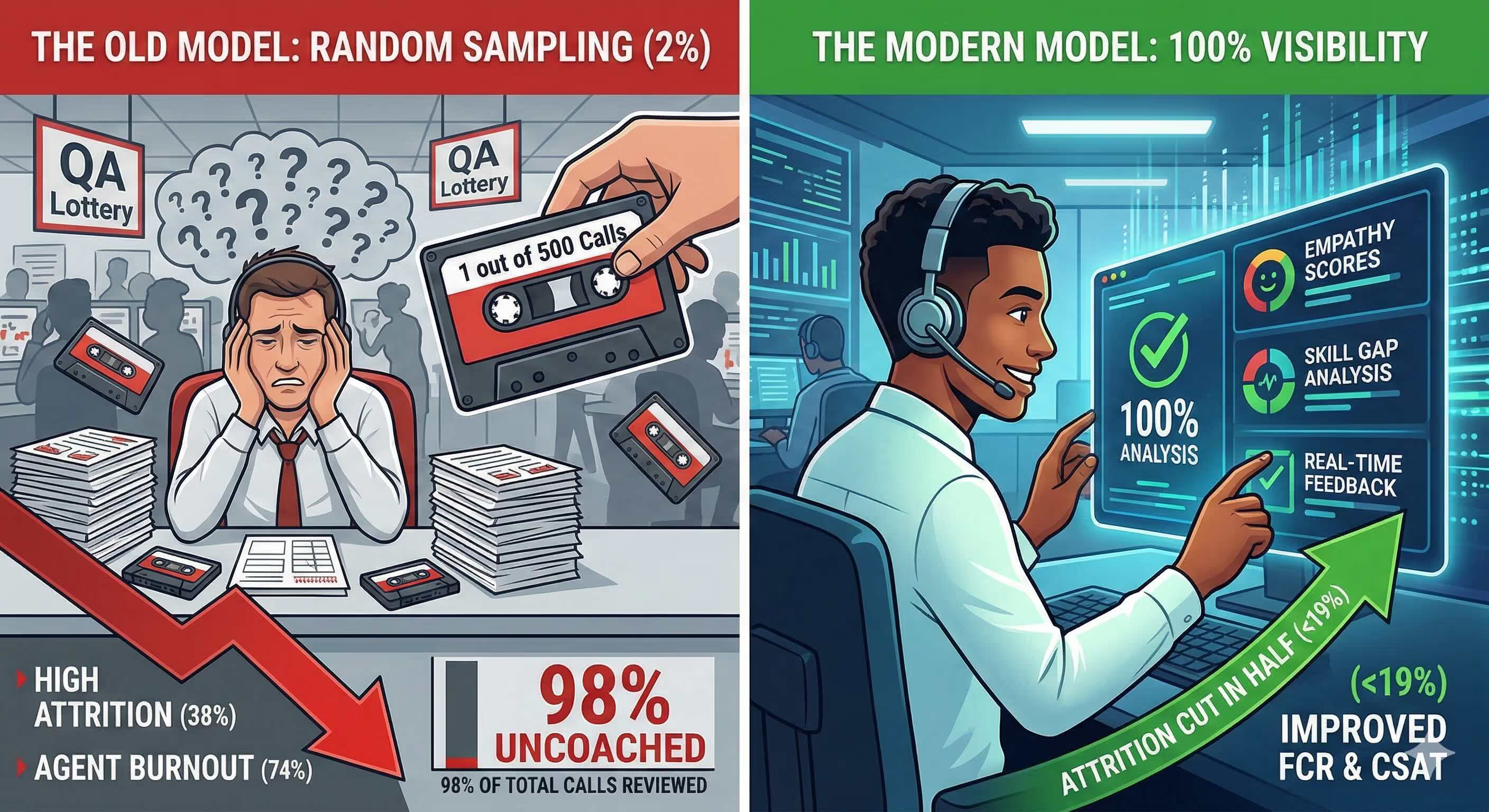
They instrument the conversation itself, beyond deflection metrics. Deflection rate is a vanity metric. What matters is what happened inside every conversation, human or AI, that reached your business. Conversation intelligence ROI comes from finding the revenue signals buried in the 98% of interactions that traditional QA never reviewed. Upsell moments. Churn warnings. Product feedback. Competitor mentions. Automated quality assurance with 100% coverage sees what 2% sampling misses.
They treat the contact center as a data source, and price it that way. McKinsey found that inbound service call centers generated up to 25% of new revenue at some credit card companies and up to 60% at some telecom companies. That revenue lives in the conversation layer. If your AI stack only measures whether a call was deflected, you are optimizing for the wrong number. The centers seeing the strongest contact center cost reduction alongside revenue growth are the ones extracting insight from every conversation and routing it to product, marketing, and finance.
None of this is exotic. It is discipline. It is refusing to treat AI as a labor substitute and starting to treat it as an intelligence infrastructure decision.
The Vertical Intelligence Problem Nobody Talks About
There is a second cost line the Gartner report glosses over. Generic models do not understand your business. A speech analytics engine trained on podcast audio and general customer service transcripts will not know that “APR” and “APY” are different things, that “chargeback” and “dispute” mean different processes in card issuing, or that a customer saying “I’ll think about it” during a collections call is a specific stall pattern.
Every one of those blind spots is a cost. Missed upsells. Misclassified churn signals. False positives on compliance flags that pull QA analysts into wasted reviews.
The vendors selling you generic AI will not tell you this because it is not in their interest. Vertical intelligence, meaning models tuned to banking, medical labs, lending, telecom, and insurance, is the difference between a system that reduces cost and one that also grows revenue. At Ender Turing, we own our entire R&D stack because off-the-shelf ASR fails on real contact center audio: noisy lines, overlapping speech, wrap-up notes mumbled by tired agents. That decision costs us money. It also means the cost line for our customers is knowable and stable.
If your vendor cannot articulate their model economics or their vertical training strategy, you are exposed. When inference pricing shifts or when a general model regresses on your domain vocabulary, you will absorb the cost.
Ask this question in your next vendor review: “What happens to our per-conversation cost if your underlying model provider raises prices 30% next quarter?” If the answer is a shrug, you have your risk assessment.
What To Do Before Next Budget Cycle
You do not have to solve the paradox. You have to price it honestly. Three things any contact center leader can do this quarter to protect their AI customer service ROI:
- Get a full cost stack from every AI vendor in your environment. Not just per-seat licensing. Inference cost per interaction, retraining cadence and cost, integration maintenance, escalation cost impact. If any number is missing, that is your risk line.
- Instrument what happens after deflection. Track handle time on escalated contacts, agent attrition among senior agents, and CSAT specifically on AI-handled interactions. If deflection is up but any of these three metrics are down, you are booking savings that are not real.
- Audit whether your conversation data is generating revenue insight or just being deflected. If your AI stack only produces efficiency reports, you are missing the kind of revenue contribution McKinsey documented: up to 25% of new revenue at some credit card companies. Route conversation signals to product, marketing, and account management, and measure whether they act on them.
The $80B in savings is not a lie. Neither is the 2030 cost inversion warning. Both live in the same industry, and the operators who thrive over the next four years are the ones treating contact center ROI as a full-stack accounting problem, not a deflection metric.
Your CFO does not need another efficiency dashboard. Your CFO needs a model that says exactly what happens to per-conversation cost when the price of inference doubles, and a plan for making sure that when it does, you are also measurably growing revenue from the same conversations.
Everything else is a Q4 surprise waiting to happen.
Sources referenced: Gartner on conversational AI and agent labor costs (2022), Gartner on GenAI cost per resolution by 2030 (2026), McKinsey on call centers and revenue (2006), McKinsey on agent attrition cost (2020), COPC on the AI ROI gap.