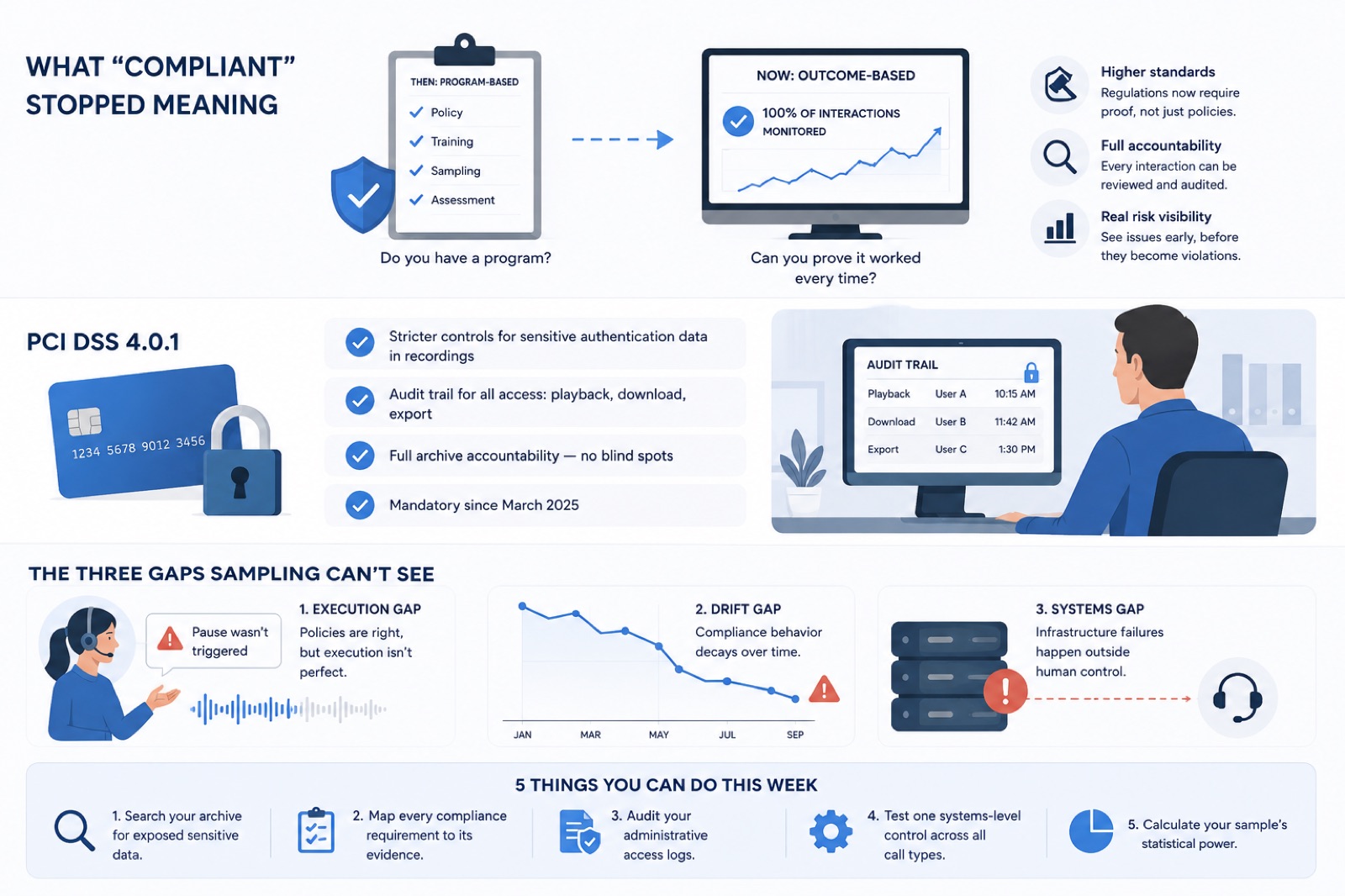
Compliance monitoring is the ongoing work of checking that a company's people, processes and communications follow the laws, regulations and internal policies that apply to it, and of catching a gap before a regulator or a customer does. Auditing looks back at a period at set intervals; monitoring runs all the time. In a contact center, much of it happens in customer conversations: the recording notice, the required disclosure, the consent question, the promise an agent may not make. This guide covers what compliance monitoring includes, how it differs from auditing, how to set up a program, and how a compliance team can check every call for required disclosures instead of a sample.
What is compliance monitoring?
Compliance monitoring is the routine, continuing check of known compliance risks: are people saying and doing what the rules require, every day, in the places where the risk lives? It produces findings, trends and fixes while there is still time to act, and it feeds the compliance team's reports to leadership.
In health care, the General Compliance Program Guidance of the US Department of Health and Human Services' Office of Inspector General (OIG) lists "Risk Assessment, Auditing, and Monitoring" as one of the seven elements of an effective compliance program, and says a compliance work plan "should contain routine monitoring of ongoing risks". The guidance is voluntary and written for health care organizations, but the idea travels: decide which risks matter, then watch them continuously.
Compliance monitoring vs auditing
| Compliance monitoring | Compliance auditing | |
|---|---|---|
| When | Continuously or on a routine schedule | Periodically, on a plan |
| Who | The business and the compliance team | Auditors independent of the work being checked |
| What it covers | Known, ongoing risks | A defined period and scope, tested in depth |
| What it produces | Alerts, trends and quick fixes | A findings report and formal corrective action |
The two work together. Monitoring catches problems as they happen; auditing tests whether the controls, monitoring included, actually work.
What to monitor in customer conversations
A contact center turns many compliance rules into words an agent must say, steps an agent must follow and statements an agent must avoid:
- Required disclosures: the recording notice, fee and product disclosures, and the scripts a regulation sets for a specific call, such as the Mini-Miranda in debt collection, the TPMO disclaimer in Medicare sales, Reg E dispute handling and the Good Faith Estimate.
- Consent: to recording, to marketing, to a change of terms.
- Process steps: identity verified before account details, the fee explained, the next step agreed.
- Prohibited statements: a promise an agent may not make, a misleading claim, advice outside the agent's role.
- Sensitive data: card numbers, health information and personal data said aloud.
Contact center compliance covers why a recording alone does not prove any of these were said.
How to set up a compliance monitoring program
- Assess the risks. List the rules that apply to your conversations and rank them by harm and likelihood. OIG's guidance says compliance risk assessments should be conducted at least annually.
- Write each requirement so it can be checked. The exact line an agent must say, the step to follow, the statement to avoid, and which calls each applies to.
- Decide what you check: a sample or everything. Manual review covers little. SQM Group found that quality assurance in many cases evaluates only 1-2% of customer calls, with most agents scored on 4 to 10 calls a month. A rule broken on the other 98% goes unseen.
- Route every finding to an owner. Each flag needs the rule it broke, the conversation behind it and a person who acts on it by a date.
- Fix the cause and check again. Retrain the agent, change the script or fix the process, then watch the same rule's results in the weeks after.
- Report the trend. Show leadership and the compliance committee which rules fail most, where, and whether the fixes held.
How can a compliance team check every call for required disclosures?
Write each required line as a rule that software scores on every call, flag the calls that fall short, and send each one to the person who fixes it. People then spend their time confirming flags and fixing causes, not listening to a sample.
With Ender Turing, a compliance team checks every call for required disclosures:
- Score each required line on each call. Write each line a call must contain, such as the recording notice, a product disclosure, the consent question or the mandatory opening, as a compliance rule. Each call gets a script-adherence score from 0% to 100% per rule: the rule's text is aligned with the transcript, so missing or reworded words lower the score, while filler words spoken around the line do not. Very short calls are skipped.
- Find the calls that fall short. The matched words are highlighted in the transcript, and the Script adherence filter finds the calls where one rule, or all of them, scored below the percentage you choose.
- Cover chats, emails and steps. Compliance rules score call transcripts only. A requirement that applies to chats and emails too, or a step such as verifying identity before account details, goes on a scorecard as a point that AutoQA scores on every call, chat and email routed to it, and a failed critical point fails its category.
- Flag what no fixed wording catches. Topics described in plain language let generative AI flag the conversations that match, such as a promise an agent may not make, with each topic's accuracy measured against the conversations your team labeled. Discovery searches the transcripts for any phrase and jumps to the exact point it was said.
- Check the past too. Run an Ender on past conversations, up to 20,000 per run, to find the ones that matched before a rule existed.
- Protect the data. Personal data and payment details can be masked in transcripts, configured per language. Ender Turing is SOC 2 Type II audited, with the latest report available under NDA, and signs a Business Associate Agreement (BAA) with healthcare customers on request.
Ender Turing analyzes 100% of conversations, seconds after each one ends, in any language your customers speak. It scores how closely each line was said and whether each step was followed; what the rules require of your calls stays your compliance team's decision. See how it works on compliance monitoring for contact centers.
Make the sample the exception
Manual review still has a job: the calls the rules flag, disputes, calibration and coaching. What it cannot do is hear every call. Let software check each required line on every call, and let your compliance team confirm the flags, coach the agent and fix the process. To see it on your own calls, start with compliance monitoring.
FAQ
What does compliance monitoring mean?
The routine, continuing check that people, processes and communications follow the laws, regulations and policies that apply, so gaps are found and fixed while there is time to act.
What is the difference between compliance monitoring and compliance auditing?
Monitoring runs all the time on known risks and is done by the business and the compliance team. Auditing is periodic, independent and tests a defined period in depth, including whether the monitoring works.
What are the seven elements of a compliance program?
OIG's General Compliance Program Guidance, written for health care, lists them as: written policies and procedures; compliance leadership and oversight; training and education; effective lines of communication with the compliance officer and disclosure program; enforcing standards through consequences and incentives; risk assessment, auditing and monitoring; and responding to detected offenses and developing corrective action initiatives.
How do you monitor calls for compliance?
Write each required line, step and prohibited statement as something software can score, check every call against it, flag the calls that fall short and route each flag to an owner. Review the flags, not a random sample.
Can software check chats and emails for compliance too?
Yes, as scorecard points. In Ender Turing, compliance rules score call transcripts only, while AutoQA scores every call, chat and email routed to a scorecard, and Discovery searches the text of every conversation you can open.