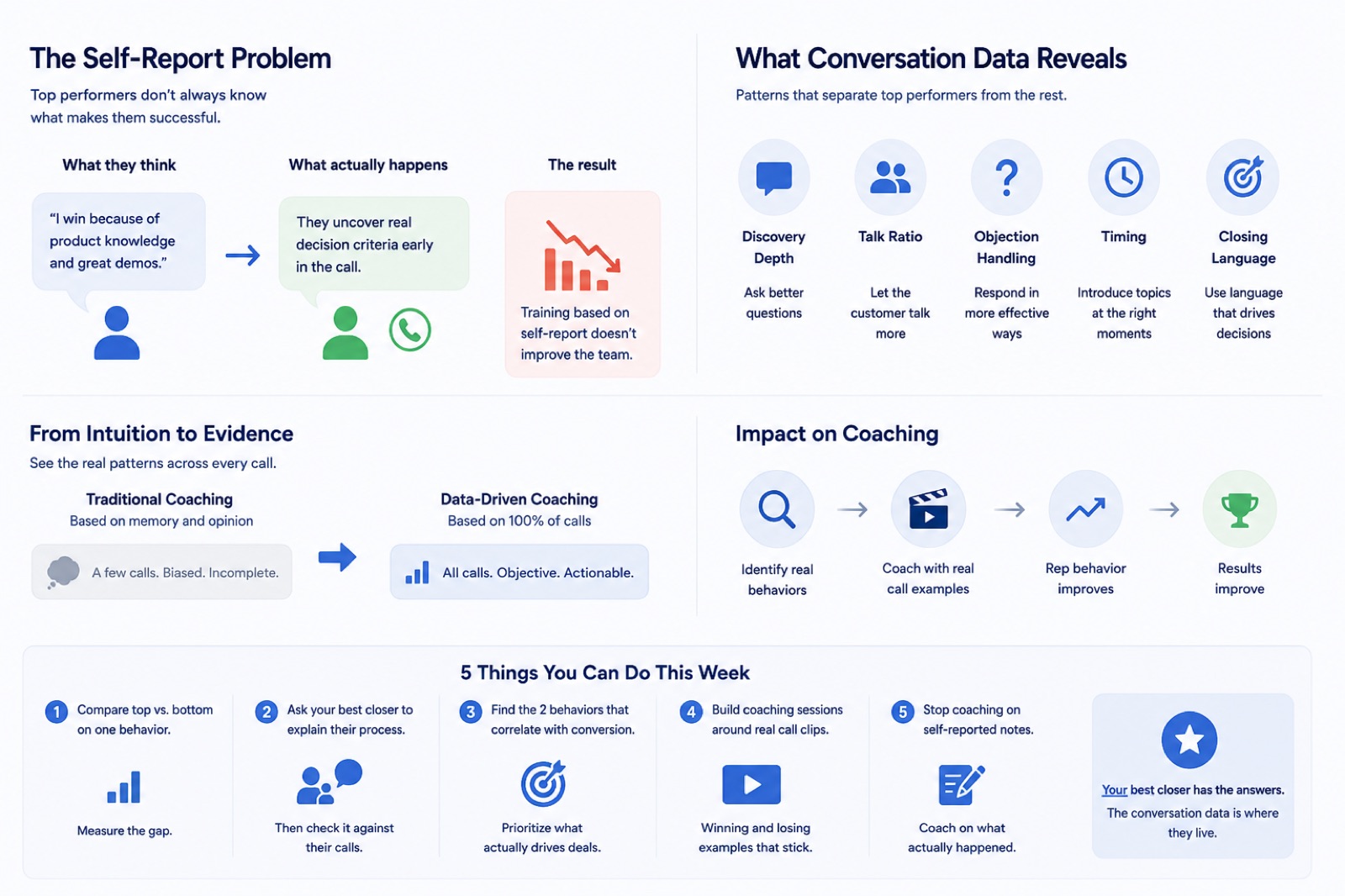
AI sales coaching is software that listens to a rep's real conversations, scores them against what good looks like, and turns the gaps into specific coaching. Done well, it fixes the oldest problem in sales management: a manager can review a handful of calls a week, so most coaching is built on whichever calls happened to be sampled.
This guide covers what an AI sales coach is, what it should produce, what it costs, where it stops, and how to judge a tool before you buy it. Ender Turing's sales use case follows the same logic and is described on the sales page.
What Is an AI Sales Coach?
An AI sales coach is a system that analyzes recorded or live sales conversations and gives reps and managers feedback from them. It has three parts:
- Capture and transcription. Calls and meetings are turned into text, in any language your customers speak.
- Scoring. Each conversation is checked against criteria you define: did the rep qualify the buyer, handle the objection, state the next step?
- Coaching output. The result is not a dashboard of scores but material a manager or rep can act on: this call, this moment, this habit.
Two kinds of tools share the label. Practice tools let a rep rehearse against a simulated buyer. Conversation-based tools coach from calls that really happened. The first builds confidence before the call; the second shows what happens on the call. Most teams get more from the second, because the evidence is their own market, their own objections and their own pricing conversations.
Ender Turing is the second kind. It analyzes every conversation in seconds, and automated scorecards typically reach 95%+ agreement with the customer's own reviewers. Agreement with your own reviewers is the figure to ask any vendor for, because a score nobody trusts produces coaching nobody follows.
What Should AI Sales Coaching Produce?
Judge a tool by the coaching it hands a manager on Monday morning, not by its feature list.
A scorecard that matches your playbook. Your discovery questions, your objection answers and your close are the standard. A generic score tells a rep nothing about your sale.
Patterns across the team. One call shows a rep's day. Hundreds show which objection stalls deals, which question separates your best reps from the rest, and which stage of the conversation loses buyers. In Ender Turing, Topics and conversation funnels group calls by what was discussed, so you can see where the conversation changes direction.
Coaching material per rep. Ender Turing's EnderGPT can run a scheduled chat for each agent: every week it prepares coaching material for every agent from that agent's own conversations. A manager reviews it, edits it and uses it in the one-to-one.
A way to ask questions. "Which calls this week mentioned a competitor's price?" should take one question, not a spreadsheet. Ask it anything, and read the answer from real conversations.
Sales Coaching Programs and Sales Training Coaching: Where AI Fits
A sales coaching program usually has three layers: training that teaches the method, coaching that applies it to a rep's real work, and inspection that checks whether it stuck. Sales training coaching tends to stall at the third layer, because inspection is the expensive part. A manager cannot listen to every call.
AI removes that bottleneck. It takes the routine, repetitive part of the job, listening to every conversation and scoring it, so that people can focus on the part that needs judgment: the critical deals, the disputed scores, calibration between reviewers, and the conversation with the rep.
That holds for high-ticket sales coaching too. When a team closes a few large deals a quarter, each call carries a lot of weight and the sample size is small. Reviewing every conversation on the account, rather than the two the manager had time for, is where the value is.
How Much Does an AI Coach Cost?
Price by the vendor's unit: per user, per conversation, or both. Ender Turing's pricing page lists the following for sales and customer-success teams:
- Free plan: 3 users, 50 conversations a month, meetings up to 30 minutes.
- Team: $59 per user per month.
- Business: $89 per user per month.
- Enterprise: custom pricing.
When you compare quotes, check four things:
- What counts as a conversation, and whether long meetings count as one.
- Whether scoring, search and coaching are included or sold as add-ons.
- Whether the price changes with the number of conversations analyzed.
- What the free plan or trial lets you test on your own calls. A sample of your real conversations tells you more than any demo.
Is AI Replacing Sales Reps?
No. A coach does not make the sale: the rep does. What changes is how fast a rep learns what works.
Before, that feedback arrived through a few ride-alongs and a sampled call review. With AI, every rep gets feedback from their own conversations, scored by the same criteria as everyone else. The new hire reaches the level of the best rep sooner, and the best rep gets feedback too, since they are rarely reviewed at all.
The human-AI split is practical. AI listens to everything and flags what matters. People decide what to do about it: which deal needs a senior call, which habit to work on, which score to dispute.
Can ChatGPT Coach Your Sales Team?
A general chatbot can help an individual rep. Paste in a call transcript, ask what went wrong, and you will get a readable critique. It is a useful way to try the idea.
It does not scale into a program, for three reasons:
- No capture. Someone has to record, transcribe and paste every call, which no team will do consistently.
- No shared standard. Each person asks differently, so two reps get two different yardsticks.
- No history. It cannot compare this month's calls with last quarter's or show which topic is rising across the team.
A purpose-built tool connects to your calls, applies one scorecard to all of them, and keeps the history. The coaching conversation can still happen in a chat: in Ender Turing you chat with your data directly.
How to Judge a Tool Before You Buy
Run a two-week test on your own calls:
- Pick one scorecard with five to eight criteria your managers already use.
- Have a manager score 30 calls by hand and compare the tool's scores with theirs. The agreement rate is the number that decides whether the coaching is trustworthy.
- Check that the tool explains each score with the moment in the call that earned it.
- Ask for the coaching output for two reps, then ask a manager if they would use it in a one-to-one.
- Compare the price on the unit that matches how you will grow: users, conversations, or both.
If the tool passes, roll it out to one team first and keep the manager's review in the loop until the scores and the managers agree. Start with the sales use case, or try the free plan on your own conversations.