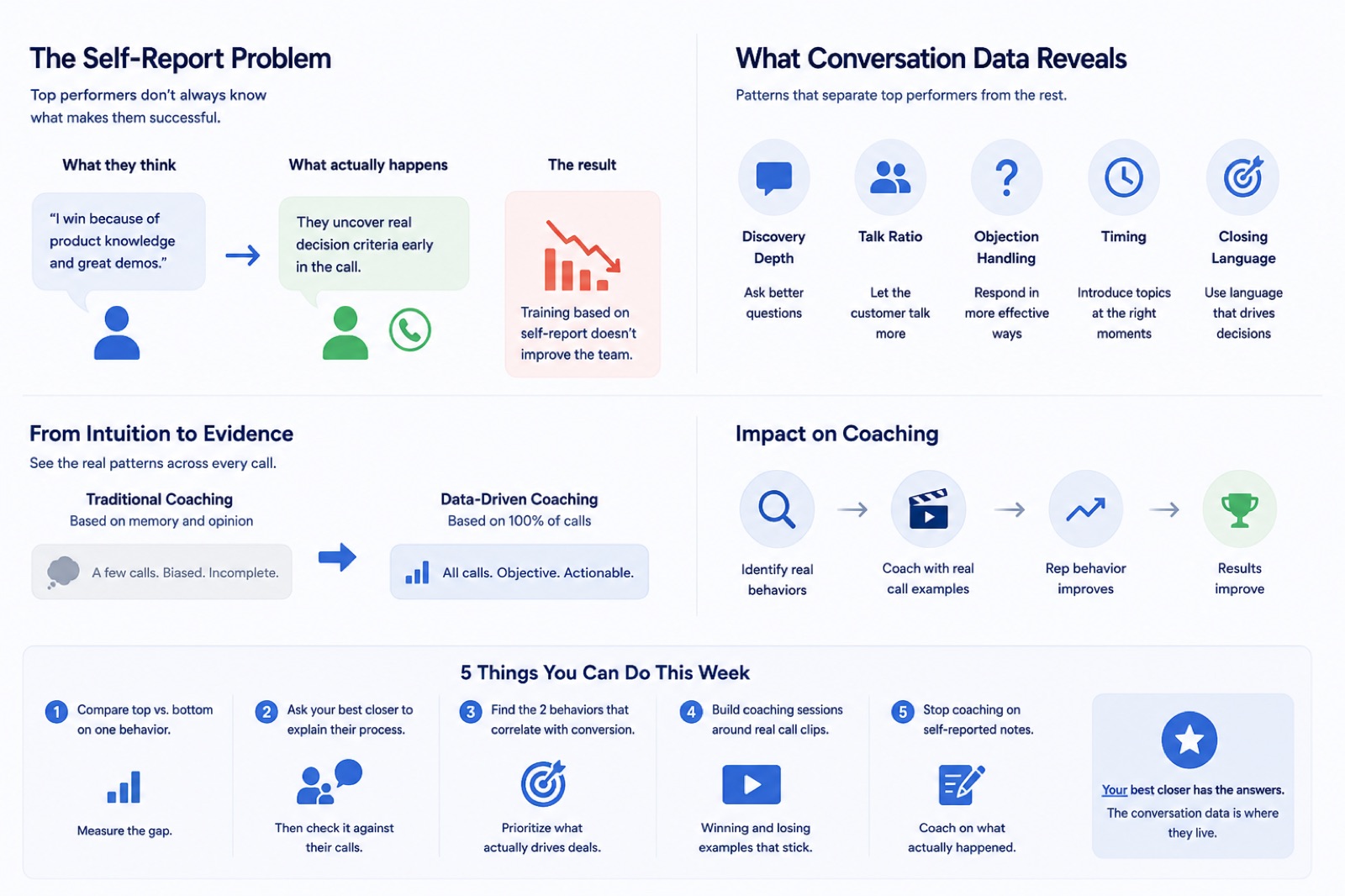
Coaching a sales team means giving each rep specific feedback on real conversations, soon after they happen, and agreeing on one thing to do differently on the next call. It is a weekly habit of the manager, not an annual workshop. This guide covers the four coaching styles, the five techniques that fit a team, what a good coach does, what each member of the team contributes, and how a platform changes the work.
It is written for the sales leader or contact center manager who runs a team of reps on the phone and wants coaching that shows up in the numbers, not in a calendar invite.
Coaching Sales Team: Where to Start
Most coaching fails at the first step: the manager has no reliable picture of what reps actually say. A manager who listens to a handful of calls a week coaches from whichever calls were sampled, and the rep knows it. Before you pick a style, settle three things:
- The behavior you are changing. One behavior per rep per cycle: opening the call, asking about budget, handling the first objection, closing with a next step. "Be more confident" is not a behavior.
- The evidence. A specific moment in a specific recording, the same one the rep can replay.
- The rhythm. A fixed weekly slot per rep. Coaching that happens when there is time happens rarely.
If your team is bigger than the manager's listening capacity, evidence is the bottleneck, not technique. That is where tooling earns its place, covered below.
What Are the Four Types of Coaching Styles?
The same manager uses different styles for different reps. These four cover most of what happens in a sales team:
- Directive. The manager tells the rep what to do and shows how. It suits new hires and a rep who is missing a basic step, such as the required opening or a compliance line. It stops working once the rep knows the steps and needs judgment.
- Questioning. The manager asks and the rep finds the answer: "What did the buyer mean when they went quiet there?" It builds judgment and ownership, and it is slower. It suits experienced reps.
- Observational. The manager listens live or to the recording and gives structured feedback against a scorecard. It is the base of most programs because it works from evidence.
- Peer-led. Reps review each other's calls and share what works. It spreads good habits cheaply and is strongest when the team's best calls are easy to find and replay.
The skill is matching style to the rep and the moment. A new hire who is asked open questions flounders; a veteran who is told what to say disengages.
What Are the 5 Coaching Techniques?
These five techniques fit a team coaching rhythm. Each works with any style above.
- Call review against a scorecard. Score a recording on the same criteria for every rep: discovery, objection handling, next step, required statements. The scorecard keeps coaching about the call and not about the manager's mood.
- Side-by-side listening. Sit in on live calls or play a recording together, pausing at the decision points. The rep hears the moment as the buyer did.
- Call replay of a strong call. Play a good call from a peer, pointing at the exact sentence that moved the buyer. Reps copy what they can hear.
- Role-play of one scenario. Rehearse the objection that cost the rep a deal this week, with the manager as the buyer. Keep it to ten minutes and one scenario.
- Goal and follow-up. End every session with one written commitment, and open the next session by checking it on a new call. Without follow-up, the other four are conversations that evaporate.
What Are 10 Qualities of a Good Coach?
A manager who coaches well tends to show these ten, and each one can be trained:
- Listens more than they talk in the session.
- Points at specific moments, not general impressions.
- Gives feedback soon after the call, while the rep remembers it.
- Asks questions before giving answers.
- Limits each session to one behavior.
- Scores every rep on the same criteria.
- Names what the rep did well, with the same precision as what to change.
- Follows up on the commitment from last time.
- Is honest about a rep's results, and patient about how long habits take.
- Shares what works across the team instead of keeping it in one-to-one sessions.
What Does a Sales Team Member Do in Coaching?
Coaching is a two-sided job, and the team's members carry the half that managers cannot do for them.
- The rep brings a call they want to discuss, not only the ones the manager picked. They state their own read of what went wrong, and they own the commitment.
- The top performer is a source of calls, not a lecturer. Their recorded conversations become the examples the rest of the team replays.
- The team lead or QA reviewer applies the scorecard consistently so scores mean the same thing across reps.
- The sales manager runs the rhythm: picks the behavior, gives the feedback, checks the follow-up.
When only the manager speaks, coaching feels like a performance review. When the rep picks the call, it feels like a working session.
Sales Coaching Platform: What It Takes Off the Manager
A sales coaching platform does the part of the work that does not scale by hand: it listens to the conversations, scores them against the scorecard and shows the manager which calls and which moments to coach. The manager's time goes to the conversation with the rep.
What to look for in a sales coaching tool:
- Coverage. It analyzes every conversation, not a sample. Ender Turing analyzes or scores 100% of conversations, so a manager picks the call to coach from all of them, not from the few they happened to hear.
- Scores you can trust. Ask the vendor for the measured agreement with your own reviewers. Ender Turing's automated scorecards typically reach 95%+ agreement with the customer's own reviewers, and the accuracy-improvement workflow rewrites point definitions from those reviews.
- Evidence behind every number. A click on a chart opens the conversations behind it, so a coaching point is a recording, not a statistic.
- Coaching material prepared for each rep. Scheduled Chats of type "For agent" have EnderGPT generate a separate report for each rep or team on a daily, weekly, monthly or quarterly schedule, built from that rep's own conversations.
- Calls and meetings in one place. Conversations come in through connectors, API, SFTP or manual upload, and meetings through the browser extension or apps such as Fireflies.
This is the routine, repetitive part of the job: listening to every call and scoring it. The manager keeps the part that needs a person: deciding what to coach, having the conversation and checking that behavior changed. The Ender Turing sales use case shows how this works for a sales team.
Coaching Salespeople Into Sales Champions: A Weekly Rhythm
A rhythm a team of ten to twenty reps can keep:
- Monday: the manager (or the platform) surfaces each rep's lowest-scoring behavior of the previous week, with one example call.
- Midweek: a 20-minute session per rep: the rep plays the moment, says what they would change, the manager asks two questions, and they agree on one commitment.
- Friday: the manager plays one strong call to the whole team and names the sentence that made it work.
- Next Monday: the commitment is checked against a new call before a new one is set.
To measure whether it works, track the behavior you coached (the share of calls where the rep asks about budget, for example) before and after, alongside the outcome you care about, such as conversion from first call to next step. Report counts before percentages while the sample is small.
What It Costs to Start
Teams can start without a budget decision. The Ender Turing free plan for sales and customer-success teams covers 3 users and 50 conversations a month, with meetings up to 30 minutes. Team is $59 per user a month and Business is $89 per user a month; Enterprise is custom. See the pricing page for the current plans.
Frequently Asked: Where Does Coaching a Sales Team Go Wrong?
Three patterns repeat. Managers coach the loudest problem instead of the most common one, because they hear too few calls to know the difference. They give five points of feedback instead of one, so the rep changes nothing. And they skip the follow-up, so the next session starts from scratch. Fix the evidence first, keep to one behavior per cycle, and check the commitment every time.