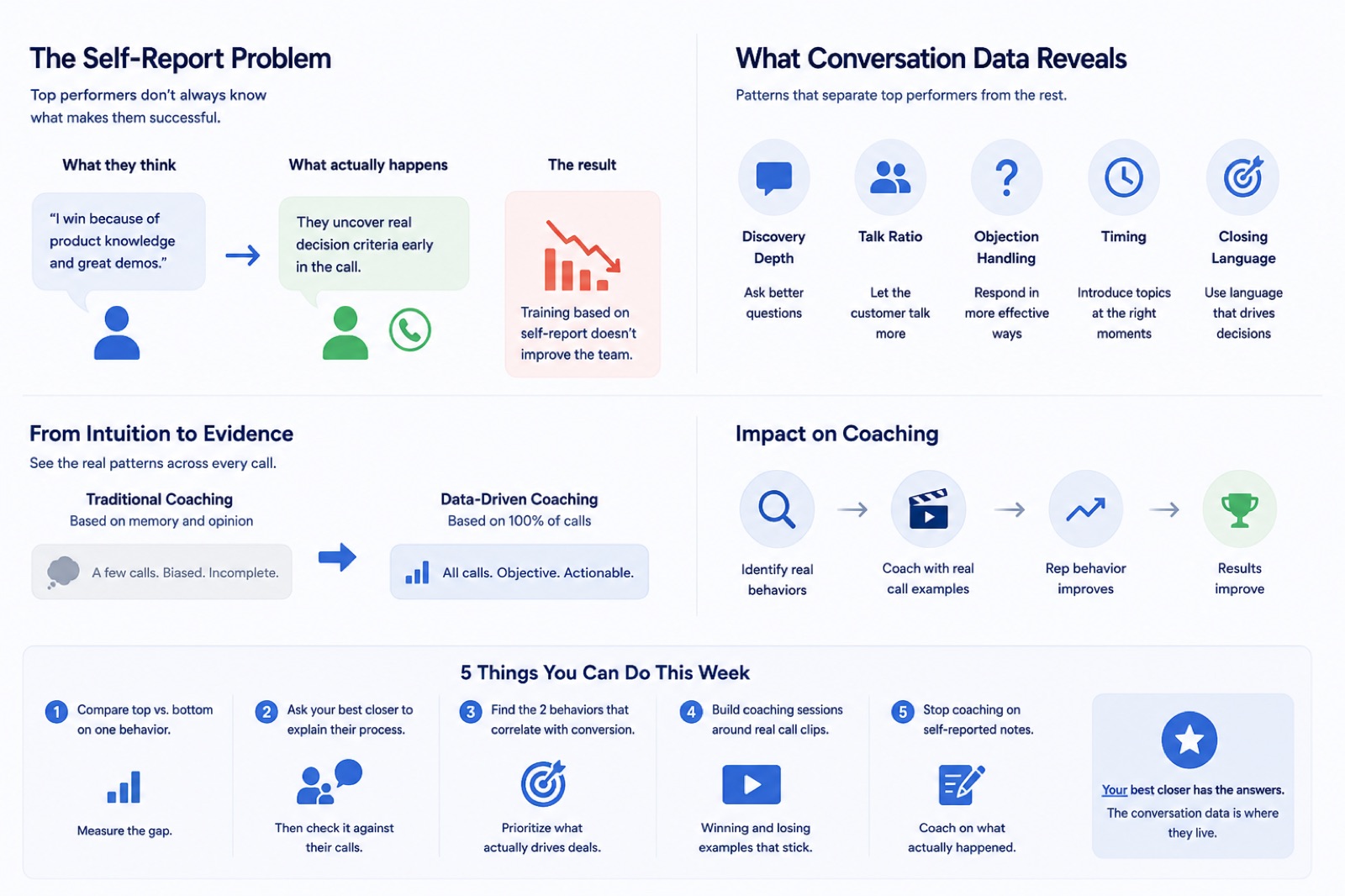
Sales training and coaching are two different jobs, and most teams pay for the first while expecting the results of the second. Training gives a team shared knowledge: the product, the pitch, the process. Coaching changes what an individual rep does on the next call. A team that only trains gets a good week after the workshop and the old habits by the month's end.
This guide is for the sales leader or contact center manager who owns both. It covers the difference, how to build a program that sticks, how to coach a sales team without drowning in call reviews, and what a sales coaching platform should do for you.
Sales Training and Coaching: What Is the Difference?
Training is group instruction on a defined topic: how the product works, the discovery framework, how to handle pricing objections. It happens at a set time, it is the same for everyone, and it ends.
Coaching is ongoing and individual. It starts from what a specific rep did on a specific conversation, names one thing to change and checks on the next conversation whether it changed.
The two depend on each other. Training without coaching fades, because nobody checks whether the new behavior shows up on real calls. Coaching without training gives managers nothing common to point to, so each rep hears a different version of what good looks like.
A practical split:
- Train what is the same for every rep: product knowledge, the call structure, required wording, tools.
- Coach what differs between reps: how they open, how they listen, where they lose the buyer, how they ask for the next step.
How Can I Become a Sales Trainer?
Most sales trainers start as sellers or sales managers who were good at explaining why a call went well. There is no single license or required route, so the useful question is what makes a trainer credible to a team.
- Sell first. A trainer who has run the calls the team runs can answer "what do I say when…" from experience.
- Learn to diagnose. Training that starts from the team's real conversations lands better than a generic curriculum. Listen to a spread of calls, not only the best and the worst.
- Teach one skill at a time. One framework, practiced on real scenarios, beats a day of slides.
- Measure what changed. Write down before the session what you expect to see on calls, then check.
If you manage a team and want to take on this role internally, the same path applies: start with what your own reps say on their own calls.
Sales Coaching Programs: What a Working Program Includes
Sales coaching programs fail for a boring reason: they depend on manager time, and manager time goes to forecasts and escalations first. A program that lasts has five parts.
- A definition of good. A scorecard of the behaviors that separate a won call from a lost one: discovery questions asked, next step agreed, required disclosures said. If two managers would score the same call differently, the program is not ready.
- A source of calls. Coaching starts from real conversations. If managers pick calls by memory or by whichever rep complains, the coaching reflects the sample, not the rep.
- One focus per rep. Each rep gets one behavior to work on until it shows up on calls.
- A fixed rhythm. Weekly, 20 to 30 minutes per rep, on a calendar. Coaching that happens "when there is time" does not happen.
- A check. The next conversations show whether the behavior moved. If it did not, the coaching changes, not only the rep.
The weak point is almost always part two. A manager can review a handful of calls a week, so a team of ten gets coached on a few conversations each month. The rest of what reps do goes unseen.
Coaching a Sales Team: A Weekly Routine
Coaching a sales team works when it is small and repeated. A routine that fits in a manager's week:
- Monday: pull each rep's conversations from the previous week, filtered by the behavior you are coaching, such as calls where the rep never asked about budget.
- Midweek: a 20 to 30 minute one-to-one. Play one moment from one call, ask the rep what they heard, agree on one thing to try.
- Friday: check the next calls for that one thing. Note whether it moved.
Group coaching has a place too. When the same gap shows up across several reps, take it to the next team training and give it a short practice round with real call moments.
What Is the 3 3 3 Rule in Sales?
The "3 3 3 rule" has no single standard definition. Trainers use the label for different things: a three-part call opening, a three-step follow-up cadence, or a limit of three questions or three sentences at a given moment. Ask which version a source means before adopting it.
The more useful point is the pattern behind it. Rules like this give a rep something short to remember under pressure. Whatever version your team uses, treat it as a coachable behavior: define it, listen for it on real calls and give feedback on whether the rep did it.
What Are the 4 C's of Coaching?
There is no standard set of four C's either, and different coaching models use different words. A set that works for sales managers:
- Clarity: the rep knows what good looks like and which behavior is being coached.
- Conversations: the coaching starts from real calls, not from recall.
- Consistency: it happens on a fixed rhythm for every rep.
- Change: you check the next calls and see whether the behavior moved.
If you cannot show the fourth, the first three are only meetings.
Who Are the Top 3 Sales Coaches?
There is no neutral ranking, and a famous name matters less than whether the coaching happens on your reps' own calls every week. A well-known trainer can give your team a shared framework. They cannot listen to the conversations your reps had this week.
When you evaluate any coach, trainer or program, ask:
- Do they work from your team's real conversations or from a generic curriculum?
- How will you see, call by call, whether behavior changed?
- What happens after the workshop ends?
Sales Coaching Platform: What It Should Do
A sales coaching platform exists to fix the sampling problem: it listens to the conversations, so the manager does not have to find them. What to look for:
- Scores the conversations against your scorecard. Ender Turing's AutoQA scores conversations against a scorecard, with automated scorecards typically reaching 95%+ agreement with the customer's own reviewers. Ask any vendor for the measured agreement on your own calls.
- Lets the manager jump to the evidence. A click on a chart opens the conversations behind it, so a coaching point is never an opinion.
- Prepares coaching material for each rep. Scheduled Chats of type "For agent" generate a separate EnderGPT report for each rep on a daily, weekly, monthly or quarterly schedule, so a coaching note per rep arrives every week from that rep's own conversations.
- Fits your calling stack. Calls, meetings and chats come in from the tools reps already use.
- Has a price you can read. Ender Turing's sales plans are published: a free plan for 3 users and 50 conversations a month, Team at $59 per user a month and Business at $89 per user a month. See the pricing page.
The division of labor is the point. The platform takes the routine part, listening to the conversations and scoring them, so that managers spend their coaching hours on the conversations that matter: the lost deals, the disputes, the rep who is close to a breakthrough.
For how this works for sales teams in practice, see Ender Turing for sales teams.
A First Month, Step by Step
You do not need a full program on day one. A month is enough to start:
- Week 1: write a scorecard of five to eight behaviors from your best recent calls. Have two managers score the same three calls and compare.
- Week 2: pick one behavior per rep. Hold the first one-to-ones on real call moments.
- Week 3: run one team training on the gap that showed up across several reps.
- Week 4: check the next calls against each rep's behavior. Keep what moved the numbers and change what did not.
At the end of the month you have a definition of good, a rhythm and your first evidence of what works, which is what separates a program from a training event.