Take a telecom contact center handling about 380,000 calls per month, with a CSAT problem it can’t explain. Its AHT is good. Its FCR is healthy. Its post-call survey response rate is fine. But CSAT is drifting downward quarter after quarter, with no clear driver in any of the operational metrics anyone is tracking.
Turn on dead air analytics across the full call volume, and a pattern can surface quickly.
Calls with more dead air in the first 60 seconds can score lower on CSAT than calls with less. Often the dead air isn’t from hold time. It isn’t from transfers. It comes from agents searching for information in poorly indexed knowledge systems while customers sit on the line listening to nothing. The agent thinks they’re being helpful by not putting the customer on official hold. The customer experiences an awkward silence they interpret as incompetence.
That’s the thing about dead air. It’s the least-tracked KPI in most contact centers, but it’s one of the most predictive ones for the metrics leadership actually cares about.
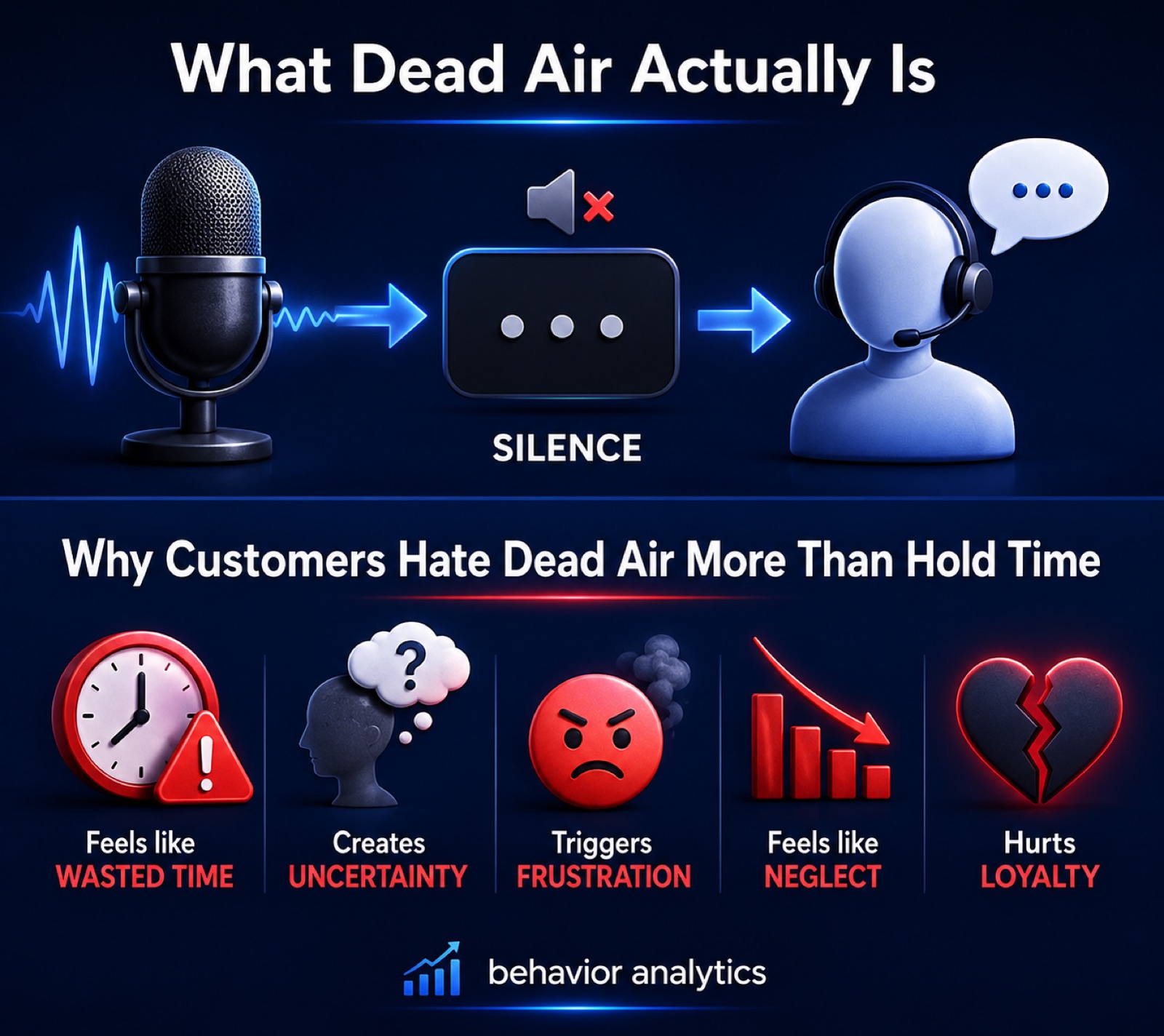
What Dead Air Actually Is (And Isn’t)
Dead air is silence on a call where one or both parties are expected to be speaking. It’s distinct from hold time, which is explicit (the customer hears music or a hold message) and from after-call work, which doesn’t involve the customer at all.
The categories that matter operationally:
Search dead air. Agent is looking up information. Customer is on the line. No music, no hold message, no narration. This is the most common form and usually the most damaging because it’s invisible to most workforce management systems.
Cognitive dead air. Agent is processing what the customer said before responding. Short pauses (under 3 seconds) are normal and healthy. Longer ones signal confusion.
Transfer dead air. The brief silence between systems during a warm or cold transfer. Modern routing platforms have largely solved this, but legacy systems still produce 5-15 second gaps that customers experience as the call going dead.
Interaction dead air. Both parties have stopped speaking and neither is taking the next turn. Usually a sign that the conversation has stalled and one party isn’t sure what’s expected next.
Each category needs a different intervention. Conflating them in your reporting means you can’t fix any of them properly.
Why Customers Hate Dead Air More Than Hold Time
This is counterintuitive, but customers tend to tolerate longer hold times than dead air time. Hold time at least gives them permission to do something else — check email, refill coffee, mute the call. Dead air requires them to keep paying attention to silence, which is more cognitively expensive than waiting.
Listeners notice silence on a call quickly, and the longer it runs, the more they read it as a problem with the conversation itself — the other party has disengaged, is confused, or isn’t competent to handle the request.
In contact center conversations, this interpretation is almost always wrong. The agent is usually working harder during the silence than during the talking — searching, reading, checking entitlement. But the customer can’t see that work. They only hear the absence of conversation, and they assign meaning to it.
The Productivity Trap
Most workforce management programs are designed to minimize talk time and after-call work. Dead air is rarely measured and almost never optimized. This produces a structural incentive that makes the problem worse.
When agents are evaluated on AHT, they avoid putting customers on formal hold because hold time inflates AHT. They keep the customer on the line while they search for information instead. From a metrics standpoint, this looks like good performance — talk time is short, hold time is zero. From a customer experience standpoint, it’s worse than a formal hold because the customer doesn’t know what’s happening.
The result is contact centers where the AHT looks healthy and the CSAT looks puzzling. The dead air is doing the damage and nobody’s looking at it.
What 100% Coverage Reveals
When speech analytics measures dead air across every call instead of sampling, four patterns tend to surface.
Knowledge-system rot. Dead air spikes around specific call topics — usually the topics where the underlying knowledge base hasn’t been updated in 18+ months. Agents are searching longer because the answers are harder to find. This becomes a precise diagnostic for which sections of your knowledge base need urgent attention.
Hidden training gaps. Agents who score well on standard QA can have dead air patterns 2-3x worse than their peers, especially on call types outside their core competency. These gaps are invisible to traditional coaching because they don’t show up in scorecards.
System latency masquerading as agent behavior. Sometimes the dead air isn’t about the agent at all — it’s a CRM that takes 8 seconds to load a customer record. This kind of pattern is invisible until you measure dead air against system-call timestamps, but once you find it, the IT remediation case writes itself.
The Monday spike. Most contact centers see dead air patterns rise on Mondays as agents come back to weekend-accumulated changes in policy or product. This is a coaching cadence issue — Friday briefings catch some of it, but the volume of weekend changes in modern operations usually outpaces what a single briefing can absorb.
The Compliance Dimension
Dead air isn’t just a CX problem. In regulated industries it’s becoming a compliance issue.
In financial services, conversations governed by Consumer Duty in the UK or CFPB guidance in the US require demonstrable clarity in the agent’s communication. Extended dead air during disclosures or product explanations is increasingly cited in supervision findings as evidence that the customer didn’t receive a clear explanation, even when the agent eventually provided one. The customer’s confusion during the silence becomes part of the compliance record.
In healthcare contact centers, HIPAA-adjacent conversations have the same dynamic. A 20-second silence during a benefit explanation is interpreted as the customer not understanding, which raises questions about informed consent for any decision made after that point.
These aren’t theoretical issues. They show up in audit findings and they generate remediation requirements.
From Invisible to Operational: A Realistic Timeline
Here is how it can unfold for a contact center that decides to track dead air seriously.
Week 1. Baseline measurement often reveals more dead air than leadership assumed. The first reaction may be disbelief, followed by a methodology audit. Once the data is validated, the picture clarifies fast.
Month 1. Agents and team leads can see their own dead air patterns in self-serve dashboards. Behavior can change quickly once it’s visible — much faster than for most other coaching topics, because dead air is easy to understand and easy to fix at the individual level.
Month 3. Knowledge base remediation begins targeting the topics where dead air clusters. This is the highest-ROI intervention because it removes the root cause for the largest cohort of calls.
Month 6. Dead air becomes a standard KPI in the operational dashboard alongside AHT, FCR, and CSAT. Workforce management starts factoring dead air into capacity planning because it’s now a known component of the call duration.
Five Things You Can Do This Week
1. Sample 50 random calls and time the dead air manually. This sounds primitive but it’s the fastest way to validate whether you have a hidden problem. If average dead air per call exceeds 15 seconds across the sample, you have material exposure.
2. Cross-reference dead air against CSAT. If you can correlate dead air seconds to CSAT scores at the call level, you’ll have a financial argument for investment. The correlation is usually stronger than leadership expects.
3. Identify your top three knowledge base search failures. Ask your agents which topics they spend the most time searching for. Their list will overlap heavily with the topics that drive dead air. Fix those first.
4. Separate dead air from hold time in your reporting. If both currently roll up into “non-talk time,” you’re hiding the operational signal. They’re different problems with different fixes.
5. Audit one CRM/desktop workflow for system latency. Time the load on a customer record from the agent’s perspective. If it exceeds 4 seconds, you have IT remediation work that will produce immediate CX gains.
Dead air is the most boring KPI in your contact center. It’s also the one most likely to be quietly destroying your CSAT while every other metric tells you everything is fine. The seconds your customers spend hearing nothing aren’t neutral. They’re being interpreted as failure, and the cost is showing up in numbers you can’t currently explain.