Call center coaching methods fall into five working types: side-by-side listening, call review with a scorecard, peer and group sessions, nesting for new hires, and targeted skill drills. Most contact centers use two or three of them. The ones that change behavior share one trait: the coach talks about a specific moment in a specific conversation, soon after it happened, and agrees on one thing to do differently on the next call.
This guide is for the operations leader or team manager who has to choose which methods to run, who runs them, and what has to be true before coaching is worth the supervisor's hour.
What are some call center coaching methods?
Side-by-side and live listening. A coach sits with the agent, or listens to a live call, and gives feedback right after it. It is the fastest feedback loop there is. It also only covers the calls the coach happens to hear, and agents tend to behave differently when someone is listening.
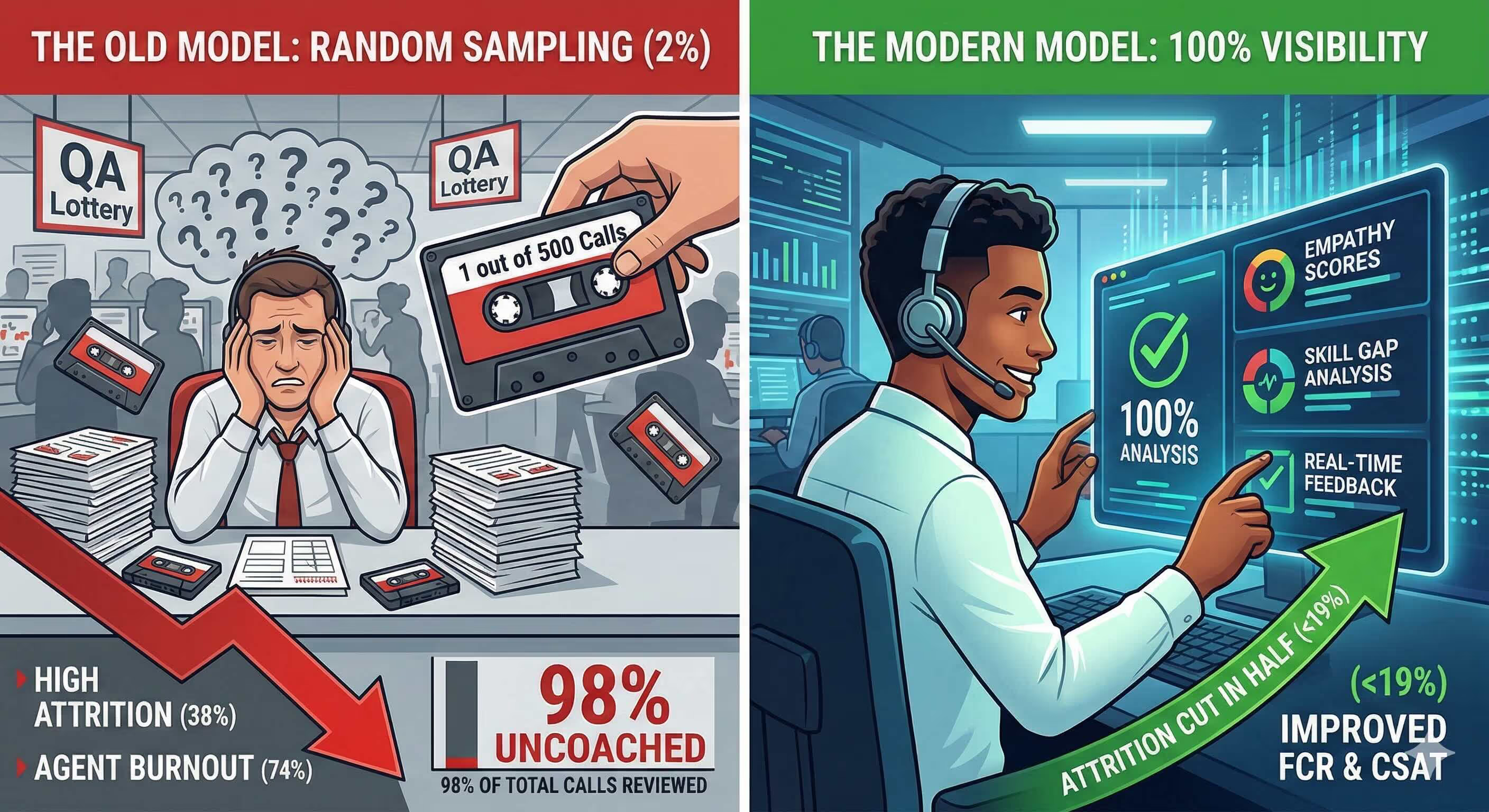
Recorded call review against a scorecard. The coach and agent open a recorded conversation, play the moment that matters and score it against agreed criteria. This is the workhorse method because the evidence is in front of both people. Its weak point is selection: if the coach picks calls at random, the session covers whatever the sample happened to contain, not the agent's real gap.
Peer and group coaching. A top performer shares how they handle a hard objection, a cancellation request or an upset caller, and the team practices it. It spreads a proven habit quickly, and it works best when the example is a real recording rather than a described technique.
Role-play and skill drills. For one narrow skill, such as a compliance disclosure, a de-escalation phrase or a closing question, short practice rounds beat a long talk. Keep each drill to one skill and repeat it until it is automatic.
Nesting. See the next section; it is a coaching method for new hires specifically.
Automated coaching notes. Instead of a supervisor assembling material for every agent, software prepares it. In Ender Turing, a scheduled EnderGPT chat of type "For agent" generates a separate coaching report for each agent or team on a daily, weekly, monthly or quarterly schedule, built from that agent's own conversations. The question, filters and frequency are defined once. The supervisor spends the hour on the conversation with the agent, not on digging for examples.
What is nesting in a call center?
Nesting is the stage between classroom training and full production. A new agent has finished training and now takes live calls in a protected setting: a reduced queue, a limited set of call types, a nearby coach or buddy, and fast feedback after each call. The agent moves to the full queue when they handle the call types independently.
Nesting is coaching with a ramp. What makes it work is that feedback arrives the same day, while the call is still fresh. What breaks it is the opposite: a new hire who gets a first review two weeks after the call has already repeated the mistake dozens of times. If you run nesting, review every nested agent's calls, not a sample, and give each agent the same one or two focus points for the week.
How to manage a call center team through coaching
Coaching fails more often from the way it is managed than from the method chosen. Four habits separate teams that improve from teams that hold meetings:
- Coach from evidence, not impressions. Open the actual conversation. "You seemed rushed" gets an argument; a timestamped moment gets a decision.
- One focus per session. An agent can change one behavior at a time. A list of eight findings changes none.
- Same criteria for everyone. If agents see different standards from different supervisors, they stop trusting the scorecard. Calibration sessions, where reviewers score the same call and compare, keep the standard shared.
- Follow up on the next calls. The session ends with a check: did the behavior change on the following calls? If you cannot answer that, you coached on faith.
All four depend on coverage. If QA reviews a small sample of conversations, coaches pick from a small pool, and the agent whose problem lives in the other calls never gets coached on it. Ender Turing's AutoQA scores every conversation, and its automated scorecards typically reach 95%+ agreement with the customer's own reviewers, so supervisors start from complete data and spend their time on the critical calls, disputes and coaching rather than on listening to routine ones. Every score shows its accuracy, and a click on any chart element opens the conversations behind it, so the coach goes from a pattern to the exact call in one step. The agent management page shows how teams, scorecards, coaching and training sit together.
What is the 80/20 rule in a call center?
In a call center, "80/20" most often names a service-level target: 80% of calls answered within 20 seconds. It is a speed-of-answer standard, and many centers adopt it as their default. It says nothing about what happens during the call.
The other common reading is the Pareto idea applied to coaching: a minority of call types, reasons for calling or agents account for most of the problems. That reading is useful for choosing what to coach. Find the few conversation topics where scores drop, coach those first, and leave the rest. The point is not the exact ratio; it is that coaching hours are limited, so aim them at the largest gap. Topics grouped from your own conversations, and scores filtered by agent, team or topic, make that gap visible without a manual audit.
Choosing your methods
Pick by the problem you have, not by what is fashionable:
- New agents failing in the first weeks: nesting, with full call review and same-day feedback.
- A few agents far below the team: recorded review against the scorecard, one focus at a time.
- A skill the whole team misses: a short drill, then peer sharing of the best real example.
- Supervisors with no time to prepare: automated weekly coaching notes per agent, so preparation is done before the session starts.
- Agents disputing scores: a dispute path and calibration sessions, so the standard is agreed rather than imposed.
The free plan lets a contact center of up to five agents try scoring and review on its own calls, with 100 calls per agent a month and calls up to 10 minutes; see pricing for the paid plans.
A simple weekly rhythm
Start small. Each week, pull each agent's lowest-scoring conversation topic, pick one moment from a real call, hold a 15-minute session, and agree on a single change. Check the next week's calls for that behavior before moving to a new one. Run this for a month on one team, then decide which methods to add. A coaching program does not need to be large; it needs to be specific, regular and based on the calls your agents actually take.