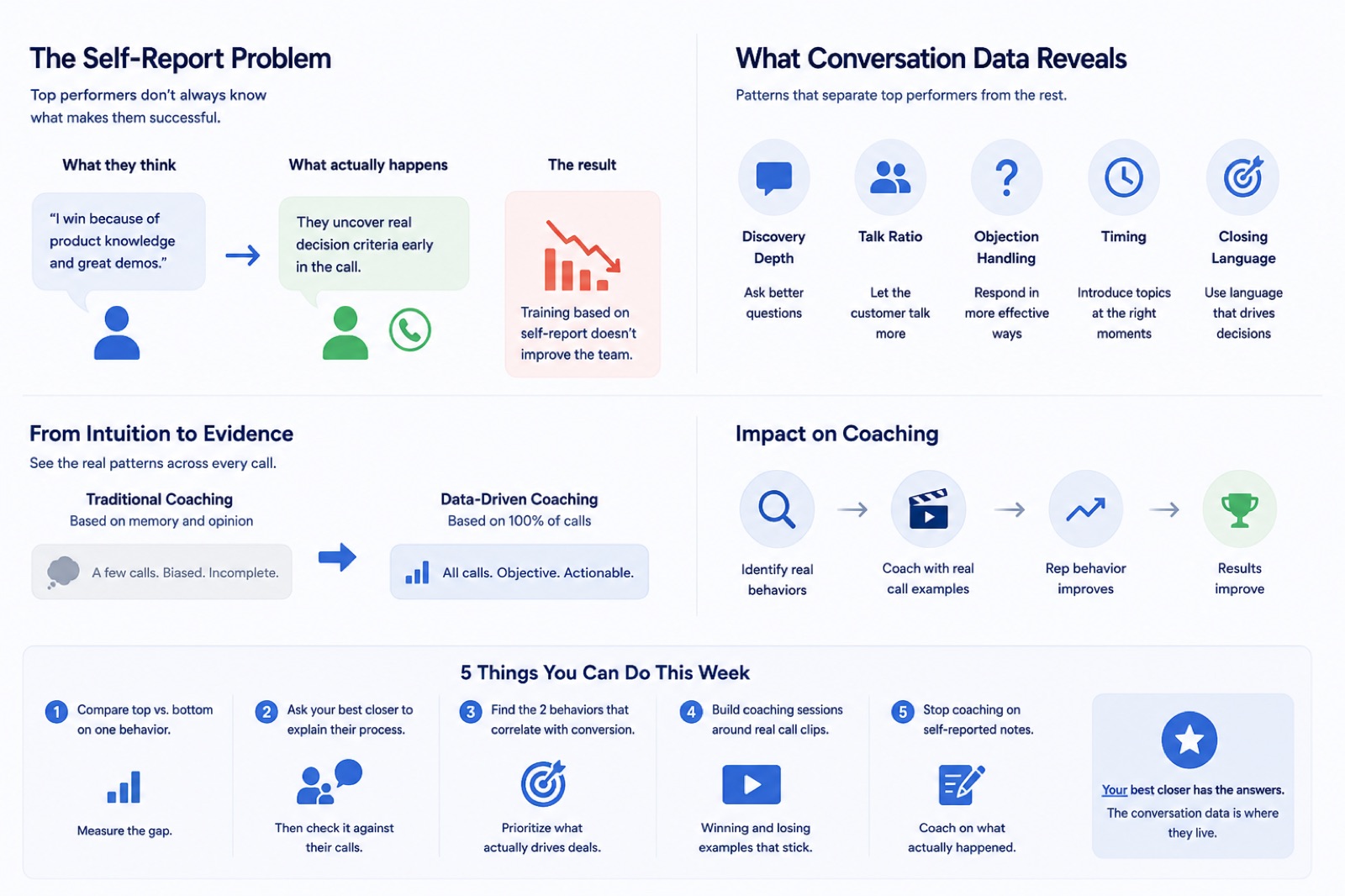
A sales coaching platform is software that turns recorded sales conversations into coaching: it listens to the calls, scores them against criteria your managers agree on, and gives each manager a short list of moments worth discussing with each rep. The test of a platform is simple. After a month, do managers coach on real calls more often, and do reps change what they do on the next one?
This guide is for sales and contact center leaders choosing a platform. It covers what the software has to do, how the main product types differ, what to ask in a demo, and how to start without a long rollout.
What a sales coaching platform has to do
Coaching fails in most teams for one practical reason: the manager cannot find the right call. A rep has hundreds of conversations a month, the manager has a few hours a week, and so coaching runs on whichever call someone happened to hear. A platform removes that bottleneck. Four jobs matter.
- Capture and transcribe every conversation. Calls, meetings and chats land in one place, in any language your customers speak, with speakers separated.
- Score against your own criteria. Discovery questions asked, objections handled, next step agreed, compliance statements read. The criteria are yours, not a generic template.
- Surface the moments to coach. A manager opens a rep's profile and sees the three conversations that explain the gap, with the exact point in each call.
- Close the loop. The coaching note, the agreed action and the next calls to check live next to the conversations, so the manager can see whether behavior changed.
If a product does the first job well and skips the others, you have bought a recording library.
Three types of sales coaching software
Call recording and conversation intelligence. Strong on search and deal visibility. Managers search for a competitor name or an objection and listen. Coaching is manual: the platform finds the call, the manager does everything else.
AI sales coaching tools. These score conversations automatically and give reps feedback, sometimes with role-play practice. They differ in what they score and how. Ask what the score is measured against, because a score nobody can check teaches reps to distrust it.
Contact center QA with coaching built in. Common for inside sales, outbound teams and sales-adjacent support. Every conversation is scored on a scorecard, and coaching workflows sit on top of the scores. This is the type that fits teams where volume is high and consistency across reps matters.
Most buying mistakes come from comparing a product of one type with a product of another type on a feature list.
B2B sales coaching: what changes for long cycles
B2B sales coaching has a different rhythm from high-volume outbound. Deals run for weeks, conversations are fewer and longer, and the decisive moment is rarely the last call. A B2B team needs the platform to follow a deal across calls and to let a manager review a full discovery call rather than a one-minute clip.
Coach on the behaviors that repeat across your won deals: how the rep opens discovery, whether the buyer's own words frame the problem, how pricing is introduced, and whether every call ends with a dated next step. Pick three, define each in a sentence your managers agree on, and score only those at first.
Sales performance coaching: from score to behavior
Sales performance coaching works when the score leads to one specific change. A practical weekly rhythm:
- Monday: the manager opens each rep's profile and reads the scored conversations, starting with the lowest-scoring criterion.
- Midweek: a 20-minute one-to-one that plays one real moment from one call and agrees on one thing to do differently.
- Following week: the platform shows whether that criterion moved on the next calls.
The platform's job is to make the first step take minutes and the third automatic. The manager's job is the conversation itself, which no software replaces.
Questions to ask in a demo
- Which of my calls will you score, and how many? Sampling hides the calls that matter. Ask for coverage of every conversation, not a selected few.
- How do I know the score is right? Ask for the measured agreement between the automated scores and your own reviewers, on your calls. A vendor who cannot show it on your data is describing a demo.
- Who defines the criteria? Your managers should write and change them without a services project.
- What happens when reviewers disagree with a score? The best systems feed that disagreement back into the definition of the criterion.
- What is the pricing unit? Per user, per conversation or per minute: get it in writing, and ask what changes when volume doubles.
- Where does the coaching happen? Notes, actions and follow-up calls should live in the same record as the conversation.
How Ender Turing approaches sales coaching
Ender Turing analyzes every conversation and scores it on your scorecard. Automated scorecards typically reach 95%+ agreement with the customer's own reviewers, and the reviews your team gives rewrite the point definitions, so agreement improves with use. Managers get the scored conversations per rep instead of a random sample, so coaching starts from the calls that explain a rep's results.
Ender takes over the routine part, listening to every call and scoring it. The important part stays with people: the critical calls, disputes about a score, calibration sessions and the coaching conversation itself. See how this works for revenue teams on the sales use-case page.
How to start in two weeks
- Week one: pick one team of 8 to 15 reps. Define three criteria with their manager and load a month of recorded conversations.
- End of week one: have two managers review the same 20 conversations by hand and compare them with the automated scores. Rewrite any criterion where they disagree.
- Week two: run the weekly coaching rhythm above for every rep and note which criteria moved.
- After two weeks: decide on evidence. If managers are coaching on real calls and the scores track their own judgment, extend to the next team.
A platform earns its place when coaching becomes a weekly habit that every rep gets, not a favor for the reps whose calls a manager happened to hear.