Contact center speech analytics is software that turns recorded customer calls into data a team can search and count. Every call is transcribed, sorted into topics such as the reason for the call, checked for the lines agents must say, and measured for silence, holds, repeat contacts and how the customer's mood moved from the first minute to the last. Instead of the handful of calls a supervisor has time to hear, the whole month becomes visible.
This guide covers how it works, what it finds, which KPIs it explains, how it differs from call recording, quality assurance and conversation intelligence, and how to roll out and choose speech analytics software.
Why contact centers need speech analytics
Almost every contact center records its calls; far fewer analyze them. In ContactBabel's 2024 US Contact Center Decision-Makers' Guide, call recording is close to universal, yet only 39% of the contact centers surveyed use interaction analytics, and a further 37% plan to.
The gap shows up first in quality assurance. SQM Group says manual QA often evaluates only 1–2% of customer calls, with most agents scored on 4 to 10 calls a month. Picture an agent who takes 800 calls a month: ten reviewed calls are just over 1% of that work, chosen before anyone knew which calls mattered.
Speech analytics closes the gap by doing the listening. It analyzes 100% of calls, so the complaint that never reached a survey, the disclosure that was skipped and the offer that was never made appear in the numbers instead of in nobody's memory.
How contact center speech analytics works
Four steps run on every call.
- Capture. Recordings arrive from the phone system or contact center platform through an integration, an export or a browser recorder. Stereo recordings, with the agent and the customer on separate channels, let the software tell who said what; ContactBabel notes that some recording environments are still mono.
- Transcribe. Speech recognition turns the audio into text with speaker labels. This step decides the quality of everything after it: a misheard product name breaks every search and topic built on it, which is why good tools let you add your own vocabulary. Why 95% word accuracy can still fail you explains the math.
- Analyze. Each transcript is classified and measured: topics (why the customer called, what they asked for, how the call ended), phrases that must or must not be said, and metrics such as silence share, hold time, talk time and repeat contacts from the same customer. A sentiment model can also estimate how satisfied the customer sounded at the start and at the end.
- Act. Results land on dashboards, in search, in alerts and in quality scores. Newer tools also answer questions in plain language, such as "why did cancellations rise last week?", with the calls behind the answer.
Real-time or post-call speech analytics?
Post-call speech analytics analyzes each recording after the call ends; real-time speech analytics works while the call is running. Post-call is the common case: among the analytics users in ContactBabel's survey, 68% run post-call speech analytics and 18% run real-time speech analytics.
"Real-time" describes two different things. One is speed: results that arrive seconds after a call ends, in time to act the same day. The other is help during the call: the next step or answer on the agent's screen while the customer is still talking, a product category usually called real-time agent assist. Ask a vendor which one they mean, and how many seconds after the call the results appear.
What speech analytics finds in a contact center
Why customers call, and what changed this week
Topic volumes by day, queue and product show the reason behind a spike before the monthly report does. A new fee, a broken delivery promise or a confusing letter shows up as a rising topic, with the calls attached.
Repeat calls and their reasons
First-contact resolution is hard to measure from disposition codes alone. Among the contact centers in ContactBabel's survey that measure first-contact resolution, 86% rely on supervisors scoring monitored calls and 47% use analytics of the recordings. Speech analytics links the second call to the first and shows what the customer had to explain again.
Required lines and compliance
Disclosures, identity checks, consent statements and closing lines can be checked on every call instead of on a sample, with the missed line highlighted in the transcript. The difference matters most when an auditor asks for the calls nobody reviewed; see the recording gap that becomes a fine.
Silence, holds and dead air
Long silences and repeated holds usually mean an agent is searching for an answer. Measured on every call, they point to the knowledge article that is missing or the system that is slow. More in dead air in contact centers.
Satisfaction without a survey
A few customers answer a survey; every customer leaves a conversation. Sentiment at the start and at the end of each call shows which topics, queues and agents move satisfaction, and the survey becomes a check on numbers you already have for everyone.
Sales and retention signals
Offers made and not made, competitor mentions, cancellation reasons and the objections that end a sale are all in the words. Seven revenue signals hiding in calls goes through them one by one.
Coaching moments
The calls where an agent recovered an angry customer, and the ones where a new agent froze, become playlists and coaching material instead of anecdotes.
Speech analytics KPIs
Speech analytics does not replace your KPIs; it explains them. Each metric it measures points to the KPI it moves:
| What speech analytics measures | The KPI it explains |
|---|---|
| Repeat contacts from the same customer, and why | First-contact resolution |
| Silence share, hold time, talk time | Average handle time |
| Sentiment at the start and the end of the call | Customer satisfaction |
| Required lines said or missed | Compliance rate and QA score |
| Topic volumes by reason for the call | Contact rate and self-service gaps |
| Offers, objections and outcomes | Conversion and retention |
For the definitions and formulas behind each KPI, see contact center KPIs.
Speech analytics vs call recording, QA and conversation intelligence
- Call recording stores the audio. Speech analytics makes it searchable and countable.
- Quality assurance scores conversations against a scorecard. Speech analytics supplies the evidence, and automated quality assurance applies the scorecard to every call instead of a sample.
- Conversation intelligence is the same idea named by the sales world, applied to sales calls and meetings; our guide What is conversation intelligence? covers the overlap.
- Voice analytics looks at the sound itself, such as pace, tone and silence, while speech analytics looks at the words. One tool can measure both: silence and holds come from the audio, topics from the words.
How to roll out speech analytics
- Start with three questions you cannot answer today. For example: why do customers call back within a week, which lines do new agents skip, and where do bookings or sales fail.
- Connect the platform you already run, read-only, or upload a week of recordings, and check that agent and customer are on separate channels.
- Add your vocabulary: product names, plan names, branch and agent names.
- Build topics from real samples and check them against your reviewers before anyone trusts a chart.
- Put the findings in front of team leads every week, with the calls attached, so the numbers turn into coaching.
- Automate the follow-up: an alert when a compliance line is missed, a review queue for calls that went wrong, a weekly report per team.
How to choose contact center speech analytics software
Six checks separate a tool you will use from a dashboard nobody opens:
- Every call, not a sample. Coverage is the point; a tool that samples repeats the QA problem.
- Your languages and your vocabulary. Test it on your own recordings, including your product names.
- Accuracy you can check. Topics and scores should show how often they agree with your own reviewers.
- On top of your platform. It should connect to the phone system or contact center platform you run, without replacing it.
- Answers with the calls attached. Every chart and every answer should open the conversations behind it.
- A published price and current security. A free plan or published per-agent pricing, plus an independent audit such as SOC 2 Type II.
Our speech analytics software page shows how Ender Turing does each of these.
Speech analytics in Ender Turing
We make Ender Turing, so read this section as the vendor's own description; every fact in it is on our product pages.
Ender Turing transcribes, summarizes, categorizes and scores every call, chat and email seconds after it ends, in any language your customers speak, on speech recognition built in-house by its R&D team. Topics come from generative AI, rules or human labels, with their accuracy checked against your reviewers; compliance rules give every call a script-adherence score. The metrics include silence share, longest monologue, holds and hold time, waiting and response time, and repeat calls from the same customer. EnderGPT answers questions about your conversations with the calls cited, and Enders turn a finding into an action, such as a manager alert or a review task.
It connects read-only to the platform you already run: Genesys Cloud, Five9 and Zendesk through documented apps or connectors, NICE CXone, Talkdesk, Amazon Connect and more through a browser extension that records calls in stereo, or any other system through the REST API, SFTP or upload.
Averages across our contact-center deployments: 100% of calls automatically scored, against a 3–5% manual baseline; a +19% average lift in customer satisfaction; a −15% reduction in average handle time; and 68 QA hours saved per specialist per month. Each customer's own numbers are in the case studies.
The free plan has no expiry: up to 5 agents, 100 calls per agent a month, calls up to 10 minutes. Team is $39 per agent a month with no limits (pricing).
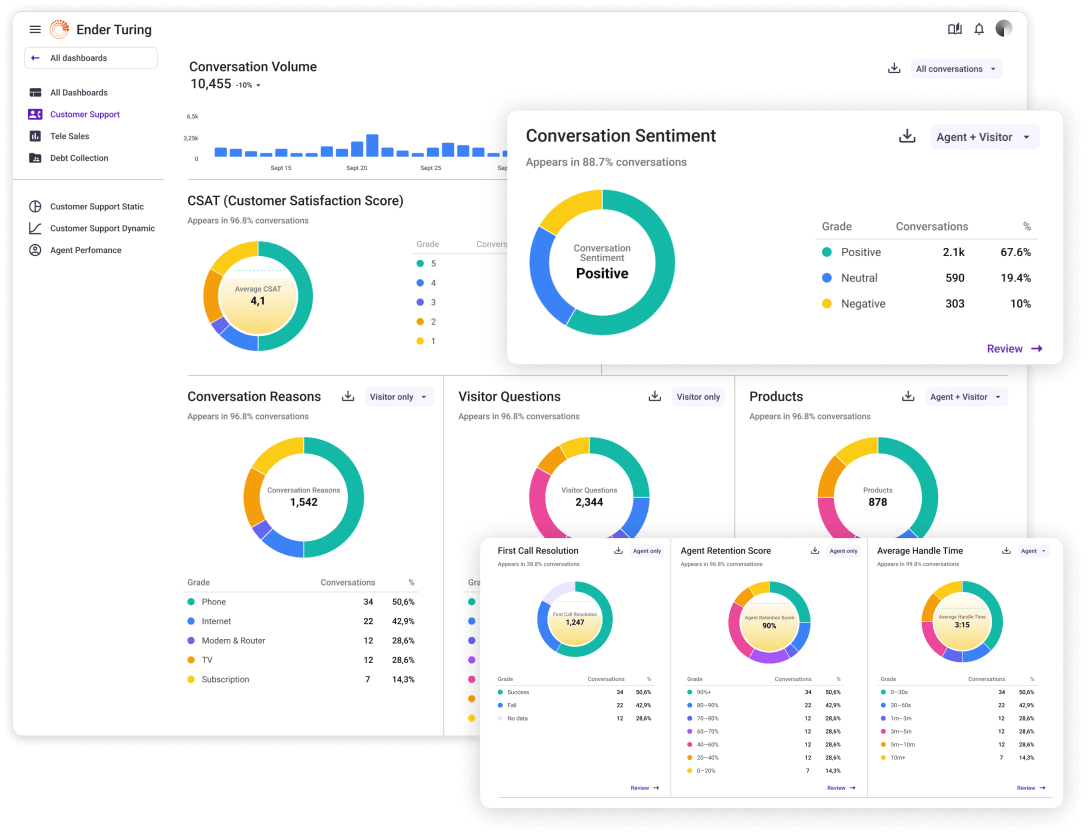
Speech analytics in Ender Turing: the reasons, questions and products behind the calls, with sentiment and CSAT. Speech analytics software →
Contact center speech analytics FAQ
What is speech analytics in a call center?
Software that transcribes recorded calls and turns them into topics, keyword and compliance checks, and metrics such as silence and repeat contacts, so a team sees what happens across all calls instead of the few someone listens to.
What is the difference between speech analytics and voice analytics?
Speech analytics works on the words: what was said, by whom, and in what order. Voice analytics works on the sound: pace, tone and silence. A contact center tool can do both, as silence and hold time come from the audio while topics come from the words.
How accurate is speech analytics?
It depends on two things: how well the speech recognition handles your accents, audio and product names, and how well the topics are defined. Test both on your own recordings, and prefer a tool that shows how often its topics and scores agree with your reviewers.
Does speech analytics work in every language?
It depends on the speech recognition behind it, so test your own languages before you buy. Ender Turing works in any language your customers speak.
How much does speech analytics cost?
Ender Turing has a free plan with no expiry for up to 5 agents, and Team at $39 per agent a month with no limits. The pricing page compares what each plan includes.
Do I need stereo recordings for speech analytics?
It helps. With the agent and the customer on separate channels, the software knows who said each line, which makes compliance checks and agent metrics more reliable. Mono recordings can still be analyzed, with less certainty about the speaker.