A CSAT survey asks a customer one question right after a contact: how satisfied were you? The customer answers on a scale, usually 1 to 5, and your CSAT score is the share of 4s and 5s. It is a quick way to learn how one call, chat or delivery went, and it has one known weakness: in 2025 the median CSAT survey got an answer from 7.5% of the people who saw it, across 560 surveys from 145 companies. This guide covers the questions to ask, the scale, the formula, when to send the survey and what counts as a good score. It ends with how contact centers now get a CSAT for every conversation, with no survey to send.
What is a CSAT survey?
A CSAT (customer satisfaction) survey is a short questionnaire sent right after a specific interaction, such as a support call, a chat, an email reply, a purchase or a delivery, asking the customer to rate how satisfied they were with it. A "CSAT test" and a "client satisfaction survey" are the same thing; B2B teams tend to say client.
Because it asks about one moment, CSAT is a transactional metric. It tells you how a contact went, not whether the customer will stay or recommend you. That longer view is what NPS measures, and CSAT vs NPS sets the two side by side.
A good CSAT survey has three parts:
- One rating question about the contact that just ended.
- One open question that asks why.
- One optional yes-or-no question, usually whether the issue was resolved.
The CSAT formula
CSAT score (%) = satisfied responses ÷ all responses × 100
On a 1–5 scale, satisfied means a 4 or a 5. As a worked example, if 420 customers answered and 340 of them gave a 4 or a 5, your CSAT is 340 ÷ 420 × 100 = 81%.
Some teams report the average rating instead, such as 4.2 out of 5. Either works if you pick one, write it down and keep it. Never compare your share of 4s and 5s with another team's average rating.
A customer satisfaction index (CSI) is a different measure: it combines the answers to several questions into one weighted score. For a contact center, the simple CSAT formula above is the one to track week by week.
Which scale to use
Use a 5-point scale unless you have a reason not to. In Survicate's 2025 data, 80.6% of 1,259 CSAT surveys used five points, and 5-, 7- and 10-point scales together made up 98.5%. The same report found 69.2% of those surveys showed the scale as stars, hearts or thumbs rather than numbers or words.
Three rules keep the scale honest:
- Label both ends: 1 is "Very dissatisfied" and 5 is "Very satisfied". On the phone, say it before the customer presses a key.
- Keep the same scale over time. A switch from 5 to 10 points breaks your trend line.
- Count 4s and 5s as satisfied, and nothing else. A 3 is neutral, not half a win.
CSAT survey questions you can use
Pick one rating question for each survey, matched to the contact that just ended:
- How satisfied were you with your experience today?
- How satisfied were you with the support you received?
- How satisfied were you with how [agent name] handled your request?
- How satisfied are you with how your issue was resolved?
- How satisfied were you with how quickly we answered?
- How satisfied were you with your order and its delivery?
- How satisfied are you with [product or feature]?
- How satisfied were you with your onboarding?
- How satisfied are you with our team's work this quarter? (for B2B clients)
Then add one or two follow-up questions:
- What is the main reason for your score?
- Was your issue resolved today? (Yes / No)
- How easy was it to get your issue handled? (1–5, the customer effort question)
- Did you have to contact us more than once about this? (Yes / No)
- What is one thing we could have done better?
- Is there anything else you want us to know?
A three-question template for a support contact:
- How satisfied were you with the support you received today? (1 = Very dissatisfied, 5 = Very satisfied)
- What is the main reason for your score? (open text)
- Was your issue resolved? (Yes / No)
Keep it to three questions at most. The hard part is the first answer, not the last: in Survicate's data, the median completion rate was 78.9%, so most people who start a CSAT survey finish it.
When and how to send a CSAT survey
- Right after the contact, in the same channel. End a chat with the rating in the chat window, add it to the email that closes a ticket, and ask at the end of a call by keypad or by text message soon after.
- One survey per contact, and not every contact. Set a limit per customer, such as one survey a month, so the people you ask most often are not the ones who stop answering.
- Make it easy to answer where the customer is. Format matters: mobile surveys had the highest median response rate, 20.2%, among the formats Survicate compared.
- Tag every answer with the contact's reason. A CSAT that you can split by topic, team and agent tells you where to act; one number for the whole operation does not.
What is a good CSAT score?
In Survicate's 2025 data, the median CSAT score was 80.0%, half of all surveys scored between 64.8% and 90.0%, and a score above 90.0% put a survey in the top quarter.
The benchmark moves with the business. Manufacturing and logistics had the highest median CSAT, 93.0%, and media and marketing the lowest, 69.9%, while companies with 11 to 50 employees reached a median of 85.6% against 75.5% for those with 1,000 or more.
Phone support sits near the bottom of the list. In a Qualtrics study of 27,146 US consumers, published in 2026, call center experiences got 75% satisfaction, behind every digital channel except virtual agents, while in-person service reached 87%.
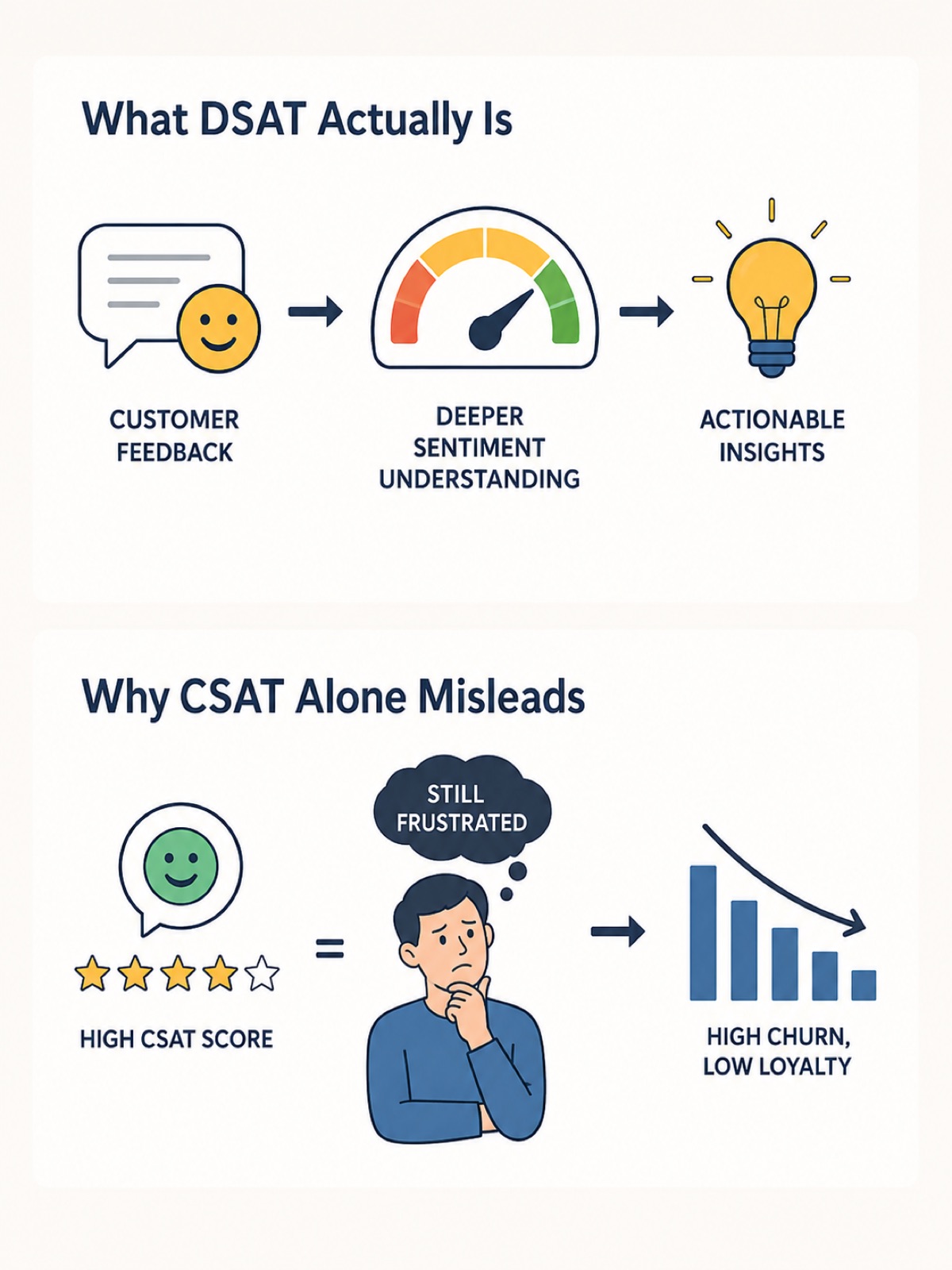
So compare your score with your own trend first and your industry second, and watch the share of 1s and 2s as closely as the average. A stable 80% can hide a growing group of very unhappy customers, which is what DSAT measures.
What a CSAT survey cannot tell you
A survey score is useful, and it has four blind spots:
- Who answered. With a median response rate of 7.5%, respondents choose themselves. The score describes them, not the customers who said nothing.
- When it happened. The answer arrives after the contact, hours or days later, when the customer who left unhappy has already left.
- Why. A rating carries no reason unless the customer writes one. The reason is in the conversation itself: the hold time, the refund policy, one line of a script.
- What you assume. A team can rate its own channel higher than customers do. In two Qualtrics studies from 2026, just 3% of CX practitioners called their phone experience poor, while customers gave phone support 75% satisfaction; Qualtrics reads the pair as a directional signal, not a like-for-like comparison.
How to get a CSAT score for every conversation
Contact centers that record their calls and keep their chats and emails can now score satisfaction on all of them, not on the few who answer. Ender Turing's AI CSAT analyzes every call, chat and email and gives each one an entry CSAT and an exit CSAT, from 1 to 5: how the customer arrived and how they left. The change between the two is what happened during the conversation.
- By agent and by topic. Entry and exit CSAT appear per agent in the Dashboard and per conversation in the export.
- For the executive who asks. The pre-built CSAT Dynamics board on C-Level Boards shows the whole picture, and each number opens the conversations behind it.
- The same day, not next week. A low exit CSAT can trigger an Ender, an automation that notifies a team lead, creates a task or sends a message.
- Next to your surveys. Where your telephony or CRM supplies survey CSAT and NPS, they become filters on the same conversations, so you can compare the customers who answered with everyone else.
- In any language your customers speak.
On one contact center's live CSAT Dynamics board in September 2026, 39,554 conversations were scored, with an entry CSAT of 2.92 and an exit CSAT of 3.38, a +15.75% change. OTP Bank improved CSAT by 18%, from 6.8 to 8.0 on a 10-point scale. And OTP Bank, Dila Med Labs and Fozzy Group report doing marketing analysis and NPS 20 times faster and 50 times cheaper with Ender Turing.
Keep the survey for what only a survey can ask
A survey still has jobs: asking something the customer never said in the conversation, such as how likely they are to recommend you, or measuring the relationship over a year rather than one contact. Keep the survey short and keep it for those questions. Let the conversations carry the CSAT: every conversation analyzed in seconds, with no survey to send. To see entry and exit CSAT on your own calls, chats and emails, start with AI CSAT.
FAQ
What is a CSAT test?
Another name for a CSAT survey: one rating question after a contact, usually on a 1–5 scale, and the share of 4s and 5s as the score.
How many questions should a CSAT survey have?
One rating question and one or two follow-ups, such as the reason for the score and whether the issue was resolved. Three is a sensible maximum.
What is the difference between CSAT and NPS?
CSAT rates one interaction right after it happens. NPS asks how likely the customer is to recommend you on a 0–10 scale, which measures the relationship rather than one contact.
Can you measure CSAT without a survey?
Yes. AI CSAT scores each recorded call, chat and email from the conversation itself, so every customer counts, including the ones who never answer a survey.