CSAT and NPS answer different questions. CSAT (customer satisfaction score) asks how satisfied a customer was with one interaction. NPS (Net Promoter Score) asks how likely the customer is to recommend the company, which makes it a measure of the whole relationship. In a contact center, that difference decides which one can tell you anything about a call, an agent or a queue.
Below: the two formulas, a side-by-side table with CES (customer effort score), when to use each, and what all three miss.
CSAT vs NPS vs CES at a glance
| CSAT | NPS | CES | |
|---|---|---|---|
| Question | "How satisfied were you with your call today?" | "How likely are you to recommend us to a friend or colleague?" | "How easy was it to get your issue handled?" |
| Scale | Usually 1–5 | 0–10 | Usually 1–7 (agree to disagree) |
| Score | Share of 4s and 5s among answers | % promoters (9–10) minus % detractors (0–6) | Average answer, or share of "easy" answers |
| Range | 0–100% | −100 to +100 | Depends on the scale |
| Measures | One interaction | The relationship | The effort of one task |
| When to send | Right after the contact | Every few months, or after a key moment | Right after the task |
| What it misses | Why the customer felt that way | Why, and which contact moved it | What went wrong, only that it was hard |
Sources, checked November 20, 2026: the NPS question, scale and formula are Bain & Company's, from Measuring Your Net Promoter Score. CSAT and CES have no single owner; the scales above are the common ones.
What CSAT measures
CSAT asks about one contact, right after it: a call, a chat or an email. The usual question uses a five-point scale, from "very dissatisfied" to "very satisfied", and the score is the share of customers who chose 4 or 5.
Picture a week with 180 answers, 135 of them 4s and 5s. CSAT is 135 ÷ 180 = 75%.
What CSAT is good for: judging a specific contact, agent, team or queue, because the question is about that contact. It reacts fast: a bad week shows up the next week.
What CSAT misses:
- The customers who don't answer. The score describes the people who replied, not everyone who called.
- The difference between the agent and the policy. A customer refused a refund by policy can give a 1 to an agent who did everything right.
- The reason. A 2 says something went wrong. It does not say what.
What NPS measures
Fred Reichheld of Bain & Company introduced the Net Promoter Score in Harvard Business Review. Bain's definition: ask "How likely are you to recommend us to a friend or colleague?" on a zero-to-ten scale, then subtract the percentage of detractors from the percentage of promoters.
- Promoters (9 or 10): loyal customers who recommend you.
- Passives (7 or 8): satisfied for now. They count in the total but in neither group.
- Detractors (0 to 6): unhappy customers.
Picture 200 answers: 110 promoters (55%), 60 passives and 30 detractors (15%). NPS is 55 − 15 = 40. The highest possible score is +100, every answer a 9 or 10; the lowest is −100, every answer 6 or below.
According to Bain & Company, promoters account for more than 80% of referrals in most businesses, which is why the score serves as a loyalty measure.
What NPS is good for: a loyalty trend leadership can follow over quarters, compared across products, segments or regions.
What NPS misses in a contact center: it is about the company, not the call. A customer who loves your product can give a 10 after a poor call, and one who is leaving can give a 2 after a perfect one. NPS also says nothing about why.
Transactional NPS vs CSAT
Transactional NPS asks the recommend question right after a contact instead of on a schedule. It shows how loyal the customer feels at that moment, with the contact fresh in mind. It still asks about the company, so it mixes the call with the price, the product and every earlier experience.
If you want to judge the contact, CSAT is the closer question. If you want to see whether contacts move loyalty, compare transactional NPS for customers who called with relationship NPS for those who did not.
Where CES fits
CES asks how easy it was to get something done: an issue resolved, a form completed, a return processed. In a contact center, effort shows up without a survey too: in transfers, holds and repeat calls about the same issue. A CES survey asks the customer for it. First call resolution by reason measures it from your own data.
Which one should a contact center use?
- To judge a call, an agent or a queue: CSAT, sent after each contact.
- To report loyalty to leadership: NPS, on the relationship, every few months.
- To find friction in a process: CES after the task, next to repeat contacts by reason.
Most contact centers run CSAT after contacts and leave NPS to the CX or marketing team. That split works, as long as nobody takes an NPS move as a verdict on the contact center, or a CSAT move as a verdict on the company.
What all three miss: the reason, and everyone who didn't answer
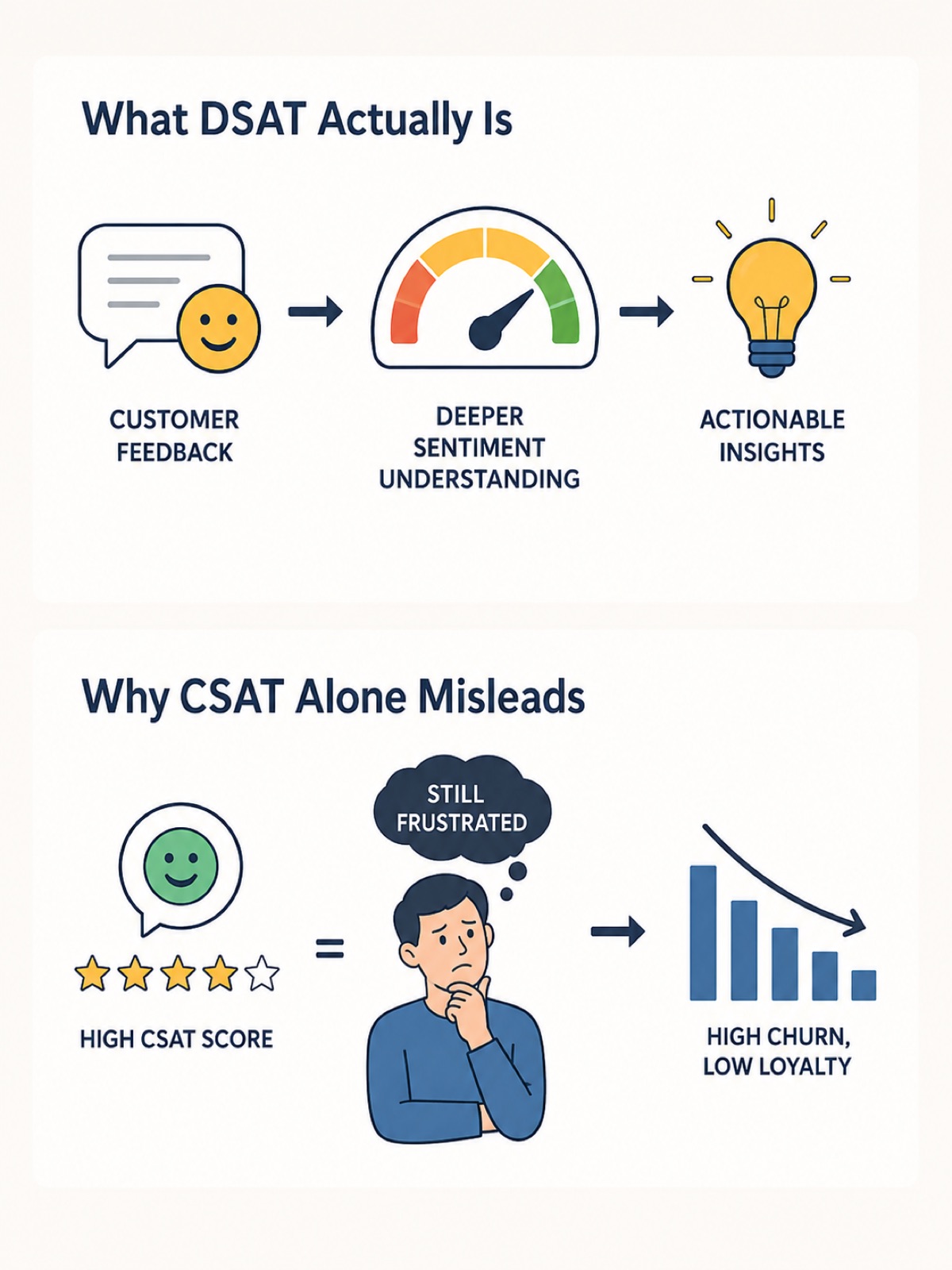
CSAT, NPS and CES are all surveys. They come from the customers who answer, after the contact, and none of them says why.
That matters most when a score falls. A survey cannot tell you whether the agent caused the drop or the customer was already upset when the call began, about a billing error, a late delivery or a new fee. Those are different problems with different owners, and only the second one is outside the contact center.
The conversation itself can tell them apart. Ender Turing's AI CSAT analyzes every call, chat and email and gives each one an entry CSAT and an exit CSAT, how the customer arrived and how they left, by agent and by topic, on 100% of conversations. Entry CSAT shows whether customers were already unhappy when the call began. Group those calls by reason, open them, and take them to the team that owns the problem (CSAT fell. Was it your team?). Where your telephony or CRM supplies survey results, CSAT and NPS sit next to the AI score as filters on the same conversations, so you can compare the two.
Keep the surveys for the trend. Use the conversations for the reason.
CSAT vs NPS: questions people ask
What is the difference between CSAT and NPS? CSAT rates one interaction, usually on a 1–5 scale, as the share of 4s and 5s. NPS asks how likely a customer is to recommend the company on a 0–10 scale, as the percentage of promoters (9–10) minus the percentage of detractors (0–6). CSAT is about a contact; NPS is about the relationship.
What are the three categories of NPS customers? Promoters score 9 or 10, passives 7 or 8, and detractors 0 to 6. Only promoters and detractors enter the formula; passives count in the total.
What is the highest NPS score? +100, when every answer is a 9 or a 10. The lowest is −100.
Is NPS better than CSAT? Neither is better; they measure different things. Use CSAT to judge contacts and agents, NPS to follow loyalty over time.
Can you convert CSAT into NPS? No. They use different questions and different scales, so one cannot be calculated from the other. Track them side by side.