The net promoter score question asks customers one thing: "How likely is it that you would recommend [company] to a friend or colleague?", on a scale from 0 to 10. Customers who answer 9 or 10 are promoters, 7 or 8 are passives, and 0 to 6 are detractors. Your Net Promoter Score (NPS) is the percentage of promoters minus the percentage of detractors, so it runs from −100 to +100. This guide covers the exact wording and its variants, the follow-up questions worth adding, how to calculate the score and what counts as good. It ends with how to replace what your NPS survey is for with analysis of every conversation, with no survey to send.
The net promoter score question, word for word
"How likely is it that you would recommend [company] to a friend or colleague?"
Show all 11 points from 0 to 10, and label both ends: 0 is "Not at all likely" and 10 is "Extremely likely". Ask it first, before any other question, and keep the wording the same from one survey to the next so the scores stay comparable.
The same question comes in a few versions:
- Relationship NPS asks your customer base about the company as a whole, at regular intervals such as twice a year.
- Transactional NPS asks right after a specific interaction, such as a purchase, a delivery or a support call.
- Product NPS names a product instead of the company.
- B2B NPS often says "a colleague or business partner" instead of "a friend or colleague".
- Employee NPS (eNPS) asks staff: "How likely is it that you would recommend [company] as a place to work?"
How to calculate NPS
NPS = % of promoters − % of detractors
As a worked example, suppose 400 customers answered: 180 gave a 9 or 10, 120 gave a 7 or 8, and 100 gave 6 or less. Promoters are 45% and detractors 25%, so your NPS is 45 − 25 = +20. Passives count in the total but not in the score.
Follow-up questions to ask after the NPS question
The score tells you how many customers would recommend you, not why. Add one or two follow-ups:
- For everyone: "What is the main reason for your score?" (open text)
- For detractors (0–6): "What is the one thing we should fix?"
- For passives (7–8): "What would make you more likely to recommend us?"
- For promoters (9–10): "What do you value most about us?"
- Optional: "May we contact you about your answer?" (yes or no)
Keep the whole survey to the NPS question and one or two follow-ups. In Survicate's response-rate data, surveys of two or three questions had the highest median response rate, 15.97%, ahead of single-question surveys at 9.75%.
What is a good NPS?
Anything above zero means you have more promoters than detractors, and the benchmark depends on your market. In Survicate's 2026 NPS benchmarks, built on 969 NPS surveys from 265 companies between January and September 2026, the median NPS was 45, the middle half of companies scored between 24 and 63, and a quarter scored 24 or lower. In the same data, the median was 44 for B2B companies and 47 for B2C companies, and SaaS sat lowest among industries at 33.
Compare your score with your own trend first and with companies like yours second. A steady score can still hide a growing group of detractors, so watch the share of 0 to 6 answers as closely as the score itself.
What an NPS survey cannot tell you
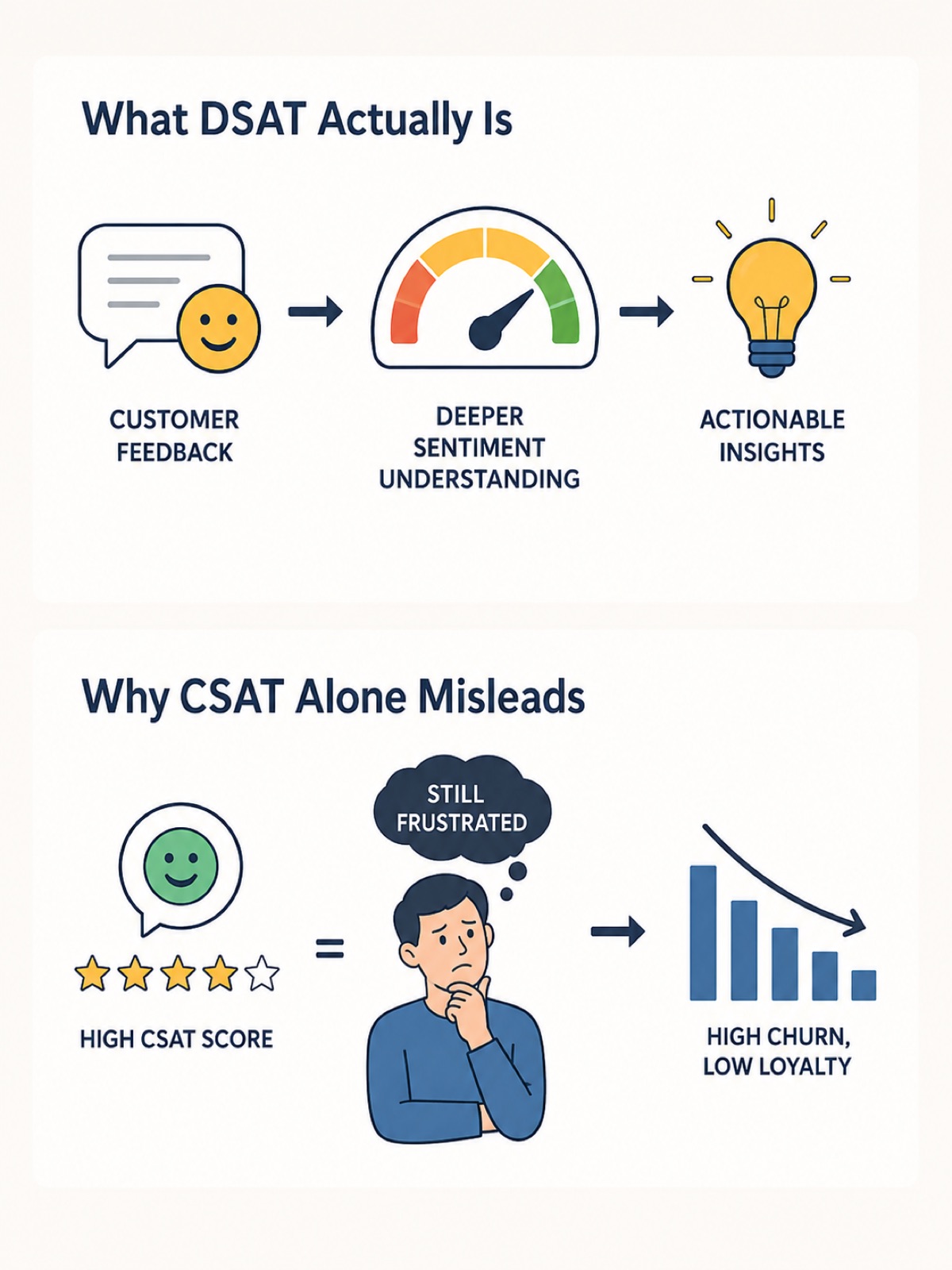
- Who answered. Most people who see a survey never answer it. Across 4,332 surveys of all kinds from 460 companies, the median response rate was 9.98%, so in a typical survey about nine in ten people who see it say nothing. The score describes the ones who chose to answer.
- Why. A 6 carries no reason unless the customer types one.
- When. A relationship survey runs once or twice a year. A detractor can leave between two waves.
- What happened. NPS measures an intention to recommend. What the customer actually went through, the long hold, the refund refused, the agent who fixed it, is in the conversation.
How can we replace our NPS survey with analysis of customer conversations?
Replace what the survey is for: knowing which customers are satisfied, which are at risk and why, every day instead of once or twice a year. Conversation analysis measures that on every call, chat and email customers already have with you. Keep a short NPS survey only if you need the number for a benchmark or a board report.
With Ender Turing, you replace what your NPS survey was for with analysis of every call, chat and email, with no survey to send:
- Score every conversation. AI CSAT gives each call, chat and email an entry CSAT and an exit CSAT, scored 1 to 5 at the start and at the end: how the customer arrived and how they left. The change between the two is what happened during the conversation. Nothing for the customer to do.
- See it by agent and topic. Entry and exit CSAT appear per agent in the Dashboard, and the pre-built CSAT Dynamics board on C-Level Boards shows the whole picture to the executive who asks. Every chart opens the conversations behind it.
- Find the reasons. CSAT Dynamics is a managed generative-AI analysis in Gen AI Studio: you can see what it does and build your own prompts next to it, such as a satisfaction reason, a churn signal or a compliment to route to the agent. In Chat with EnderGPT, ask the main question, such as "What leaves customers unhappy at the end of a call?"; Ender does the analysis, with citations to the exact calls and moments.
- Act on a detractor the same day. Set one Ender: exit CSAT at 2 or below notifies the team lead, so a low exit CSAT becomes a follow-up the same day, not a survey answer next week.
- Keep the survey beside it. Where your telephony or CRM supplies them, survey CSAT and NPS become filters on the same conversations, so you can compare the customers who answered with everyone else and keep the surveys you want to keep.
It works in any language your customers speak. On one contact center's live CSAT Dynamics board in September 2026, 39,554 conversations were scored, with an entry CSAT of 2.92 and an exit CSAT of 3.38, a +15.75% change. And OTP Bank, Dila Med Labs and Fozzy Group report doing marketing analysis and NPS 20 times faster and 50 times cheaper with Ender Turing.
For how the two survey metrics differ, see CSAT vs NPS; for the CSAT survey itself, see CSAT survey questions, scale and formula. When detractors become cancellations, churn analysis covers how to count why.
Keep the NPS question for what it does well
The NPS question is a good relationship benchmark: one question, comparable over time and across companies. It is a weak early warning, because few customers answer and the reason arrives late or never. Keep it short and periodic, and let your conversations carry the day-to-day signal: every conversation analyzed in seconds, with no survey to send. To see entry and exit CSAT on your own calls, chats and emails, start with AI CSAT.
FAQ
What is the NPS question?
"How likely is it that you would recommend [company] to a friend or colleague?", answered on a scale from 0 (not at all likely) to 10 (extremely likely).
What is the full form of NPS?
Net Promoter Score: the share of promoters (9 or 10) minus the share of detractors (0 to 6) among the customers who answered the NPS question.
Is 47 a good NPS score?
It is above the middle of the field. In Survicate's 2026 benchmarks it sits just above the overall median of 45, level with the B2C median of 47 and above the B2B median of 44.
How do you calculate NPS?
Subtract the percentage of detractors from the percentage of promoters. With 45% promoters and 25% detractors, NPS is +20.
Can you measure customer loyalty without an NPS survey?
The NPS number itself needs the survey question. What you can measure without a survey is what NPS is meant to track: how satisfied customers are after each contact, why, and who is at risk. AI CSAT scores every call, chat and email at the start and at the end, so every customer counts, including the ones who never answer a survey.